

The Digital Markets Act (DMA for short, EU Regulation 2022/1925) has been in force since 1 November 2022. This law will promote competition between companies in the digital world and prevent abuse of power by major players in these markets.
New opportunities and challenges through the DMA
Since November 1, 2022, the Digital Markets Act (DMA, EU Regulation 2022/1925) has been in force. This law will promote competition between companies in the digital world and prevent abuse of power by major players in these markets.
This law achieves this by designating companies with significant power in digital markets as gatekeepers of these markets, and imposing a number of obligations and prohibitions on gatekeepers.
Already in the 1990s, lawsuits were filed against major ICT companies such as IBM, Intel and Microsoft on charges of unfair competition. In a number of cases, these lawsuits eventually led to fines, but this did not eliminate the unfair competition. It turned out that the legislation was formulated too broadly to be able to act effectively against unfair competition in the digital market. Moreover, it took years before a sanction could be enforced in a specific case after a court ruling, and the damage was already done and could not be undone.
Toolbox
The new DMA legislation gives the EU a specific toolbox to act while the violation is still taking place. Unlike in America, the European approach to digital monopolists is to break them open. Mechanisms to protect markets by creating a platform economy are restricted by the DMA, so that free competition is made possible on such a platform, and the platform itself has to compete with similar platforms.
What are Digital Markets? This is formulated broadly in the DMA and a number of examples are also specifically mentioned. The DMA applies to all specifically named digital markets as well as to future digital markets that have not yet been identified, but which appear to meet the general criteria in the future.
The markets already specifically named are:
- Online mediation
- Online search engines
- Online social networks
- The video platform
- Interpersonal messaging services
- Computer Operating Systems
- Cloud computing services
- Online advertising services
- Web browsers
- Virtual assistants
- Cable television services
(These are not mentioned in the legal text that came into force on November 1, 2022, but are mentioned in several other publications)
For all these types of services, companies with significant market power within the EU (monopoly or oligopoly position) can be designated as gatekeepers. As a result, they will be obliged or forced to adhere to a set of rules of conduct that will ensure a freer and fairer business environment for companies that depend on such gatekeepers. It will also become easier to set up comparable competitive services. This gives consumers more freedom of choice to use services from gatekeeper competitors.
 |
What does the gatekeeper do
What are gatekeepers required to do?
- They must enable third parties to cooperate with their own services in specific situations (interoperability obligation)
- Business users are given the right to access all data generated by these users through their services (open data)
- They must make tools available that enable advertisers and publishers to analyze their own data generated on their platform (open software)
- They must enable business users to sell their products and services using the platform to their customers outside the platform (no forced shopping)
What gatekeepers are not allowed to do (anymore):
- Favor own products and services on the platform over comparable products or services from third parties
- Prohibit or prevent consumers from making contact outside their platform with companies that (also) use their platform
- Prevent or prohibit users from automatically uninstalling installed software or apps
- Tracking end users outside their own platform for targeted advertising or influencing
Functioning
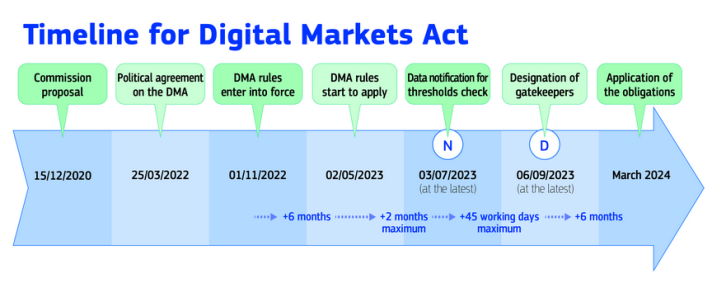
It will take some time before the DMA is fully functional. As reported, the regulation came into force on November 1, 2022. Until 2 May 2023, companies have the opportunity to prepare and adjust their policy and/or business operations. Before July 3, 2023, companies that meet the criteria to be designated as gatekeepers must report to the European Commission. By September 6, 2023 at the latest, the EC will determine which companies will be regarded as gatekeepers in which digital markets. From March 2024, the above obligations and prohibitions for the gatekeepers will come into effect and be enforced.
Because digital markets are naturally unfettered by national borders, this legislation will apply equally across the EU, with the European Commission as the executive authority and the European Parliament as the oversight body. There is therefore no ratification round by the various national parliaments. The DMA does not apply when a digital service is only offered at national level, unless this service is available nationally in three or more EU countries. This does not alter the fact that individual EU countries can adopt or have already introduced additional legislation that then only applies within that country.
 New markets
When new digital markets emerge, the European Commission can also appoint gatekeepers there. It is also possible that an existing gatekeeper loses its status as such due to increased competition. The EC can independently decide at any time to start a market study to see whether there is a platform economy, and to add this digital market to the list and designate gatekeeper(s) for this digital market. In such a case, the new gatekeepers will have a maximum of one year to comply with the rules for gatekeepers.
The EC will also be given significant powers to punish offenders, without the need for a court ruling on a case-by-case basis. After August 2024, a single violation can be immediately fined with ten percent of the gatekeeper’s global turnover. Repeated violations can result in fines of 20% of global turnover. And persistent refusals to comply with the new rules are threatened with structural measures, such as splitting up the company, forced sale of business units, or even closing the service on the European market.
 The coming months
Which companies are likely to be regarded as gatekeepers? In the coming months it will be known which companies in which digital markets will fall under the scope of the DMA.
It is expected that companies such as Google, Apple, Microsoft, Meta, Twitter, Amazon, Tiktok, Sony, Nintendo and UPC will experience the consequences of the DMA in one or more digital markets.
For consumers, this means greater freedom of choice and less advertising pressure. In general, tied sales of digital services and products will be broken. The interoperability between platforms enforced by the DMA is a major technical challenge that will boost employment. For example, a WhatsApp user will need to be able to send and receive messages from a Telegram user, WeChat user, Signal user or a LinkedIn user. A video conference set up in Zoom will therefore also be accessible to a Webex or Teams or Jitsi user and vice versa.
For companies that want to use one or more platforms to set up their own digital services, this means a greater scope for innovation. And for the tech giants the need to comply with European rules and allow competition. For example, Apple and Android users will soon be able to choose which app store they want to use, that of the platform or that of an independent third party. Users of electric cars can then decide for themselves through which telecom provider their car uses online services, and are free to choose the provider of navigation software. Soon, independent third parties will be able to add software for fire engines, ambulances or taxis, for example. Users will no longer depend on the services of the car manufacturer to realize their application. A more versatile range of products and services can also be expected in the energy sector and home automation. Long live freedom of choice!