

There are particles behind almost all phenomena in the universe: They are the basic building blocks of matter and radiation, give everything mass and mediate the basic forces. The Standard Model of particle physics lists all known particles and their antimatter counterparts – but gaps remain. So these particles and processes cannot explain what dark matter is made of, why there is more matter than antimatter or what drives dark energy. Physicists have therefore been looking for evidence of a new physics for decades: for particles or forces that have not yet been included in the standard model.
When a beauty quark meets a down antiquark…
Physicists at the LHC particle accelerator near Geneva have now demonstrated for the first time a process that is considered a particularly sensitive indicator of such new physics. The starting point for this decay is the combination of two quarks – the family of elementary particles that also make up protons and neutrons. It involves a beauty quark – the second heaviest type of quark – and a down antiquark – the antimatter version of a quark that also occurs in atomic nuclei.
This quark combination is extremely unstable: beauty quark and down antiquark immediately cancel each other out, releasing a muon and an antimuon – heavier “cousins” of the electrons. “This beauty-down combination (B0d) decay belongs to a group of particle decays that are so rare that they have long been considered ‘golden channels’ for the search for new physics,” explain the physicists of the LHCb collaboration at the CERN research center.
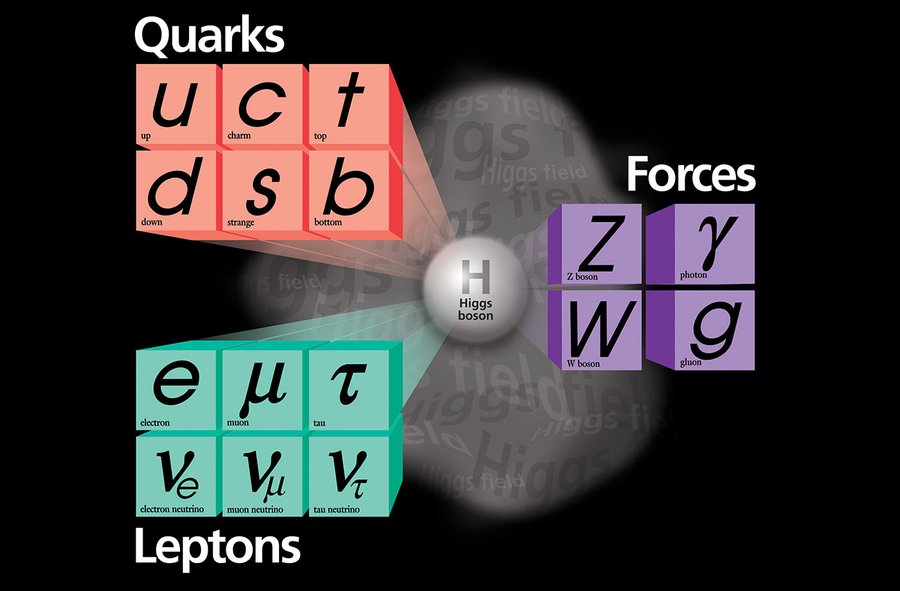
The beauty quark (also called the bottom quark) is one of six different quarks in the Standard Model. Building blocks of matter such as protons and neutrons are composed of U and Down quarks. — © Fermi National Accelerator Laboratory
Wanted for more than 40 years
But because this particular decay of the beauty quark is so extremely rare, it has not yet been clearly proven. According to the standard model, it occurs only once in every ten billion decays of the beauty quark. “Physicists have been hunting for this decay for more than forty years,” explains team member Marco Santimaria. “Extremely high precision is required to filter the muons generated from the overwhelming background.”
In 2015, this initially seemed to have been successful: researchers at CERN came across the first indications of this extremely rare decay when they evaluated data from proton collisions in the LHC particle accelerator. But analyzes of further collisions could not confirm this. The long-sought beauty anti-down decay remained undiscovered.
Manhunt at the world’s largest particle accelerator
Until now: Thanks to an upgrade of the LHC accelerator and its detectors, the physicists of the LHCb collaboration have finally succeeded in pinpointing the long-sought quark decay. For their analysis, they evaluated data from 2024 and 2025, in which protons with an energy of 13.6 teraelectron volts collided in the LHC. These collisions produce beauty quarks, among many other short-lived particles, which can meet down antiquarks and decay into muons.
With the help of improved sensors and AI-supported analysis programs, the physicists were able to filter out the muon and antimuon pairs from the vast number of collision products that must have been formed by the decay of a beauty quark and a down antiquark. They should appear as a slight excess in a certain energy range of the detected particles.
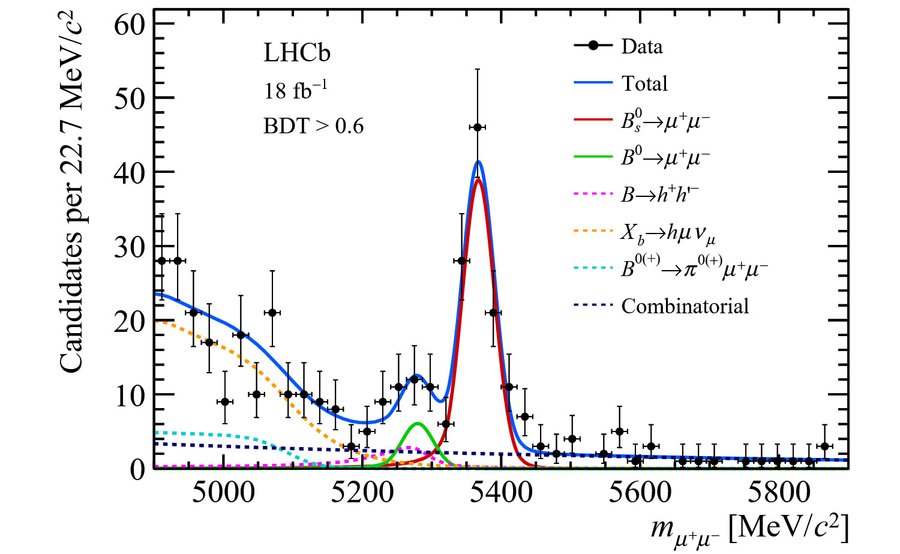
The small green bump in the curves shows the decay path of a beauty quark and down antiquark into two muons (B0 –> μ+ μ-) — © CERN/ LHCb Collaboration, /CC by 4.0
Done: Proof of beauty decay succeeded
And indeed: “We observed an excess of B0 → µ⁺µ⁻ events, which, taking systematic uncertainties into account, has a significance of 3.0 standard deviations,” report the physicists. When combined with data from the particle accelerator’s previous lifetimes, the significance increased to 3.2 standard deviations. In particle physics, a significance of 3 sigma is the threshold above which an observation is considered proven. The probability that this result is due to pure chance or a statistical fluctuation is around 0.27 percent.
The new results therefore meet the requirements: “Seeing evidence of this rare decay is incredibly exciting,” says Harry Cliff from the LHCb collaboration. For the first time, it has been possible to clearly demonstrate this but extremely rare decay path of the beauty quark, which was predicted by the standard model. This now opens up the possibility of looking for subtle deviations from theoretical predictions in these decays – and thus for evidence of new physics.
What happens next?
Physicists hope that by expanding the LHC particle accelerator and its detectors they will be able to observe even more of these extremely rare beauty quark decays. “By the middle of the next decade, LHCb upgrades could increase the data collection rate by another order of magnitude,” they explain. This upgrade means that more collisions will take place in the accelerator at the same time and more particles will be detectable. This also increases the chance of beauty quarks and their decay products forming.
“These decays could then become precision probes for undiscovered particles,” explains Bolek Pietrzyk from the LHCb collaboration. “This opens up new opportunities for us physicists to find gaps in the Standard Model and reveal what might be hidden behind them.” The research team also aims to increase the significance of Bd decay to five standard deviations – from then on a result is considered an official discovery.
Source: CERN/LHCb Collaboration, 2026; arXiv preprint, doi: 10.48550/arXiv.2611.00230