
I wonder how to calculate the speed of an object after this object (object 1) has passed through another object (object 2) at a certain speed, for example a concrete wall.
I can imagine that the following variables play a role in this:
– mass object 1 and 2
– speed object 1 and 2
– object density 2
Is there a mathematical function for this?
Answer
Dear Jan,
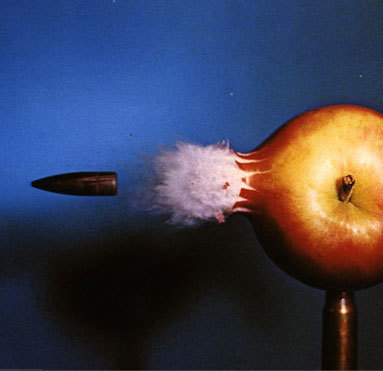
a mathematical formula for this is very difficult. You are usually not dealing with a homogeneous object. For example, take the apple from your photo. It consists for the most part of water. So is a water balloon. A formula can be drawn up quite simply for the water part (you are dealing with dynamic friction), but you still have to add the balloon itself.
For homogeneous materials (especially “soft” materials) you can therefore calculate with the coefficient of friction, which can be determined experimentally. However, there is one more variable that you haven’t listed but is immensely important: the material structure of the object. Just think of Kevlar, the fabric from which bulletproof vests are made. That is a fairly light substance (compared to concrete), the density is not exceptional and yet a bullet will not get through. This is because the structure is made in such a way that the energy that the bullet has is completely converted into fracture energy of the material.
In short: if you want to know the speed of object 1 after it has passed through object 2, it is best to place a measurement setup behind object 2 that can measure this. Be careful during your experiments!

Answered by
ir. Bart De Schouwer
For my position I am the manager of a group of engineers who maintain production equipment. It is mainly with my ready knowledge (education, interests, …) that I could answer questions.

Kapeldreef 75 3001 Leuven
http://www.imec-int.com
.