


Answer
Dear Karel,
Archimedes determined the content of the sphere by the so-called “method of exhaustion”. This is a predecessor of the classical integration method in which the body is divided into a series of smaller volumes, the contents of which could be determined. You can find more information on this at: http://www.britannica.com/eb/article-247681/analysis.
A variant of this proof goes as follows:
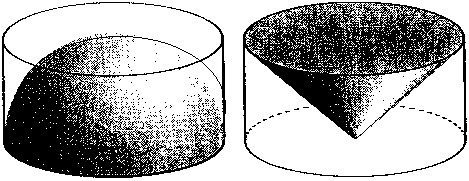
Consider the hemisphere and the cone (with the same radius and height) as shown in the first figure.
Archimedes already knew the formula for the volume of a cone: V(cone) = π.r².h/3 (in this case r and h are equal). He also knew that of a cylinder: V(cylinder) = π.r².h.
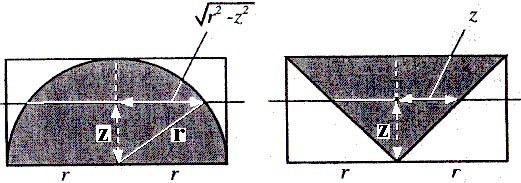
The second figure shows a side view of the cross-section through the center of the bodies, with the distances indicated. At the height z, one considers the area of the horizontal section of the bodies (they are circles with respective radii given by √(r²-z²) and z; see figure 3).
The sum of the areas of these two circles is given by:
π.(r²-z²) + π.z² = π.r²,
so independent of the height z. In other words, the total area at any height is equal to that of a cylinder with radius r (circumscribed to the sphere). Therefore, the total volume of the hemisphere + the cone is also equal to that of the cylinder. In formulas, this yields the following:
V(hemisphere) + V(cone) = V(cylinder)
or:
V(sphere)/2 + π.r³/3 = π.r³
So: V(sphere) = 4.π.r³/3
Kind regards,
Answered by
Laurent Vanbeylen

Avenue des Pélain 2 1050 Ixelles
http://www.vub.ac.be/
.