
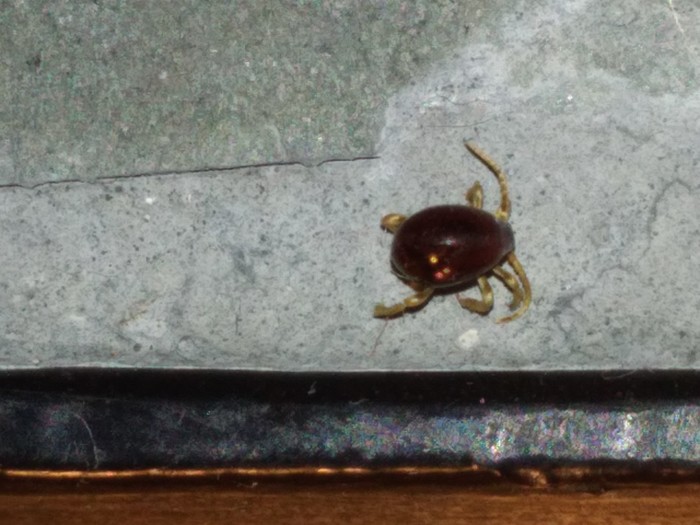
Dear, Someone suggested me to contact the institute to ask for your opinion as a professional. I have already encountered this kind of insects (see attached photo) in my bedroom twice and almost every night I woke up with bites. I was wondering if you could help us determine which “insect” it might be. Professional pest control services cannot tell us whether it is bed bugs, ticks or another creature. If you need more information, I also have the insect available in a glass tube. If it were not possible to answer this question, could you recommend someone or an organization that could help us further? Sorry for any inconvenience and thank you in advance!
Answer
Dear Naomi,
this is the round thief beetle Gibbium psylloidesfamily Ptinidae.
Both the adults and the larvae of the round thief beetle are omnivorous, so eat everything, and this does not make it easier to trace the source of infection. And yet, finding (and removing/destroying) the source of infection or source of infection is of paramount importance in combating these beetles in the home. If not, the problem will persist even with repeated chemical treatments.
This insect feeds on both animal and vegetable material, mainly food stocks (cereals, dried fruits), straw, feathers, hair, textiles (wool and synthetic fibres), leather, packaging. But also, for example, insect remains in the attic and bird nests can be a source of infection. An additional problem is that the beetles can survive for a long time without food. In any case, the larvae need food for their development.
Initially, you may want to try to locate the source of infection and the larvae. These larvae are white in color, with dark heads, densely hairy and C-shaped with a length up to 3.5 mm. This source of infection therefore does not have to be present in the home, although this is possible (eg food stocks in the kitchen). Residues in the attic or a bird’s nest outside under a gutter can also be a source of infection.
When the source of infection is found, the environment can be carefully cleaned with the vacuum cleaner. We also recommend this way of working to remove the beetles. Any beetle that can be destroyed manually is no longer capable of producing offspring. Due to the nocturnal nature of this insect, they are often hidden in seams and crevices. These can be closed as much as possible.
If desired, seams and cracks can be treated with a product against flying and crawling insects in homes. The company Edialux has a range of products that are distributed through large garden stores (Aveve and others), see https://www.edialux.be/products/insects/Home/Creeping-insects. They can certainly give you further advice there.
Success with it!
kind regards,
Hans

Answered by
Hans Casteels
identification of pest insects in agriculture and horticulture, stock goods and homes

Burg. van Gansberghelaan 96 box 1 9820 Merelbeke
http://www.ilvo.vlaanderen.be
.