
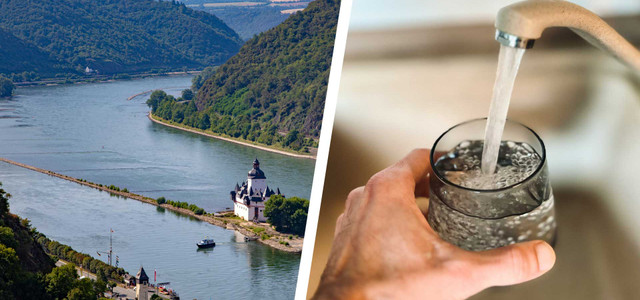
Tire chemicals, plasticizers and mysterious substances: There are numerous different micropollutants floating in the Rhine, some of which cannot even be identified. This is shown by data that Techzle\.com evaluated together with Correctiv.Lokal. What does this mean for our drinking water, some of which is obtained from the river?
The Rhine has a comparatively clean image today. In the 1950s and 1960s, Germany’s most important waterway was heavily polluted by growing industry. In the 1980s, around 20 tons of chemicals were released into the river along with firefighting water, with devastating consequences for the ecosystem. Since then, water quality has improved greatly – thanks, among other things, to stricter laws, environmental programs, wastewater treatment plants and international cooperation.
But not everything is pure in the Rhine. Monitoring stations along the river regularly record contaminants, including unexplored micropollutants. Data that Techzle\.com evaluated together with the editorial network Correctiv.Lokal shows the extent.
In at least eight cases, drinking water suppliers were informed about the sources of pollutants and recommended self-responsible measures to protect drinking water. Techzle\.com asked what that means exactly.
These micropollutants contaminate the Rhine
Micropollutants
The term “micropollutants” is not clearly defined. But it usually refers to potentially harmful tiny particles that pollute water. These can be, for example, microplastics, drug residues or industrial chemicals.
The following pollutants were detected in the Rhine water by measuring stations in North Rhine-Westphalia, Rhineland-Palatinate and Baden-Württemberg from 2020 to 2025. This emerges from data that Correctiv.Lokal provided to us at Techzle\.com. This is a selection; the total of 65 measurement results demonstrated a large number of different micropollutants.
- Triacetonamine (TAA) is used as a stabilizer for polymers. According to the German Statutory Accident Insurance (DGUV), the substance is hazardous to water and poses acute or chronic health risks. TAA was detected ten times in Rhineland-Palatinate. The highest concentration measured was 8.6 micrograms per liter.
- About half of the 65 entries are declared as “unknown substances”. The material could not be clearly assigned here. The substances were present in concentrations of up to 8.3 micrograms/liter.
- 13 cases in North Rhine-Westphalia are probably DPGME isomers, i.e. solvents. These are, among other things, slightly hazardous to water.
- Substances for the production of plasticizers (α-methylstyrene) have also been detected; these are considered to be significantly hazardous to water.
- Benzothiazole was also detected. The material is primarily used for tire production. According to Correctiv, researchers cannot rule out the possibility that the chemical can also get into drinking water.
Some pollutants only develop their effects in high concentrations. But it is difficult to assess the risk, especially with unidentifiable substances. In some cases, the substances appeared in the measurements several days in a row.
Do micropollutants endanger our drinking water?
The Rhine is an important source of drinking water in many regions. The so-called “bank filtrate” is prepared as drinking water by various suppliers in Germany.
Between 2020 and 2025, conspicuous levels of micropollutants were discovered and analyzed by the state environmental authorities in 65 cases. In North Rhine-Westphalia, drinking water suppliers were informed eight times about the sources of pollutants and self-responsible measures to protect drinking water were recommended.
In the data from Baden-Württemberg, six findings state: A report was initiated which contained the measure recommended by the Baden-Württemberg State Environmental Agency to inform the waterworks about the incident. The data from Rhineland-Palatinate does not contain any information on measures.
Techzle\.com asked what measures drinking water suppliers specifically take and how they are monitored.
Tap water safe? That’s what utilities and authorities say
The Kleve-Bimmern measuring point in North Rhine-Westphalia is represented eleven times in the data; in five measurements, drinking water suppliers were informed about waves of pollutants. That’s why Techzle\.com contacted the nearby water supplier Stadtwerke Emmerich, among others. When asked what measures he took in response, we received no answer.
We have also contacted the Rhine Water Association (ARW), an association of water suppliers on the Rhine. A company spokesman for the drinking water supplier RheinEnergie from Cologne, which is the president and managing director of ARW, responded to our request.
He explained to Techzle\.com that water suppliers sometimes do not even have to react to such information. For example, “because a reported substance is not relevant to drinking water or swims past the wells so quickly that it does not even reach the groundwater.” Or individual collection systems or wells may be switched off briefly.
He refers to monitoring programs and event-related investigations. “If a substance from the Rhine water were relevant to drinking water, there would be several weeks to take countermeasures. That’s how long it takes for such a substance to reach a well near the bank.” Even then, it does not necessarily end up in the drinking water because of the treatment in the waterworks.
The State Office for Nature, Environment and Climate North Rhine-Westphalia (LANUK) also points out to Techzle\.com that drinking water is regularly tested by specialized laboratories. These are intended to ensure that the water meets the requirements of the Drinking Water Ordinance. Exceeding the limit values must be reported immediately.
The Federal Environment Agency explains to Techzle\.com that the so-called general precautionary value of 0.1 micrograms per liter applies in German drinking water for substances that cannot yet be assessed due to a lack of data. The authority also assures: “From our point of view, drinking water can be consumed safely. Compared to bottled water, it has significant ecological and economic advantages.” However, it does not address limit values for the safety of river creatures; the danger must be “considered substance and organism-specific”.
Correctiv criticizes the lack of transparency and lack of research
So the micropollutants in river water aren’t a problem at all? It’s probably not that easy. In joint research with other editorial teams (including Correctiv.Schweiz and the investigative medium Pointer from the Netherlands), Correctiv tried to reconstruct what happened in the case of the discovery of an “unknown substance” on March 8, 2023. The report about the substance reaches the water police and the Netherlands via the North Rhine-Westphalia State Environmental Office. But what happened after drinking water suppliers were informed can no longer be completely reconstructed, according to Correctiv.
The medium also criticizes the fact that only a fraction of the 30,000 chemicals floating in the Rhine have been thoroughly researched, meaning that their effects on people and the environment are known.
A look at the Netherlands, which the Rhine passes through to Germany, also reveals problems. According to Correctiv, drinking water suppliers have to turn off pumps there again and again; in 2024, according to the medium, this happened thirteen times, for almost a month.
Its director complains to Correctiv about the lack of limit values in Germany. The authorities relied on “voluntary measures by operators” instead of clear guidelines.
“Unknown substances could prove to be toxicologically questionable”
Around 20 million people in Germany use drinking water that comes at least partially from the Rhine. This is considered safe – but experts are still concerned.
“Many of the currently unknown substances could soon prove to be toxicologically questionable,” Werner Brack, ecotoxicologist at the Leipzig Helmholtz Center for Environmental Research (UFZ), tells Correctiv. They could make you fat, cause allergies, disrupt children’s learning behavior or promote diabetes.
“The unknown substances pose an invisible but serious danger,” warns the expert.
He refers to the eternal chemicals PFAS, whose health risks remained undetected for decades. Limit values have only been in place since the beginning of 2026. The researcher criticizes the fact that the industry is not obliged to report the substances used. Instead, they have to be analyzed in an expensive, complex and time-consuming manner.
There are currently no legal requirements for dealing with unknown micropollutants. This has consequences: The treatment of drinking water is becoming increasingly more expensive and complex, warns Correctiv. Consumers would also bear the costs.
Water suppliers, experts and authorities spoke to Correctiv in favor of stricter requirements for the industry, increased controls and the application of the precautionary principle.
Utopia says: Tighten laws to protect water
Are current measures sufficient to prevent micropollutants from harming river life and entering drinking water?
In the case of drinking water, there is a lot to be said for it: drinking water suppliers, state and environmental authorities reassure and point to a multi-stage system that is intended to ensure this. However, Correctiv criticizes the fact that many of the measures in this system are based on voluntary action. And downstream in the Netherlands there are regular problems with water quality.
All of this seems as if the supposedly clean Rhine could be a lot cleaner. And since local industrial groups, which according to Correctiv are responsible for the majority of micropollutants in river water, show little interest in doing their part, stricter legal regulations would be important. After all, this has helped to keep the Rhine clean in the past.
** marked with ** or orange underlined Links to sources of supply are partly partner links: If you buy here, you are actively supporting Techzle\.com, because we then receive a small part of the sales proceeds. More info.