
Answer
The distance to the Moon at any time can be “calculated” from published ephemerides of the Moon, namely the period with which it orbits the Earth, the semimajor axis of the elliptical orbit it describes, the inclination of that orbit, the eccentricity of that ellipse, a moment when it is at its closest point to the Earth, and angles that determine the direction to that point. But of course all that data did not just appear in the books, and cannot simply be calculated on the basis of ‘first principles’. What must be done in the first instance is ‘measure’ rather than ‘calculate’. This answer is therefore primarily an answer to the question ‘how do we measure the distance to the Moon?’
Today that answer is very simple. Since the Apollo project, a number of antennas and mirrors have been placed on the Moon that can reflect radio and laser signals from Earth. So we send a signal, measure how long it takes to measure a reflected signal, multiply it by the speed of light, and divide by two. But before those mirrors were on the Moon, we had to send a spacecraft there, and for that it was useful to have an idea about exactly how far the Moon is. How did we know? And since when?
The answer to the last question is: since more than 2000 years. The Hellenistic astronomer Hipparchus has determined a fairly accurate distance from the Moon; he has even rightly inferred from various measurements that the distance from the Moon changes. The principle of the measurement is based on triangulation, the ‘solving of triangles’, and is the same as what surveyors have traditionally used to determine distances on the Earth’s surface. One looks from two points A and B at a distant object C (a high tower for example), and each time accurately measures the angles CAB and CBA; Since the sum of the angles of a triangle is 180 degrees, then all three angles of the triangle are known. If one then accurately measures the distance AB, one can calculate the distances AC and BC.
In the case of the Moon, this is tower C. One can then choose two points on the Earth’s surface between which the distance is known, and simultaneously measure the angles CAB and CBA. ‘Simultaneous’ is very important here, because the position of the Moon changes over time. Hipparchus, of course, couldn’t be in two places at the same time, and talking to someone else on the phone wasn’t so good then… Also, the timing devices at the time weren’t as accurate as to synchronize readings from two places by different observers.
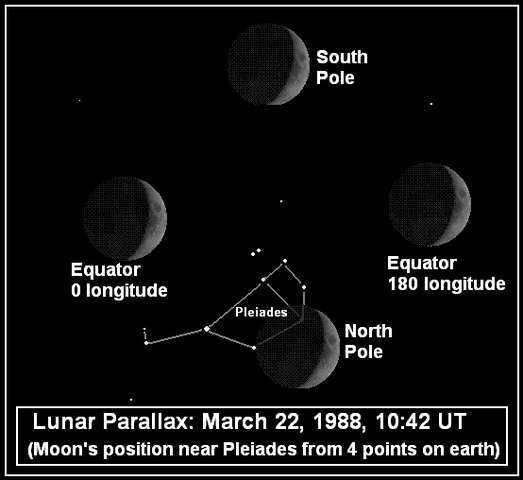
How did he handle it then? By realizing that he could be A and B at the same time from his island, by measuring at different times! To an observer on the Earth’s surface, the Moon moves around the center of the Earth, not around the observer himself. This means that the Moon in the sky describes a ‘great circle’ (so with the center the center of the celestial sphere, and that is the center of the Earth), but not for an observer who is a little far from that center. From the Northern Hemisphere, we always see the Moon a little more south from the stars than from the center, and how much more south that is changes over time. If the Moon were exactly above us, we would be between the center of the Earth and the Moon, and we would see the Moon in the same direction as from the center. But when the Moon sets, we look (in the Northern Hemisphere) from a point that is manifestly higher than the center of the Earth, so we look down more than if we looked from the center. The orbit of the Moon between the stars that we see therefore fluctuates somewhat with respect to the orbit from the center. The latter describes a large circle on the celestial sphere, so the orbit that we see is not. And that deviation depends on how far away the Moon is: the closer the Moon, the greater the deviation. If the Moon were infinitely distant, there would be no difference. The figure below clarifies this.
To measure it all correctly, there is a lot to consider. Where Hipparchus lived, the Moon was never in the zenith, but anyway there was a difference in how great the divergence was between meridian transit and setting. And the effect is not really small: the radius of the Earth (Eratosthenes had already measured it then!) is 6400 km, the distance to the Moon is 380000; a ratio of about 1/60, which means that the direction to the Moon from all the way above is one full degree different from that from the Earth’s center, which is two lunar diameters. And our friend Hipparchus was a phenomenal observer, with great insight and perseverance too. The result he found is completely consistent with the current findings, and all those who have imitated him have not added anything substantial.
The same Hipparchus was also able to confirm his measurements with the more direct method, being in two places simultaneously. How did he do that? From the finding that an occultation of the Sun as a total ‘eclipse’ had been observed from the Hellespont, but that the Sun had been ‘eclipsed’ only four-fifths at Alexandria. The angular difference between the two images of the Moon and the Sun represents the difference in angle from which one sees the distance between the Hellespont and Alexandria from the Moon. When that angle is expressed in radians, the distance from the Moon is simply the distance between the two places divided by the angle. And it knocked again!
“Lunar parallax 22 3 1988”. Photo released under Wikimedia Commons.

Answered by
Prof. dr. Christopher Waelkens
Astronomy

Old Market 13 3000 Leuven
https://www.kuleuven.be/
.