
The ice in Antarctica has grown over the years with likely remnants of organic matter. If one examines a drill sample now, how far back in time can one go in analyzing the ice?
Answer
Dear Marc
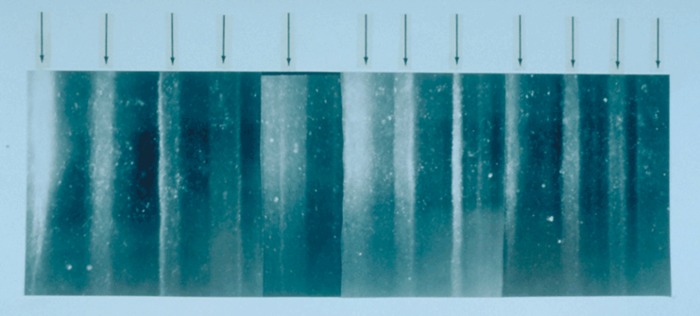
Indeed, when drilling a hole in an ice sheet, older ice is found with depth. The last snow is on top and the oldest snow, now compressed into ice, is at the bottom. The age of the ice can be determined using the cyclic patterns (and chemical composition) of the many ice layers that are somewhat reminiscent of tree rings (see photo of a segment of the Greenlandic GISP ice core). The oldest Antarctic ice that has been drilled and dated to date drifted into Antarctica as much as 740,000 years ago. This ancient ice was drilled at a depth of over 3000 m in the EPICA ice core, taken from a thick dome of the central Antarctic ice sheet. The annual snow cover there is compressed to an average of less than half a centimeter of ice (300,000 cm / 740,000 years). Older ice may exist somewhere in Antarctica, but to discover it, a new ice core would have to be drilled. Incidentally, it will not be easy to tap into much older Antarctic ice, because most ice disappears much earlier due to the dynamics of the ice sheet, either by erosion at the edge of the glaciers or by sublimation at the glacier surface.

Answered by
Prof. dr. Robert Speijer
Geology – Paleontology – Paleoclimatology. You study geology in Leuven!

Old Market 13 3000 Leuven
https://www.kuleuven.be/
.