
Recently I looked to the sky and saw that both the sun and the moon were beautifully visible in the sky. Then I wondered if people on the other side of the world couldn’t see either of them. For example, if there is an eclipse on one side of the world, then neither of the celestial bodies can be seen on the other side, right? Is it pitch black on that side, since the moon isn’t there to reflect the sun’s light?
Answer
It’s not that simple, unless it is indeed about a solar clip, because then the earth, sun and moon are aligned, with the moon in the middle. Then one side of the world sees the moon and sun, and the other side sees neither. In a lunar eclipse it is more evenly distributed: then one side only sees the sun, and the other side only sees the moon. After all, the earth is in the middle.
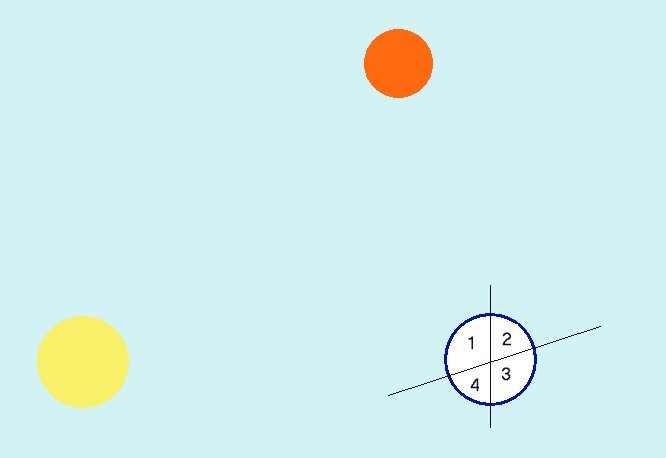
But otherwise you actually have four cases as you can see on the accompanying drawing. In area 1 we see both sun and moon, in area 2 only the moon, in area 3 neither and in area 4 only the sun.
So in area 3 we don’t see the sun or moon, but we do see the stars. After all, it is night there because we do not see the sun, and the starry sky is not “spoiled” by moonlight. Unless there are clouds of course…

Answered by
prof.dr. Paul Hellings
Department of Mathematics, Fac. IIW, KU Leuven

Old Market 13 3000 Leuven
https://www.kuleuven.be/
.