In September 2023, the James Dyson Award recognized the smartest inventions from national winners and runners-up in 29 countries and regions. Now 15 Dyson engineers, scientists and designers have judged the 87 James Dyson Award national finalists to select the global Top 20 shortlist.
From intravenous home therapies to devices for stroke rehabilitation, the James Dyson Award reveals the smartest inventions. Now 15 Dyson engineers, scientists and designers from around the world have judged the 87 James Dyson Award national finalists to select the global Top 20 shortlist. The James Dyson Award Top 20 Shortlisted Inventions are designed to directly solve global problems with unique solutions, for example a floating barrier to channel plastic waste into rivers or a breast health monitoring device.
About the James Dyson Award
The brief for the James Dyson Award is to design something that solves a problem. This problem may be a daily frustration or a global problem. The most important thing is that the solution is effective and well thought out. The process is as follows: entries are first judged nationally by a panel of external judges. Each market awards a national winner and two national runners-up. From these winners, a panel of Dyson engineers then select an international shortlist of 20 entries. The top 20 projects are then judged by Sir James Dyson, who selects the international winner, the international runner-up and the international sustainability winner.
The international winners, chosen by Sir James Dyson, will receive up to €33,000, the international runners-up will receive €5,800 and each national winner will receive €5,800.
In brief
• The top 20 entries from this year’s global James Dyson Award were selected by a panel of Dyson engineers.
• 15 Dyson engineers from around the world came together to determine the finalists.
• From Ireland to Singapore, inventions range from an interactive multiplication table for children to a solution for eczema itching.
• Today the James Dyson Award publishes a video in which the judges tell more about the 20 best inventions.
• Sir James Dyson will now select his global winners from this shortlist, which will be announced on 16 November.
Which Inventions Are Top 20 Shortlist Worthy?
According to Sam Dill, Sustainability Engineer at Dyson, says: “A Top 20 Shortlisted idea should demonstrate that it solves a real problem. There should be evidence of real-world research and analytical thinking, with iterative prototyping and testing to refine and adapt.” to show that a concept withstands scrutiny and has the potential to make a difference on a large scale.”
Below you can read which 20 inventions made the Top 20 Shortlist, you can read more information here.
Agro Biomaterials: As a solution to food waste, the Agro Biomaterials Kit consists of the ingredients that the user needs to make bioplastics from organic waste at home. Spain
AgZen-Cloak: AgZen-Cloak is a spray system that uses vegetable oils to disguise sprayed pesticide droplets. This prevents pesticide spray from bouncing off plant surfaces and polluting the environment. USA
Airy Scoliosis Brace: Airy is a scoliosis brace that overcomes the brace’s typical limitations of lengthy manufacturing, low patient compliance and non-recyclability. Airy’s repositionable feature allows patients to adapt the brace to their body and future growth for three years. USA
argo: Argo is an open source project designed to increase the autonomy of visually impaired swimmers by signaling their turn and orientation in the pool through various vibrations. Italy
banoo: Integrated aquaculture technology that can increase the dissolved oxygen in water up to 10ppm and has been proven to increase the yield of fish farmers by up to 78% compared to other technologies. Sweden
Brakong: Brakong is a durable prosthesis for those who have undergone a mastectomy. The goal is to empower breast cancer survivors by equipping individuals with a choice in how they want to look and feel. Philippines
CareRare: CareRare is a diagnostic system for genetic syndromes/diseases. The machine can then tell the user if there is a suspected disease type, what the associated likelihood is, and provide recommendations for follow-up testing, medication recommendations, and other diagnoses and treatments from the physician as needed. China
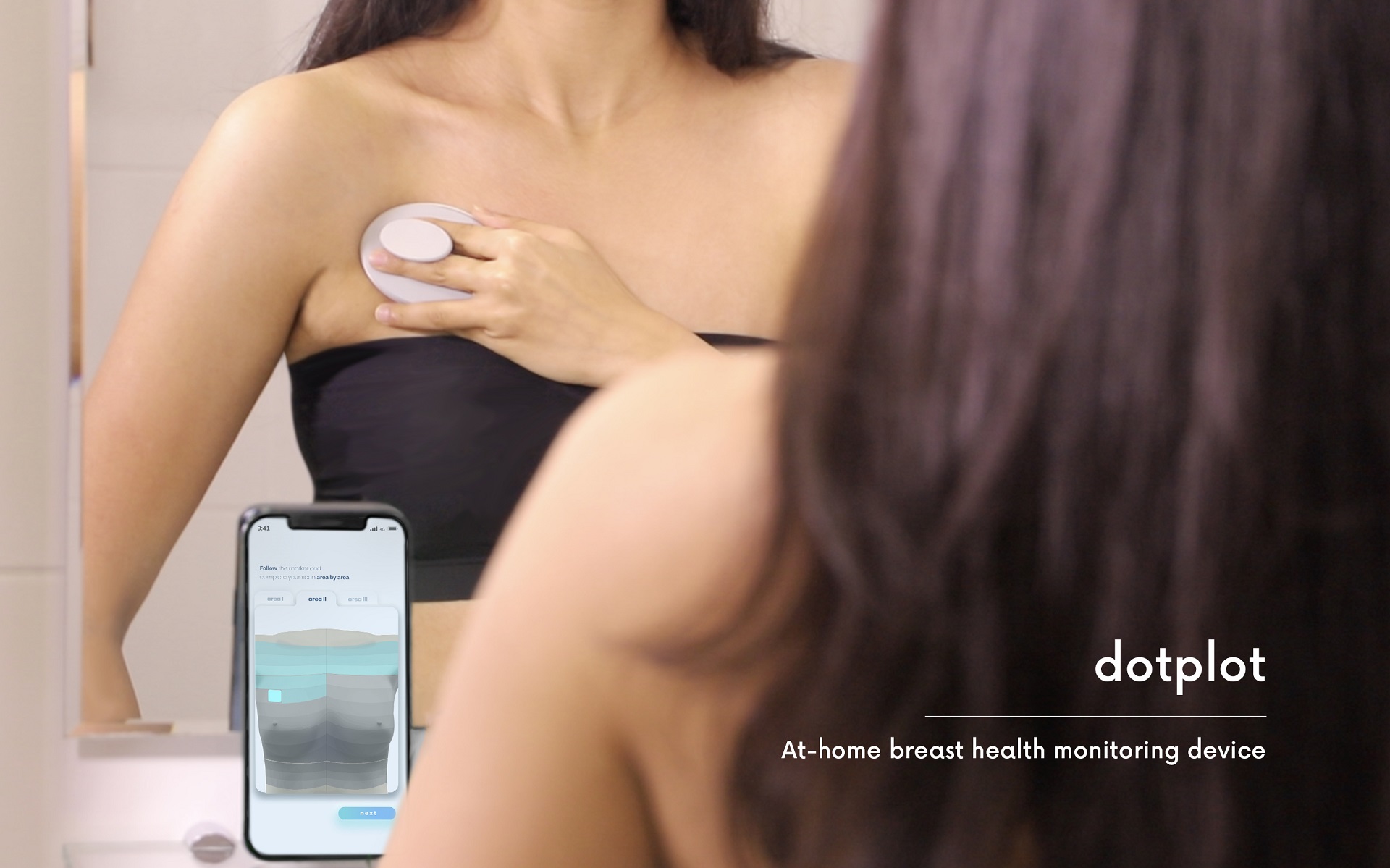
dot plot: Dotplot is a home breast health monitoring tool that provides guided self-checks. It is designed to facilitate the early detection of breast cancer by enabling and encouraging women to adhere to a regular self-monitoring routine. UK
hatch: Hatch reduces the physical strain on new mothers experiencing limited mobility and pain by allowing close proximity to the mother. This helps new mothers build confidence to care for their newborn independently, especially after cesarean deliveries. New Zealand
Ivvy: Ivvy replaces the current intravenous pole with a portable device, providing greater patient comfort and mobility. Belgium
Low Temperature Evaporation: A system that uses waste heat to treat liquid hazardous waste from industries such as foundries, workshops and recyclers. Sweden
Meadu: Méadú wants to help curb the development of math anxiety in students aged seven to 12 through interactive math lessons. The device primarily functions as an interactive multiplication table (up to twelve times tables) for children to learn. Ireland
Polyformer: Polyformer is a machine that recycles plastic bottles into a 3D printer filament. The device reduces plastic consumption and at the same time produces 3D printer filament at a low cost. Canada
Proteus Controller: The Proteus Controller is designed to give disabled gamers access to games by providing a Lego-like kit of components that can be assembled in infinite configurations. Ireland
R2Home: A sensor package that aims to increase the recovery of radiosondes used in weather forecasting. Switzerland
rehabilitation: Rehabit is a device designed to be the personal therapist of a stroke patient at home. There are 4 products, which focus on upper limb rehabilitation. Singapore
Rollerball Itch Relief: A device designed to help eczema patients cope with their excruciating itching. The textured rollerball gives it a scratching feel, while the roller mechanism ensures that the skin never tears. Singapore
SmartHeal: SmartHeal is an accurate, affordable and scalable smart pH sensor integrated with a wound dressing. By monitoring the pH of a wound, it can assess wound condition and detect infection without removing the dressing and without tissue disruption. Poland
sumnum: Somnum is a range of anesthesia masks of various sizes that are applied to animal patients in veterinary clinics. They provide an adequate seal that prevents gas leaks and protects veterinary personnel from inhalation of the anaesthetic. New Zealand
TrashTree: A floating barrier that stops or directs plastic waste in rivers. Germany