
When you hear wireless communication, you think of Wi-Fi. If it depends on commercial players such as Signify, you will soon also be thinking of LiFi, or Light Fidelity. This technology makes clever use of light waves.
Toon van Daele
 |
|
| LiFi: wireless communication by modulating light waven |
If you flash your flashlight three short times, three long times and three short flashes again, the receiver will know that you are in distress. That is, if he can handle Morse code, because within this system it has been agreed that three short signals indicate an S and three long signals an O: SOS. So there is a modulation of light signals here and we see this, for example, with fiber optic cable. Only the modulation in such a cable takes place ten times faster and also over long distances.
Now Harald Haas, a German professor at the University of Edinburgh, discovered about a decade ago that you can also communicate wirelessly via the light modulation of LED lamps. His ‘TED Talks’ on youtube. com/watch?v=NaoSp4NpkGg and youtube.com/watch?v=iHWIZsIBj3Q are certainly interesting and also accessible.
 |
|
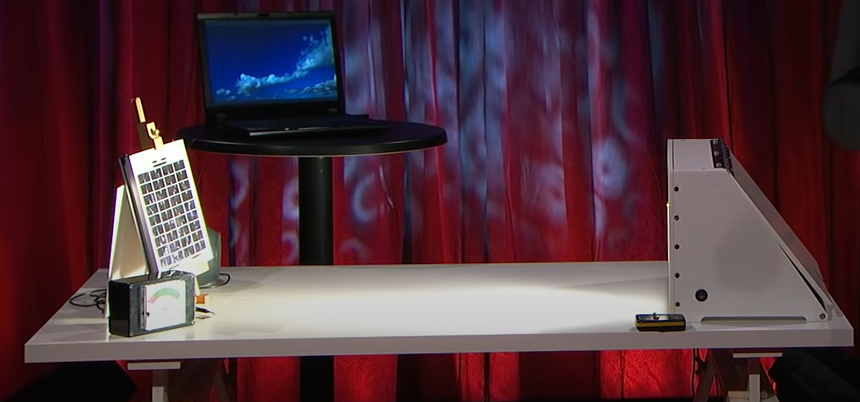
Professor Haas shows how an LED lamp (via a transceiver) converts the digital signals of a streaming video into modulated light signals, which are captured by solar cells and then sent as digital signals to a laptop Professor Haas shows how an LED lamp (via a transceiver) converts the digital signals of a streaming video into modulated light signals, which are captured by solar cells and then sent as digital signals to a laptop (TED Talk, 2016) |
LIGHT VS RADIO
As you may know, wireless internet is made possible by modulating radio waves (see the box ‘Radio waves’). You will unfortunately only find these in a limited part, or frequency band, of the electromagnetic spectrum. Moreover, this belt is used for all kinds of applications. In addition to WiFi, think of 4G and 5G, bluetooth, radar, and so on. This ensures that free frequencies are scarce. You may have experienced this yourself when your neighbors’ wireless network disrupts your own WiFi signals.
As mentioned, LiFi uses the modulation of light waves. To put it more precisely: from the visible light spectrum and also from infrared, and therefore not from the harmful frequencies for UV light, x- and gamma radiation. But even then, the bandwidth turns out to be many hundreds of times greater than with radio waves. In addition, this part of the spectrum is unregulated and no permits are required in this regard.
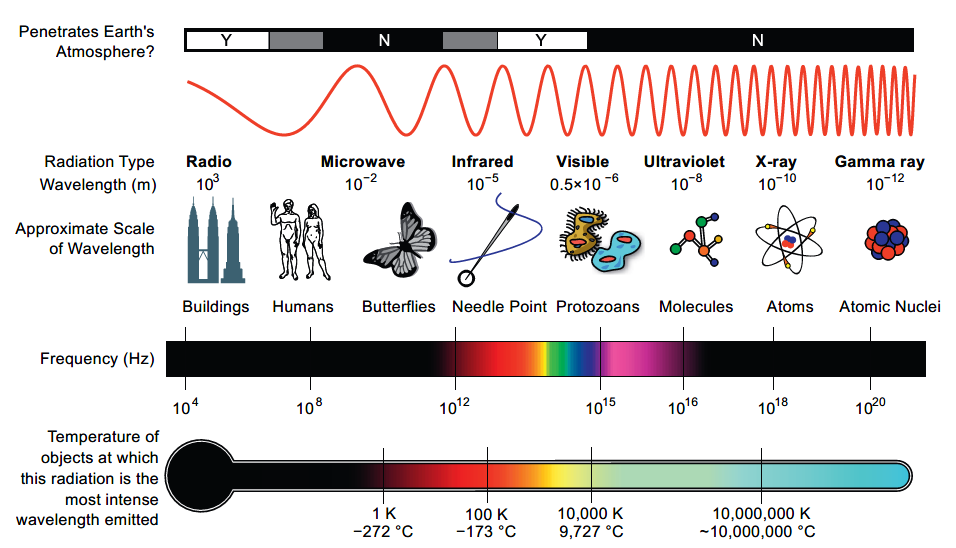 |
| The electromagnetic spectrum (the wave variation drawn is in reality much larger) |
POSSIBLE BENEFITS
LiFi does have a few other advantages, such as in the field of safety. After all, visible light cannot pass through solid walls, unlike Wi-Fi, where radio signals with powerful receivers can still be (covertly) received at a reasonable distance, especially at lower frequency bands. At the same time, this is also a disadvantage if you want to use LiFi in multiple rooms, because in that case you normally need more transmitters (at least one per room). In addition, LiFi enables almost instant connections with hardly any delay. In practice, the latency times appear to be limited to less than 2 milliseconds, which is nice during gaming, for example.
Furthermore, all kinds of experiments show that LiFi can also achieve very high speeds, up to 200 Gbps or more. In practice, unfortunately, things are not going that fast yet, but there are already commercial products that achieve 1 Gbps, at least with point to pointsetups in which the transmitter is pointed exactly at the receiver. This is the case, for example, with certain Internet of Things equipment. The speed in normal setups, where a larger coverage area is important, is now a lot lower, in the vicinity of 220 Mbps downlink and 160 Mbps uplink† LiFi producers also emphasize that the use of the visible light spectrum has no adverse health effects, or at least less than the emission of radio waves, but this remains to be proven. This does not alter the fact that LiFi is promoted as an excellent alternative in schools and hospitals, for example. For the latter also because Wi-Fi radio signals sometimes threaten to interfere with all kinds of other equipment, which is not the case with LiFi. For that reason, airlines also listen to it.
radio wavesTo better understand how LiFi works, let’s briefly review how Wi-Fi works. To better understand how LiFi works, let’s briefly review how Wi-Fi works. Wifi, or wireless internet, may work with radio waves and LiFi with light waves, but in both cases it is essentially about modulating electromagnetic waves. Simple modulation forms: |
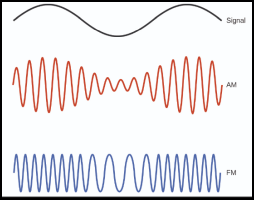 With Wi-Fi, much more complex
 DESIGN
So the technology is promising, but what do you actually need to set up such a LiFi system? Of course you won’t get there with an LED lamp alone. You have to somehow connect your light source to your home network and the internet, and on the other hand, your laptop, for example, must be able to receive and process the modulated light from the light source. You can already feel it coming: you need equipment on both ‘sides’ of the light source.
Such a setup might look like this: you connect a LiFi(-controller and) –transceiver via an Ethernet cable to your network. This is connected to the light source and makes the LED light flash at the correct frequencies. This happens so quickly and usually within a specific light spectrum that it is not noticeable with the naked eye. Incidentally, this flickering would not adversely affect the life of the lamp. It can even happen entirely within the infrared spectrum, which ensures that no visible light is needed and you can, for example, dim the lamps in the room in this case.
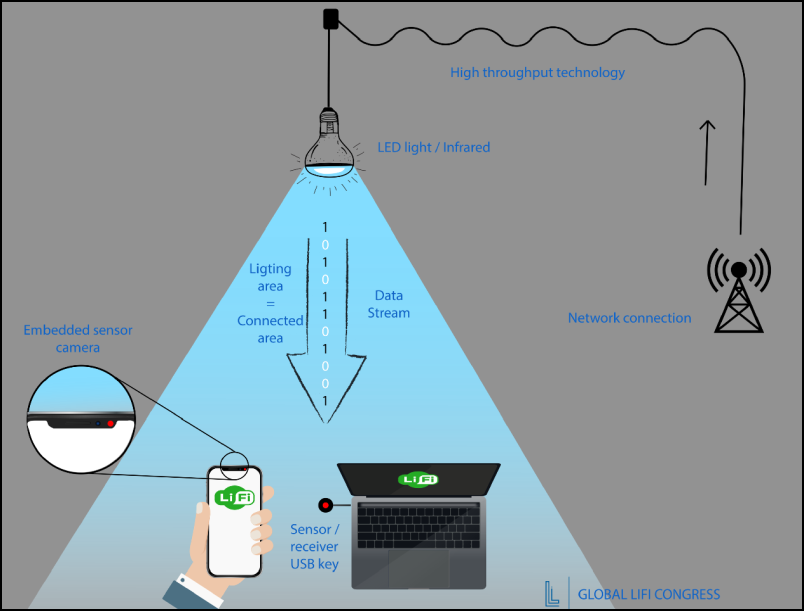 |
| A simplified LiFi setup with LED and LiFi receiver(s) |
You then logically need a receiver on your laptop and this is usually a receiver access key in other words dongle with a photoreceptor – although they are now also working hard on more integrated alternatives. This receiver must also contain the necessary intelligence to amplify, demodulate and forward the signals. Usually that receiver also contains an optical filter to filter out light that does not come from the transceivers originates.
In order to enable bi-directional communication, such a dongle also contains an infrared transmitter whose light waves pass through the transceiver are collected and processed.
BUSINESS MARKET
There are several manufacturers of LiFi products, including the French OLedcomm, the American VLNComm, the Scottish pureLiFi (a spin-off from the University of Edinburgh and co-founded by Harald Haas) and Signify (formerly Philips Lighting).
However, before you run to the store for your personal LiFitransceiver and dongle: at the moment there are actually no products for home use available.
For the business market, on the other hand, they already exist. For example, Signify’s product line includes the Trulifi 6002 system, in which the transceivers According to Mark Gunther, segment manager at Signify, they can also be easily integrated into existing Signify luminaires. Aesthetically, this may also be more desirable. There is also, for example, Trulifi 6014, but this system is specifically intended for point to pointconnections.
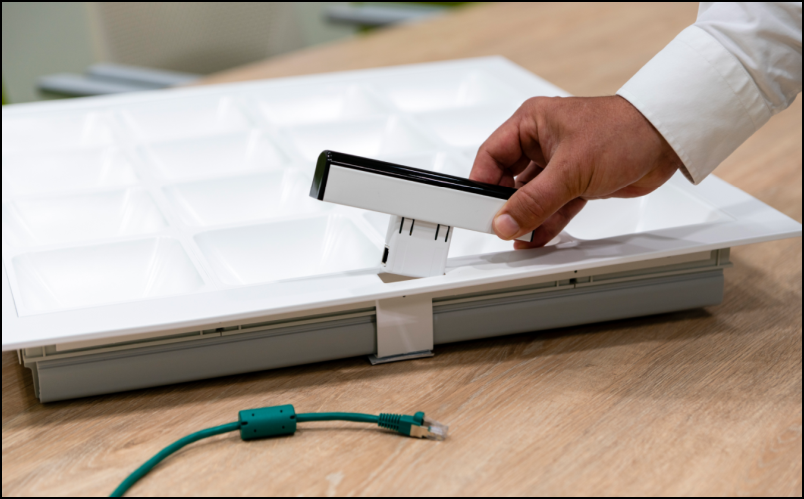 |
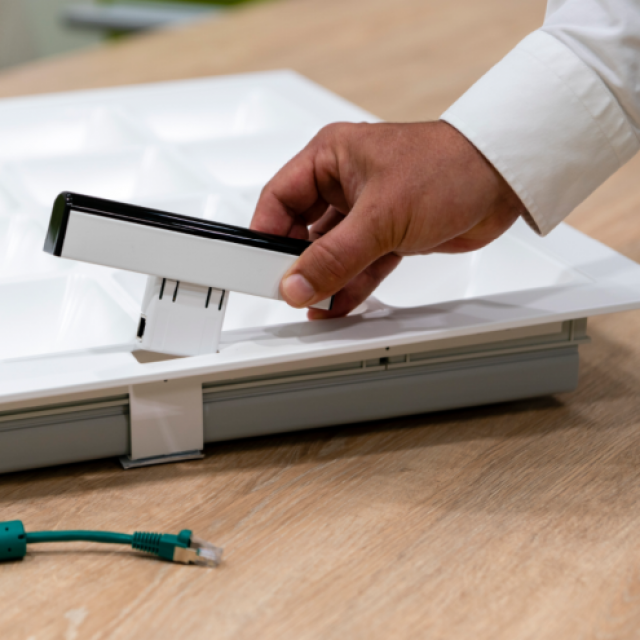
| A Trulify 6002 plug-in transceiver |
FURTHER DEVELOPMENT
As with Wi-Fi, standardization is also very important for LiFi and various manufacturers have therefore united in a task group (IEEE 802.11bb) to make LiFi part of the 802.11 standard. This should pave the way for neatly integrating the technology into various chipsets. In this way it is hoped that LiFi will penetrate the (consumer) market more quickly. The question, of course, is when and to what extent this will happen exactly. Although part of the LiFi infrastructure is already there – LED lighting can be found just about everywhere these days, from offices and living rooms to car lamps and street lighting – and existing solar cells and panels may also be used for certain (one-way) transmissions. But of course you also have equipment like transceivers and receivers are needed and for the time being they are not yet easy to implement.
The chance that LiFi will eventually supplant Wi-Fi technology does not seem that great to us, partly because, as mentioned, the light signal cannot pass through walls and the range is therefore often limited in practice. On the other hand, there are plenty of advantages, such as impressive spectrum and speed potential, that make LiFi more than useful as a complement to technologies like Wi-Fi and 5G. LiFi certainly has a future.