

A single cigarette a day can’t do much harm? Some people think so, but a study clearly shows that the long-term health effects of this daily cigarette are significant.
It is now common knowledge that chain smokers expose themselves to major health risks. It is also clear: the more you smoke, the worse it is for your health.
- Smoking increases the risk of some diseases – including lung problems, diabetes, various cancers and COPD – as well as strokes and heart attacks.
- Smoking becomes addictive very quickly.
- If you want to become a non-smoker, you have various strategies and contact points available to help you achieve this.
- Pregnant women in particular should not smoke so as not to harm their unborn child.
It is reasonable to assume that a person who smokes twenty times as much has a twenty times higher risk. But if you only smoke one cigarette a day instead of twenty, the harmful health effects are by no means divided by twenty. This was shown by a meta-study from Great Britain in 2018.
One cigarette a day: study shows effects
The researchers involved in the study evaluated over 140 studies on the health disadvantages of smoking. The specialist article focuses on so-called “light smoking”, which includes one to five cigarettes per day.
The result: The risk for light smokers is still half as great as for people who smoke over 20 cigarettes per day. According to the authors, in order to avoid such health problems, there is very little point in simply reducing smoking. However, there are really big advantages if you stop completely.
Compared to non-smokers, the risks change as follows:
- One cigarette a day increases the risk of heart disease by 48 percent (in men) and by 57 percent (in women).
- The risk of a stroke increases by 25 percent (in men) and by 31 percent (in women).
- On average, someone who smokes “only” once a day still has about half the risk that heavy smokers face.
The study does not explain why the risks generally increase more for women than for men.
Why doesn’t the risk decrease the same with every cigarette?
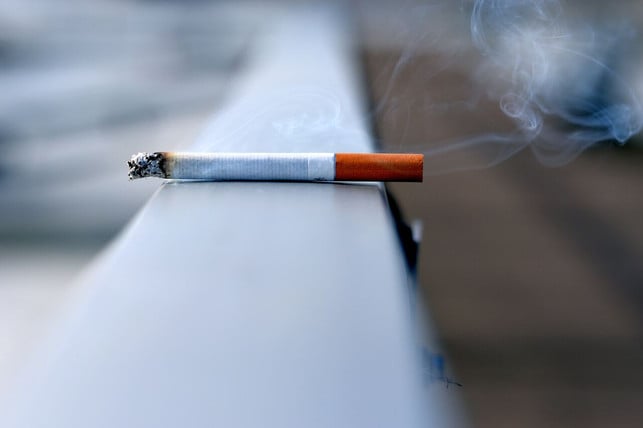
The fact that such a large reduction in cigarette consumption only leads to such small positive effects is due to certain biological mechanisms.
“The problem is with cardiovascular disease, the impact on the blood system and the heart occurs really quickly,” Alan Hackshaw, lead author of the article, told the Guardian. “It only takes a small amount of exposure to cause significant adverse effects. Therefore, one cigarette a day poses a much greater risk than many people realize. Smoking up to twenty cigarettes a day increases the risk, but not excessively.”
The situation is different with lung cancer, another disease for which smokers have a significantly higher risk: Here the risk of the disease falls proportionally to the number of cigarettes smoked daily.
Measures: No cigarettes a day instead of just one
The authors of the study emphasize that their findings could also have a positive influence on health campaigns. These should therefore focus more on achieving complete freedom from smoking instead of encouraging people to just smoke less.
“There is no safe amount of smoking,” says Hackshaw, summarizing the findings.
According to the researchers, replacement products such as nicotine chewing gum, patches or e-cigarettes could help you quit smoking.
E-cigarettes are the most controversial option. Official authorities and reviews believe that e-cigarettes pose a lower risk compared to tobacco cigarettes, but are not risk-free. Studies show, for example, that e-cigarettes can have negative effects on the heart and lungs.
Many people overestimate or misunderstand the risks of e-cigarettes compared to tobacco, according to University College London.
Recent studies confirm the findings
In 2025, researchers wanted to examine the question again. Using data from 22 prospective cohort studies with over 320,000 participants, they analyzed how smoking of varying intensity (even just a few cigarettes per day) and duration of quitting is related to the risk of cardiovascular and other diseases as well as death. The most important results:
- Even low to moderate smoking (two to five cigarettes daily) was associated with significantly higher risks of cardiovascular disease and mortality compared to non-smokers.
- The risk continued to increase with heavier consumption, but, as in the 2018 study, it was not linearly proportional to the number of cigarettes. This means: twenty cigarettes a day instead of one does not necessarily mean a twenty times higher risk.
- Stopping smoking early significantly reduced the risk – the risks continued to fall significantly in the first 10 years after quitting.
What happens to the body when smoking?

Smoking not only has long-term but also immediate effects on the body, including the brain. Cigarette consumption also has a negative impact on your health before you become acutely or chronically ill. Among other things:
-
Leads to more stress: Studies have shown that smokers have higher stress levels than non-smokers. The feeling of relaxation occurs because smoking returns you to the normal, lower stress level of non-smokers.
-
Bronchospasm: This term basically refers to an irritated windpipe. This makes breathing feel more difficult and can cause asthma-like wheezing.
-
Increases mucus production: The lungs produce mucus to trap chemical and toxic substances. Small finger-like hairs normally move this mucus out of the lungs, including when coughing. Tobacco smoke paralyzes the hairs and allows mucus to build up in smokers’ lungs.
-
Reflux disease: This disease includes symptoms of heartburn and the rise of stomach acid. Normally, the body prevents this by secreting an alkaline substance to neutralize digestive acids and by keeping the path between the esophagus and the stomach tightly closed – except when the stomach absorbs food from above. The alkaline substance produced by smokers is less neutralizing than that produced by non-smokers, allowing digestive acids a longer period of time to irritate the esophagus. Smokers also occasionally experience loosening of the muscle that separates the esophagus and stomach. This increases the chance that stomach acid will rise and damage the esophagus.
Read more on Techzle\.com:
- Disposable e-cigarettes: Why you shouldn’t buy them
- Remove the smell of smoke: This will make your apartment smell fresh again
- Herbal cigarette: Why you should avoid the tobacco substitute
** marked with ** or orange underlined Links to sources of supply are partly partner links: If you buy here, you are actively supporting Techzle\.com, because we then receive a small part of the sales proceeds. More info.