
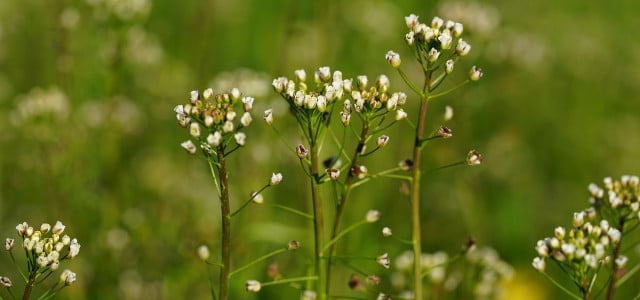
Shepherd’s purse herb no longer plays a major role as a medicinal herb, but was used to treat wounds until the Second World War because of its hemostatic effect. It can also help people with menstrual problems.
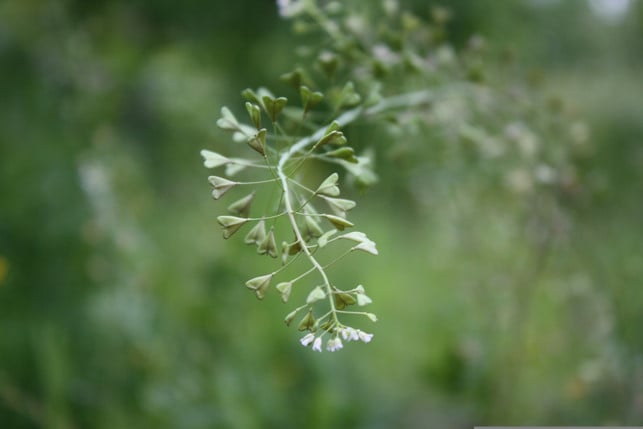
The nicknames “heart herb” and “blood herb” not only indicate the effect of shepherd’s purse herb, but also its shape. You can easily identify shepherd’s purse by the heart-shaped pockets on the fruit. Visually, the medicinal herb is otherwise inconspicuous. It has fine leaves and small white flowers that bloom from March to October.
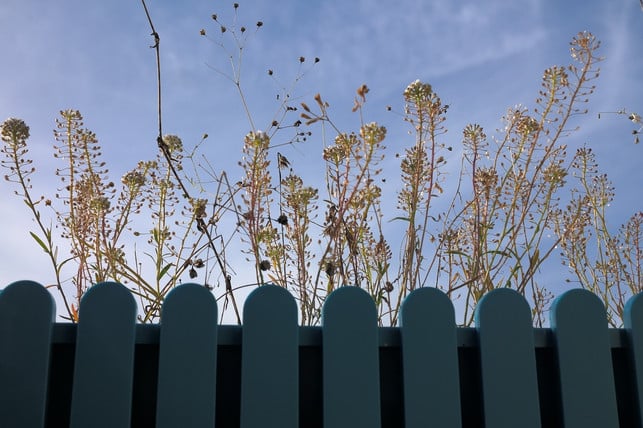
The shepherd’s purse belongs to the cruciferous family and reaches a height of up to 40 centimeters. The medicinal plant is found worldwide and grows primarily on roadsides, in meadows and fields. It is also widespread in Germany and you can collect it. Shepherd’s purse herb is edible from flower to root. The dried plant parts are also available in pharmacies.
Shepherd’s purse herb: ingredients and effects
Shepherd’s purse herb is now considered a weed, but it has many healthy ingredients. These include, among others:
- Flavonoids
- Alkaloids
- Amino acids
- secondary plant substances
- Trace elements
The shepherd’s purse herb also contains vitamins and minerals, namely:
- Vitamin A
- Vitamin C
- iron
- potassium
You can use shepherd’s purse herb for various complaints. In the past, the herb was used, for example, to stop nosebleeds. It has been scientifically proven that shepherd’s purse herb can provide relief for the following complaints:
- Shepherd’s purse herb helps with menstrual problems: Regardless of whether the period is particularly heavy, long-lasting or irregular, shepherd’s purse herb helps to regulate the cycle again. Shepherd’s purse herb is used medicinally, especially when menstrual bleeding is too heavy.
- It can support wound healing and has antibacterial, antioxidant and anti-inflammatory effects.
- Shepherd’s purse herb is also said to help against fever.
Since shepherd’s purse herb is rarely used as a medicinal plant today, it has hardly been studied and further study results are needed.
Shepherd’s purse herb: Use as a tea

The medicinal herb is mainly used as a tea, which tastes mild and slightly bitter. This is how you can prepare it:
- Place about 10 grams (2 tablespoons) of dried shepherd’s purse in a tea strainer.
- Pour about 250 milliliters of boiling water over the herb.
- Let the tea steep for 10 to 15 minutes before removing the plant parts.
You can drink shepherd’s purse herb as a tea, for example during your period.
Shepherd’s purse herb: use in the kitchen
The young shoots and leaves of shepherd’s purse herb are suitable as an ingredient in smoothies, salads or steamed as an alternative to spinach.
But you can not only use the leaves, but also the seeds. They taste nutty and spicy and were once even used as a substitute for pepper. If you roast the seeds, their aroma intensifies. Here’s how you can use them:
- as a topping in a salad or on bread
- to make your own mustard – shepherd’s purse herb used to be called “farmer’s mustard”.
You can also use the flowers of the shepherd’s purse as a decoration for desserts etc.
Shepherd’s purse herb: harvesting and cultivation
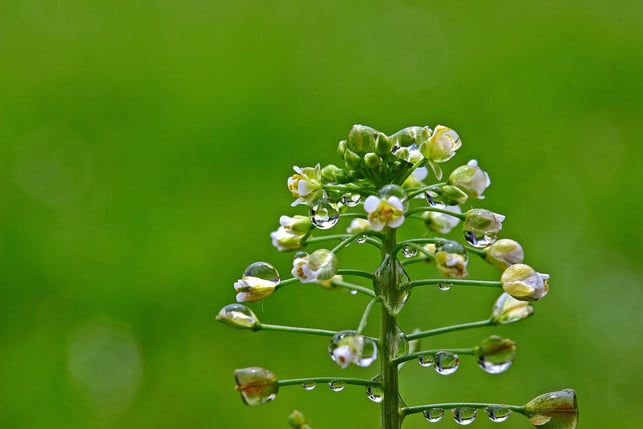
As already mentioned, the adaptable shepherd’s purse blooms for a relatively long time. It also grows almost everywhere: along the side of the road, in meadows and fields and even between paving stones. It is best to harvest it in spring.
If you want to collect shepherd’s purse herb, you should focus on the following characteristics:
- A growth habit that is reminiscent of dandelions or plantains with its long leaves on the ground
- A size of ten to 50 centimeters
- The initially mentioned heart-shaped leaves, which are located on the upper part of the plants
- Small, white flowers
If you are unsure when harvesting whether it is really shepherd’s purse herb, you can use an app to identify plants. This is how you go about harvesting:
- Cut the plant about a hand’s width above the ground – this ensures that the shepherd’s purse herb can grow back easily.
- Wash off the herb.
- Hang it upside down in a dry place to dry.
You can also grow shepherd’s purse herb in the garden. It feels most comfortable in a sunny or partially shaded location with nutrient-rich soil. To do this, simply sow a few collected seeds. The insects in your garden also benefit from this: shepherd’s purse is considered an important food source for wild bees.
Edited by Lea Hermann
Read more on Techzle\.com:
- Collecting, identifying and eating wild herbs: 11 tips
- Domestic medicinal plants: The strongest plants and their effects
- Harvesting nettle: This is what you need to pay attention to
** marked with ** or orange underlined Links to sources of supply are partly partner links: If you buy here, you are actively supporting Techzle\.com, because we then receive a small part of the sales proceeds. More info.