
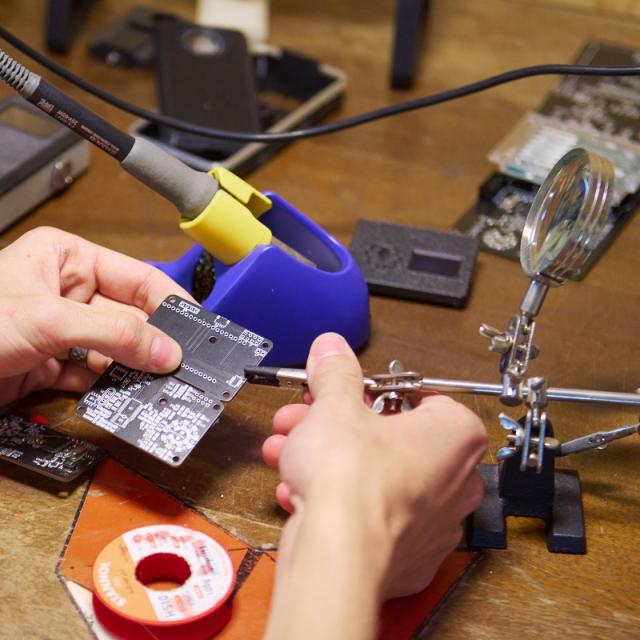
Dutch student Jerry de Vos from Delft will win the international James Dyson Sustainability Award 2021 this year with his invention, the Plastic Scanner. With more than 2,000 entries from 28 countries, Jerry’s invention has been voted the best sustainable invention of 2021.
Plastic waste is a global problem. Industrial Design student Jerry de Vos (TU Delft) decided to tackle this problem in his Master’s graduation project “Plastic Identification Anywhere” and wins the JDA sustainability award. Jerry’s mission is to tackle the plastic soup at all levels through improved recycling.
plastic scannerr
The portable plastic scanner enables on-site identification of plastic with the aim of simplifying recycling and drastically reducing plastic pollution. Student Jerry de Vos (TU/Delft) succeeds in translating the infrared reflection technology of large-scale plastic sorting processes into a simple portable and user-friendly device so that it is available everywhere. Jerry wins the international sustainability prize James Dyson Award 2021 with the Plastic Scanner.
The problem
Every year 11 million tons of plastic ends up in the sea and this is increasing all the time. That is an amount of plastic per hour that could fill 11 Olympic swimming pools. Jerry’s mission is to tackle this plastic soup at all levels, including through improved recycling. Globally, only 14 percent is now recycled, although theoretically almost all types of plastic can be recycled. Much plastic is not recycled (and collected), because recycling remains complicated and therefore economically unprofitable. Also, in many countries there is no good infrastructure for recycling.
The solution
Jerry de Vos has devised a solution for his graduation assignment at TU Delft to simplify recycling and reduce plastic pollution. Much of the plastic from the oceans comes from low- and middle-income countries, where plastic is often sorted manually and with the naked eye. This costs a lot of time and money and can be very error-prone. As a volunteer for Precious Plastic, he saw the negative impact of plastic pollution and the bottlenecks caused when plastic is not (correctly) identified and sorted in the recycling process. The portable plastic scanner tells you on the spot what kind of plastic a product is made of. Infrared light is used to detect the plastic components. This allows the plastic to be separated easily and better.
By developing an affordable, portable and inexpensive scanner, Jerry wants to give a lead in the field of plastic recycling in countries where there is still a lot of manual sorting to recycle better and more. The plastic scanner thus enables anyone to properly identify and sort plastic, overcoming one of the most complex barriers to plastic recycling anywhere in the world.
How does it work?
Jerry developed the portable plastic scanner using near-infrared spectroscopy, a technology that can categorize more than 75% of the plastics used in everyday life. The device serves as an open source project, the components of which can be purchased and produced locally. The plastic scanner thus helps to correctly separate the plastics for a better quality of the end products for reuse.
