
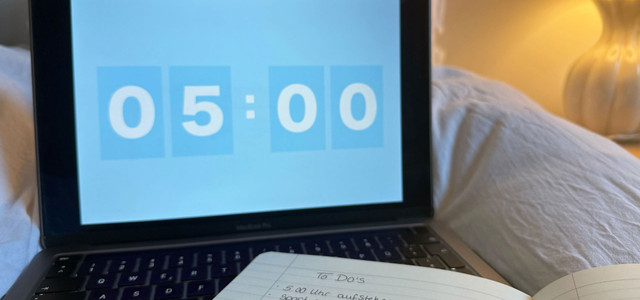
Is getting up early the key to a fulfilling life? Why the trendy recipe of getting up early can become a health risk – and what really counts for restful sleep.
Getting up at 5 a.m., doing some exercise and then going to work: Is that the recipe for success for effectively using your life? According to numerous social media trends and coaching books, getting up early is said to help you live a more efficient and successful life. However, sleep experts note that this approach ignores many important factors. Because not everyone is an early riser.
“This whole movement is actually based on the assumption that getting up early creates discipline and that discipline automatically leads to success,” says sleep psychologist Günther Amann-Jennson from Frastanz in the Austrian state of Vorarlberg. But the mistake in thinking is to place discipline above biology. Because sleep clearly follows biological laws and every person has a genetic internal clock – that cannot be changed.
Lark, owl or pigeon?
Basically, research distinguishes between day people and night people. “The larks like to get up in the morning, they have an appetite straight away when they get up and they are mentally and physically productive in the morning,” explains neurologist Birgit Högl from the Medical University of Innsbruck. “The owls like to sleep a little longer and are at their mental peak in the afternoon.”
Getting up early is not always compatible with everyday life and the recommended sleep time of seven to nine hours, says Högl. So if you wanted to get up at 5 a.m., you would have to go to bed around 9 p.m. “For early people who like to go to bed early, this may be an option if you can take total sleep time into account, but not for evening people.”
Sleep psychologist Amann-Jennson assumes that around 20 to 25 percent of people are larks and around 20 to 30 percent are owls. The largest part of the population – around 50 percent – lies in between and is classified as an intermediate chronotype – as pigeons. The early bird recipe for success is therefore unsuitable for many people.
Success without getting up early: prioritize sleep correctly
Instead of fighting the need for sleep, there are other ways to achieve success. “If you understand sleep as the basis of health, performance and satisfaction, you will of course find a much better way to achieve it in the long term than with simple recipes for success,” says Amann-Jennson. This path does not begin with getting up earlier, but with the willingness to take your own biological and psychological limits seriously.
“I would say that if you have a limited lifespan and a limited 24-hour day, you should think carefully about what you weight and how,” advises Högl. In order to stay healthy in the long term, in addition to a healthy diet, exercise and social environment, it is also important to get enough sleep.
Tips for restful sleep: These 4 factors help
According to Amann-Jennson, the expensive triple-padded mattress is not crucial for a good night’s sleep. And sleep expert Högl names four requirements that you should take into account for a restful night’s sleep.
-
Darkness: The bedroom should be as dark as possible. Roller blinds, opaque curtains or a sleep mask are helpful here. If you want to shorten the time it takes you to fall asleep or move it forward a little, you can dim the lights one to two hours before going to bed.
-
Quiet: To ensure a restful sleep, it should be as quiet as possible. Even small sources of noise that don’t wake you up could subliminally disrupt your sleep.
-
Temperature: The bedroom temperature should not be too warm. The best way to fall asleep is when your individual core body temperature drops. This works if you can release heat from the body into the environment. This usually happens via hands and feet.
-
Meal time: The last meal of the day should be based on sleep. It shouldn’t be too late in the evening or too close to bedtime. However, it is also not recommended to go to bed with a completely empty stomach.
Why lack of sleep is dangerous – consequences for body and mind
According to Högl, anyone who sleeps too little risks impaired working memory, language fluency, emotion regulation or decision-making ability. The sensitivity to pain is also higher. Long-term studies show that people who chronically don’t sleep enough have a higher risk of metabolic diseases, diabetes and high blood pressure, says the expert.
“Biologically speaking, 95 percent of people have insufficient sleep, from little to big,” says Amann-Jennson. Lack of sleep is not only an individual problem, but also a social problem. Schools, for example, start too early and working hours are not compatible with the internal clock for many people.
Lack of sleep also affects social interactions: “Fatigue causes people to become less empathetic and much more aggressive.” We know that, criticizes Amann-Jennson. However, no one is able to change this.
** marked with ** or orange underlined Links to sources of supply are partly partner links: If you buy here, you are actively supporting Techzle\.com, because we then receive a small part of the sales proceeds. More info.