
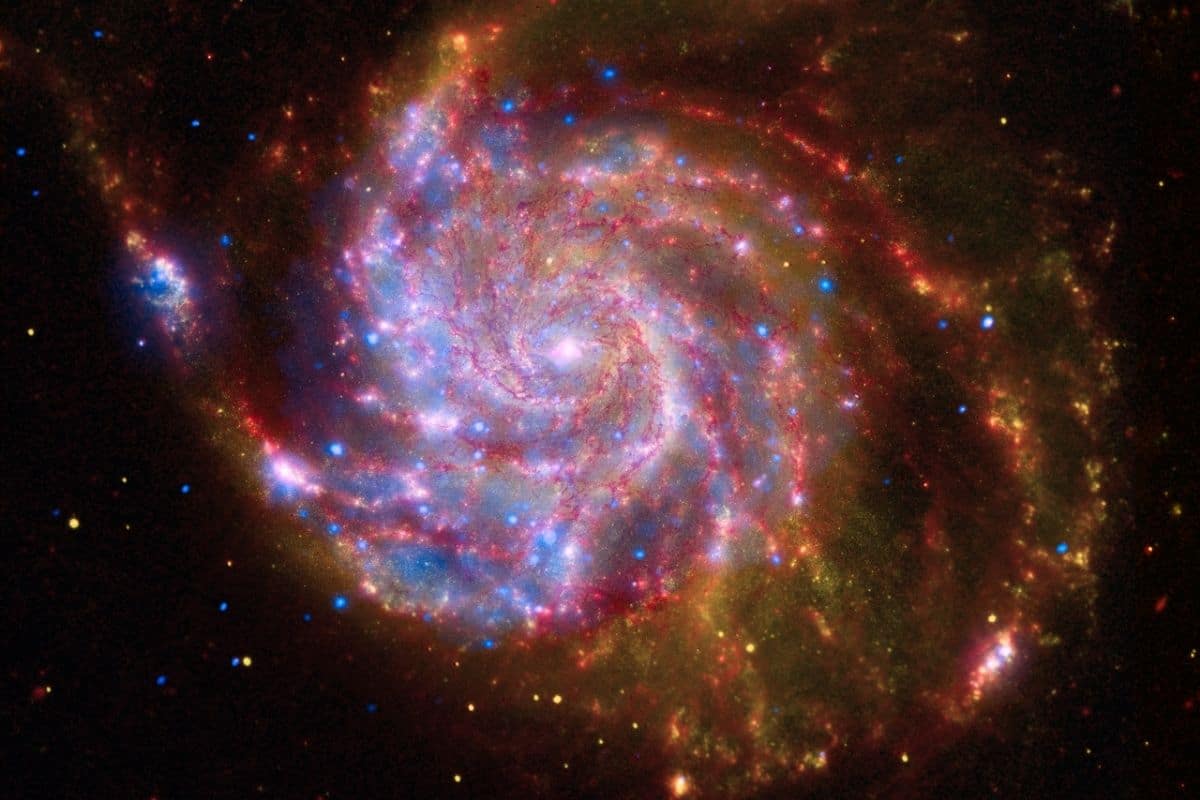

Unfortunately, we cannot see infrared light, ultraviolet radiation or X-rays with our own eyes. Still, scientists look at galaxies, black holes and other objects at different wavelengths to learn more about these mysterious objects.
The space photo of the week is a mosaic of galaxy M101. The Windmill Galaxy is a spiral galaxy with a diameter of 170,000 light-years. This makes this galaxy two times wider than our Milky Way. The galaxy was photographed in 2009 by three space telescopes, namely Chandra (in X-ray), Hubble (visible and ultraviolet) and Spitzer (infrared). Let’s take the different layers apart to see what there is to see.
First Chandra…
The photo below was taken by the Chandra Space Telescope. This telescope has four parabolic mirrors. The X-rays from objects such as black holes and neutron stars fall through these mirrors onto the spectrometers. The white dots in the photo above are X-ray sources, such as the remnants of exploded stars or gas colliding around stars. The pink and blue clouds are extremely warm gas clouds and clusters of massive stars.

…then Spitzer…
In Spitzer’s infrared image, we see dark dust clouds (green/yellow) in which new stars are being born. Dust heated by hot, young stars turns red. The other hundreds of billions of stars in M101 are less prominent in the image and together form a blue glow in the image below.

…and then Hubble
Then there is only one photo left and that is the galaxy M101 in visible light. The blue clouds are areas where new stars are born. The yellow core consists mainly of old stars. Then dark brown fabric bands remain. These are cold, dense regions of interstellar clouds. These can collapse, after which new stars are formed.

A beautiful end result
If we now put the three different photos on top of each other, we get the image below:

Source material:
†SPITZER-HUBBLE-CHANDRA COMPOSITE OR M101” – Hubble site
Image at the top of this article: NASA