
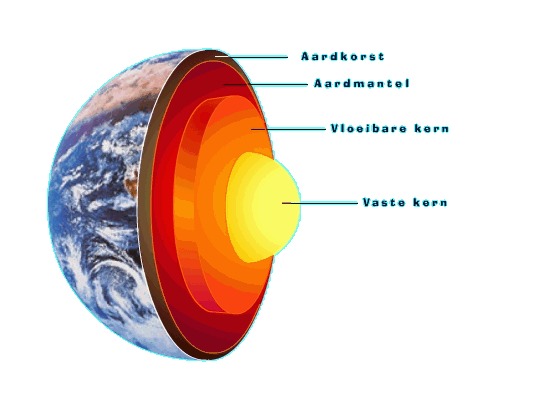
Where in the earth is the magma, I know that there is a solid core, a liquid core in the earth, but what is the magma then?


Answer
At the beginning of the last century, geologists had a problem. On the one hand, the continents seemed to float on “something liquid” (we call this isostasy); on the other hand, earthquake waves propagate through most of the Earth, meaning the entire Earth is “solid” (outside the liquid outer core). We must therefore ask ourselves what geologists mean by “liquid”.
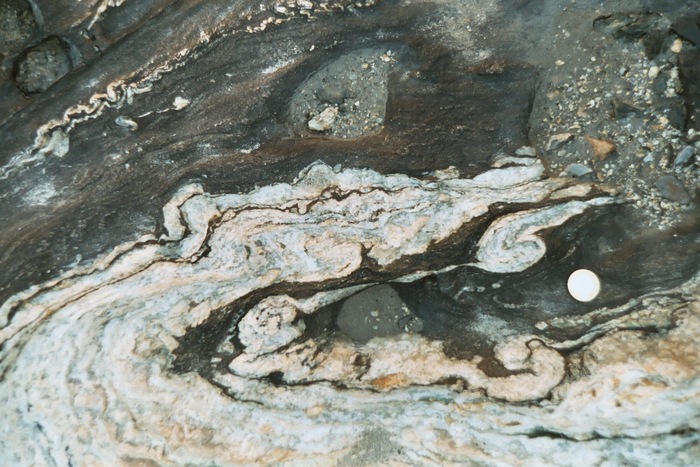
Actually, all rock is “liquid”! Sometimes you just have to wait a very long time. When I tell you that water is liquid, you will believe me. If I tell you that ice is liquid, you can understand that too. Just look at glaciers, those are real streams of ice. But ice is solid water, so it can actually be seen as a rock. Rocks can therefore also flow like ice (see for example the attached photo). But it happens so slowly that we don’t notice it. This happens at rates of a few mm to cm per year (a bit like the speed at which your toenails grow). But Earth holds one trump card: time! The rocks have millions of years to flow. Just think: if the flow rate is 1 cm per year, that means that in 1 million years the rock has flowed 10 kilometers.
But what is “magma” then? Magma is really molten rock. That is rock that has become liquid. If that magma then flows out of a volcano, we get lava flows.
And where is magma now formed. Actually very close (on a terrestrial scale) below the surface of the earth. We are talking about a depth of several tens to hundreds of kilometers below the earth’s surface. Due to special circumstances (heat, pressure relief, presence of water), the solid mantle rock or crustal rock can melt there. That melted, really liquid rock then collects in large magma chambers under the volcanoes. And every now and then these volcanoes erupt and the magma flows out like lava.
So: the entire mantle is a solid and hard rock that behaves “liquid” on a geological timescale of millions of years; here and there this solid rock can really melt and become a liquid, and we’re talking about a magma.

Answered by
Prof. Manuel Sintubin
Tectonics Geodynamics Earthquake Geology Earthquake Archaeology

Old Market 13 3000 Leuven
https://www.kuleuven.be/
.