
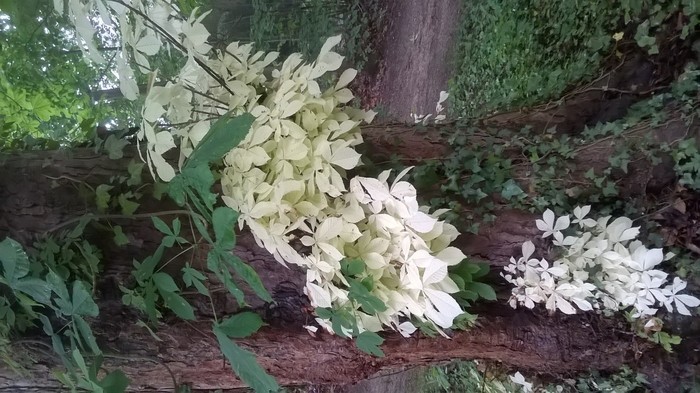
We made a strange discovery in the nearby domain in Kessel-Lo. During a walk we came to the conclusion that on a tree trunk of a wild chestnut branches grew on which there were leaves of that wild chestnut, only they had a bright white color. My question is how that is possible, because the whole tree has beautiful green leaves except at the bottom and a small bunch of branches at a height of ten meters.
Answer
Dear Luke,
What you see here is a form of albinism. In green leaves, the green color is caused by the presence of chlorophyll (chlorophyll). Leaves are green because chlorophyll absorbs blue and red wavelengths in light and reflects the green wavelengths. When the chlorophyll is missing and there are no other color pigments, the leaves are white. A genetic error is at the root of this phenomenon and results in no chlorophyll being produced. When such an error occurs in a cell that continues to divide, and from which new branches and leaves arise, this error also occurs in the newly formed cells and this eventually becomes visible in the resulting leaves.
In plants with a panached leaf (two-tone white-green), the color difference can also be caused by a lack of chlorophyll.
Cultivated forms of trees are often created by cuttings or grafting such a phenomenon that has been noticed in nature, for example bi-coloured leaves. If you try to do that with the branches of this chestnut, it will not work, the leaves need chlorophyll to be able to photosynthesise, that is the way plants acquire energy. In the chestnut tree with the white branches, the green leaves provide energy. Albino plants therefore have little chance of success.
Regards,
borrow.
Answered by
dr.ir. Lee Lee
Plant breeding, plant genetics, ornamental plants, horticulture

Burg. van Gansberghelaan 96 box 1 9820 Merelbeke
http://www.ilvo.vlaanderen.be
.