
Last year we were in France and suddenly we heard a loud bang. Dad said it was a plane that flew through the sound barrier.
But how is that possible? Why does it have such a bang?
Answer
Dear Emily,
When an airplane flies faster than the sound, you will hear a bang. This is, indeed as your daddy told you, when the plane flies through the sound wall or sound barrier. To understand the bang, you must first understand what ‘sound’ actually is.
Sound is actually vibrations that we perceive with our ear. Those vibrations propagate in the form of sound waves. This can be compared with the propagation of water waves if, for example, you throw a stone into the water.
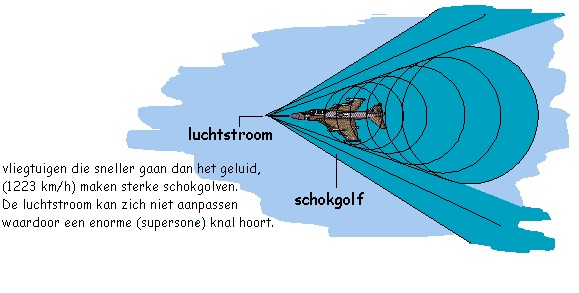
The speed at which sound waves travel depends on the substance in which they move. In air, the speed of sound is about 340 meters per second (= 1224 km per hour). If the aircraft flies faster than the speed of sound, i.e. faster than 1224 km per hour, a large difference in air pressure, also called a shock wave, is created, especially just in front of the nose of the aircraft. The sound waves in front of the nose of the aircraft are compressed, as it were. Such a shock wave then has a cone shape, with the point of the cone at the nose of the aircraft (see also inserted figure).
This large pressure difference at the front of the nose is nothing but the air vibrating very hard. You can hear this on the ground as a loud bang.
With airplanes, one often speaks of supersonic airplanes or airplanes exceeding the speed of Mach 1. Mach 1 is actually equal to the speed of sound. An F16 has a top speed of about Mach 2. An F16 can therefore fly 2 times faster than sound. The Concorde is an example of a passenger plane that can break the sound barrier.
Answered by
lic. Dr. Physics Natasja Duhayon
Semiconductor technology, nanotechnology, microelectronics, physics, patents

Kapeldreef 75 3001 Leuven
http://www.imec-int.com
.