
Answer
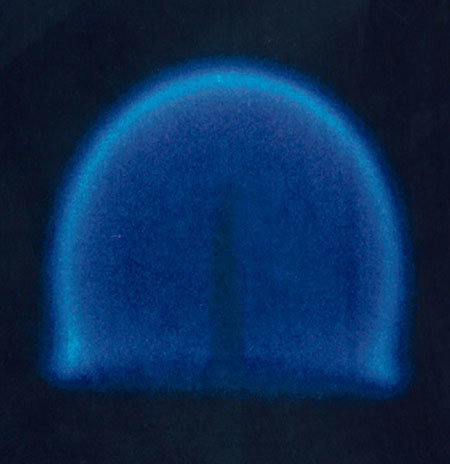
First of all, you mean a flame in the absence of gravity, or in microgravity, so in a spaceship. After all, “in space” strictly speaking means, in the void, in the vacuum of space. A candle would never burn there because there is no oxygen present.
We also assume here that it concerns the flame of, for example, a match or a candle, whereby the combustible material does not move. It is therefore not about a flame that is fed by, for example, a gas stream that flows out of a tube at a certain speed.
On Earth, a flame not only has an elongated shape, but the elongation is always directed upwards. This is a result of gravity. Hot (combustion) gases expand and therefore have a lower density, causing them to rise. As a result, additional cooler air is drawn in from below and the flame takes on its typical elongated shape. In the absence of gravity this effect is absent and the hot gases have no preferred direction to expand, (assuming no air currents are present). They simply expand due to the higher pressure in the gas cloud, and because pressure acts equally in all directions, the flame takes on a spherical shape.

Answered by
prof.dr. Paul Hellings
Department of Mathematics, Fac. IIW, KU Leuven

Old Market 13 3000 Leuven
https://www.kuleuven.be/
.