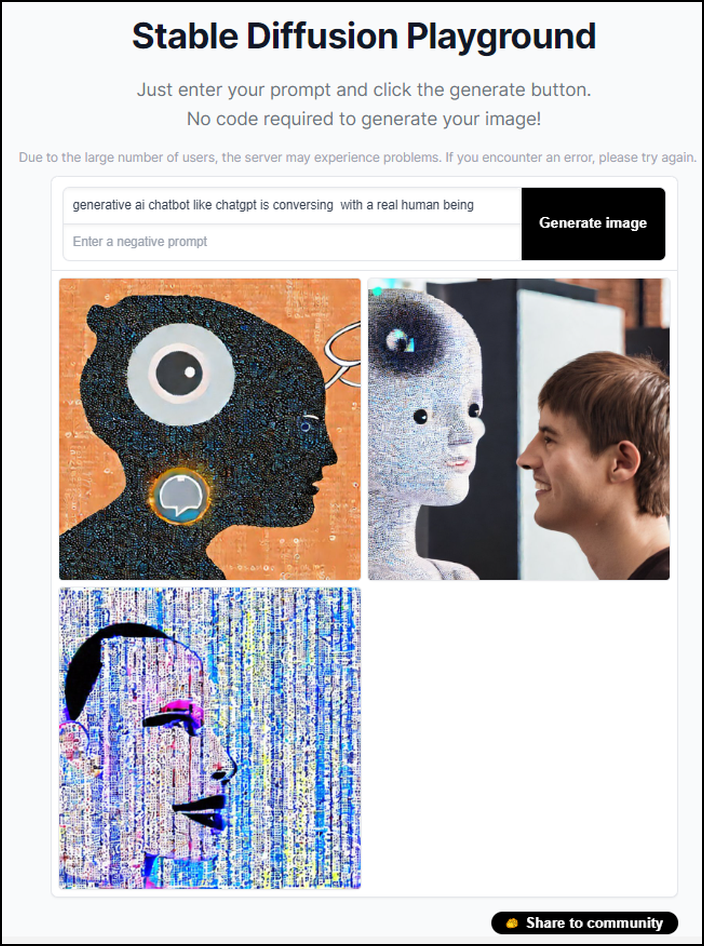
Tell me something about yourself, write a nice poem, summarize this text: all assignments that are intended for people. However, since the arrival of ChatGPT you can just as well go to a computer program.
Show Van Dale
|
You’ve no doubt heard about ChatGPT in recent months, because it’s the fastest growing application ever. In barely two months, ChatGPT attracted no less than 100 million users – something that took Twitter and Facebook, for example, almost five years. ChatGPT is therefore extremely popular. But what is it actually?
What’s in a name?
The name ‘ChatGPT’ doesn’t sound very attractive, but it says a lot. After all, the tool has a lot to do with ‘chatting’, but it is different from Messenger or WhatsApp. While you converse with people in a typical chatbot, in ChatGPT you do this with… the computer program itself.
You do this by typing in questions or commands, the so-called ‘prompts’, to which the chatbot responds with text. This is not just text retrieved from a static database, but generated by the bot itself (hence the letter G, for ‘Generative’). What’s more, the bot can also easily convert text sources into a shortened version or style them differently, partly based on instructions in your prompt (hence the letter T, for ‘Transformer’).
Of course, this bot can’t do all of this just like that. The makers, the American company OpenAI, have given the bot an appalling amount of information in advance. This so-called ‘corpus’ is composed of books, web pages and other documents, with a total of about 50 terabytes of text data (hence the letter P, for ‘Pre-trained’). Furthermore, ChatGPT can also use the feedback that employees and users can pass on to the bot.
ChatbotLoosely translated one |
 |
|
ChatGPT: ‘chat’ with an AI bot |
Artificial intelligence
To be able to do something with all this information, the bot must of course have some ‘intelligence’ and that in turn requires smart code and algorithms. All together we call this a ‘language model’ and with OpenAI this is the ‘GPT-3 model’. Incidentally, ChatGPT will already use the GPT-4 model this year, which would be much more powerful. The company has not released this language model, but it does allow other providers to use it via a so-called API (‘application programming interface’).
Precisely because ChatGPT can generate answers where you would suspect human intelligence, this is called a typical AI bot (Artificial Intelligence). A ‘bot’ is short for ‘robot’ and is little more than a computer program that can automate a process, in this case: formulating answers.
The concept of AI is certainly not new and is being used in many other domains, including in self-driving cars and in speech and image recognition. It is true that ChatGPT acts as a real catalyst that AI in a short time mainstream much like the iPhone has done for mobile telephony.
Alternatives: announced
ChatGPT is currently the most popular and much-discussed generative AI bot, which has now prompted Microsoft to invest an additional $10 billion in the development of this bot. The company has concrete plans to integrate ChatGPT into search engine Bing. At the time of this writing (end of February), you must register for a waiting list via www.bing.com. So it remains to be seen what the intended integration will yield, but unlike the ChatGPT implementation with OpenAI, the Bing version could also consult current (internet) sources and list the sources used. Microsoft also plans to integrate ChatGPT into MS Office to further increase user productivity.
Opera (www.opera.com) also intends to make ChatGPT accessible soon, from a sidebar in its browser.
The use of current internet resources and source reference are two features that Google has now also announced for its own generative AI chatbot: Bard. Chances are that this chatbot will also be available by the time you read this.
In China, access to ChatGPT is blocked, but here a few internet companies are putting the finishing touches to their own chatbots, in particular e-commerce giant Alibaba and search engine Baidu (chatbot ERNIE).
|
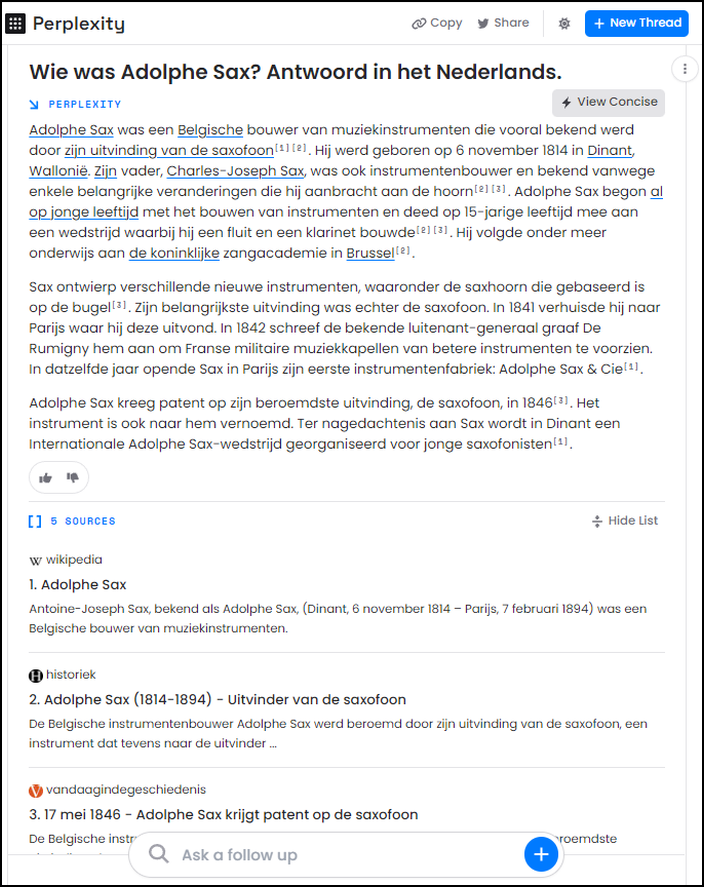
Perplexity also uses GPT |
Alternatives: available
If you want to get started right away with free alternatives, you can go to YouChat (https://you.com/chat; free registration required). This uses GPT-3, but can be a useful alternative to ChatGPT, for example when the latter proves difficult to access. Another handy feature is that you can request and share a link to your chat conversation here.
Perplexity is also very useful (https://perplexity.ai). In addition to OpenAI’s GPT3.5 language model, this bot also uses Microsoft Bing, which means that the bot can also draw from current information on the internet. In contrast to ChatGPT, you will also see source references in the answers. If you click on a footnote reference, the bot will take you directly to the corresponding source site, or you can click View List for an overview of all sources used. Also handy: one click View Detailed suffices for a more detailed answer.
Other media
Finally, there are also generative AI bots that do not focus on text but on other media. For example, various image bots are already available. These have already been discussed in detail in the article ‘AI creates pictures’ (PC-Active no. 328).
The impact of artificial intelligence is also becoming increasingly clear in other media, especially in music (e.g. at Harmonai, www.harmonai.org, Aiva, www.aiva.ai and Soundful, https://my.soundful.com) and soon no doubt also in video. After all, OpenAI is said to be already working on a video generator, inspired by image bot DALL∙E2.
|
A conversation with ChatGPT, |