
‘This car takes you from A to B in comfort’
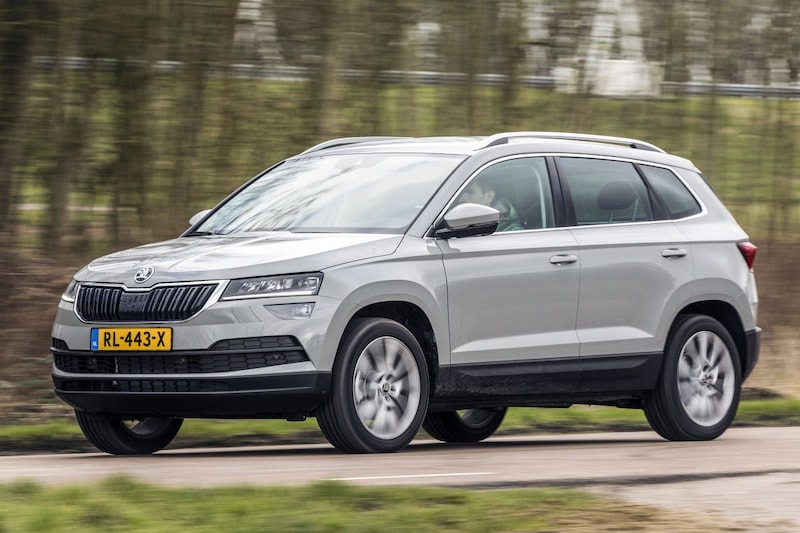
In 2017, Skoda launched a full-fledged family SUV, the Kodiaq. A slightly more modest, shortened version called Karoq followed a little later. This finally succeeded the Yeti and gave a popular model such as the Nissan Qashqai a formidable competitor. In the Review section on this website we discover how owners and users experience the ‘little Kodiaq’.
Now that we are comparing: the Karoq is 31.5 cm shorter, 4.1 cm narrower and 5.2 centimeters lower than the Kodiaq. The Karoq was also shortened by 15.3 centimeters on its wheelbase compared to its big brother. This scaling back was not limited to the bodywork, because the entry-level engine also became significantly smaller. With the Kodiaq you always get at least a 1.5 TSI with four cylinders (in the first years of construction a 1.4 TSI), while a 1.0-liter three-cylinder roars as standard in the front of the Karoq. Last week Skoda presented the new Kodiaq with electrified powertrains, which we will undoubtedly see in the next Karoq.

Practical ease of use
Despite its smaller size, the Karoq still appears to be very suitable as a family car. “We were looking for a car that was big enough for the baby and the buggy and all the accessories around it. A car that you could customize by increasing or decreasing the trunk space,” writes a Karoq 1.5 TSI driver, who also describes the car’s MPV-like capabilities. “The rear seats can be moved and removed. The front passenger seat is equipped with Isofix. It also folds down, which makes it easier to transport longer items. So the ease of use is certainly a plus.”
A Karoq diesel driver also mentions the flexible rear seats, which are not standard on every version. “Enthusiasts of compact SUVs from the Volkswagen Group will probably compare the Karoq with its cousin Seat Ateca. In addition to the different looks, the Karoq can boast Varioflex seats, which are not available with its Spanish cousin. If you remove the middle seat, you can position the two outer ones more centered.” What about the space next? “Combined with the high front seats, which you as a passenger can easily fit your feet under, it also makes it pleasant to stay in the back.”
It also appears to be a great place to stay in the front. “The seating position in the front is easy to adjust, both the height and the slope of the backrest (with a dial). The lumbar support can be operated with a rotary knob. Now, with my height of 1.92 meters, I sit quite close to the handlebars. With the chair in this position I can sit comfortably ‘behind myself’ (with more than enough knee room). There is not as much space as in an Octavia, but it is more than 30 centimeters longer. Due to the relatively high seat in the back and the fact that you can easily fit your feet under the front seats, you also sit comfortably in the back.” He concludes with a comment about the headroom: “There is plenty of it both front and rear.”
Infotainment and ease of use
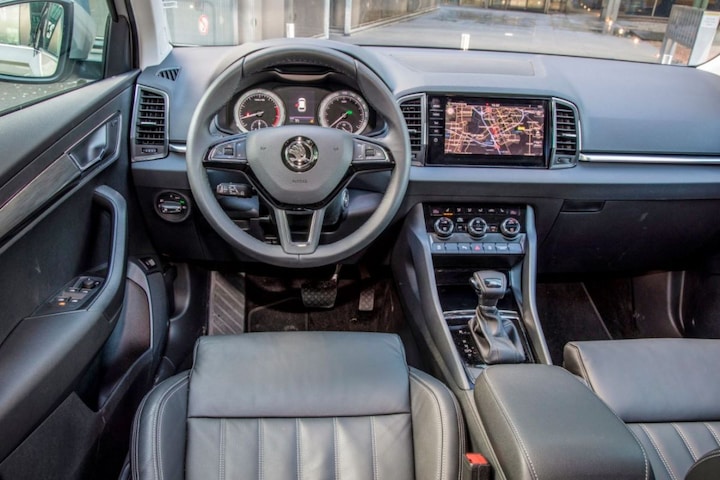
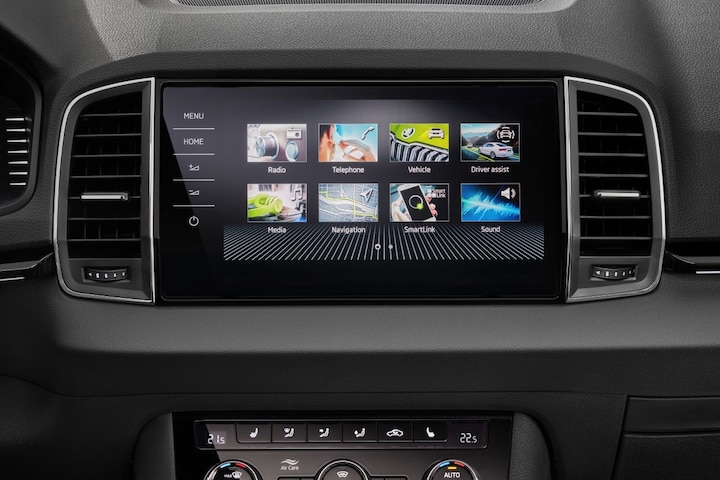
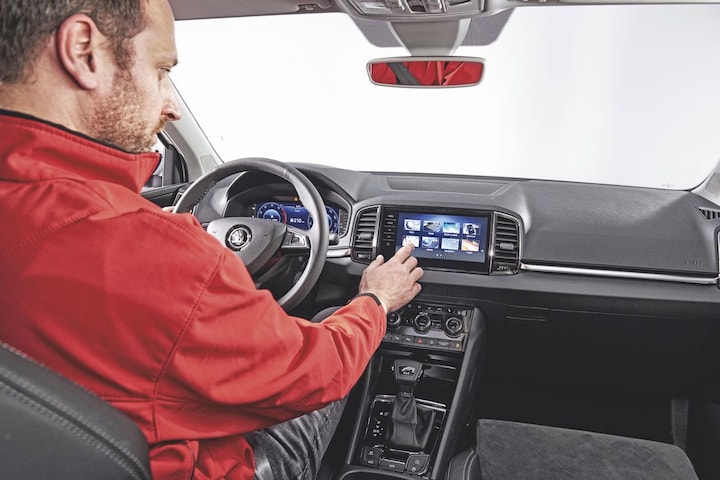
Most drivers are pleased with the ease of use. “The multimedia system is largely known from Octavia. The buttons are all logical and the touchscreen works quickly and clearly,” writes one satisfied driver. Another driver is also satisfied with most of the controls and his choice for a more expensive audio system. “The sound is wonderful to listen to. No doubt that will be the contribution of the Canton system. I am still investigating the use of the apps. The navigation apps Waze and Maps have already been used and work flawlessly.” Yet all that glitters is not gold. “Unfortunately, the built-in navigation leaves much to be desired. Besides having a major error, the built-in voice is annoying. Hearing ‘please’ after every notification is starting to get really annoying.”
The Karoq is also available with digital instruments. “The virtual cockpit looks nice and gives you plenty of setting options. Apple CarPlay also works fine, although I immediately have two negative points about it,” writes a third Karoq driver. “Sometimes you just can’t get the CarPlay connected. The next time you drive the car, it all works again. This happens about 1 in 30 times, so it is not really disturbing.”
How does the Skoda Karoq drive?
“This car is not intended to take a winding road or to give ‘fun’ in driving,” says the owner of a Karoq 1.5 TSI Greentech Sportline Business. “No, this car takes you from A to B in complete comfort. Of course it is not an S-class, but emotionally the Skoda exceeds all my expectations in this area. Maybe I was a bit biased because I came from a ‘premium’ product. But really, the car feels very luxurious on all sides. The Skoda also feels very mature. It has long suspension travel and therefore has excellent driving comfort (despite the flat tires).
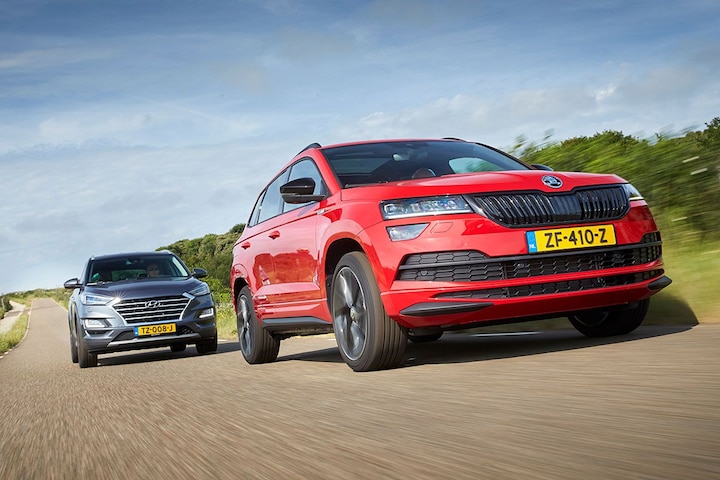
The Skoda Karoq with a previous generation Hyundai Tucson in its wake.
It is an experience that is widely shared among drivers, including the following 1.0 TSI driver: “The emphasis is on comfort. Small but also larger imperfections are nicely smoothed out. The carriage leans a bit in bends and steering is not very precise, but light. The Karoq is not the place for sporty cornering. On the highway – and especially now at the speed limit of 100 km/h – you can cruise relaxed for a long time and the car makes little noise.”
Short and sweet are the positive words of a 1.5 driver: “The car steers and drives excellently. I drove it to Italy again and with the adaptive cruise control it drives very smoothly and comfortably. Truly a car for driving long distances!”
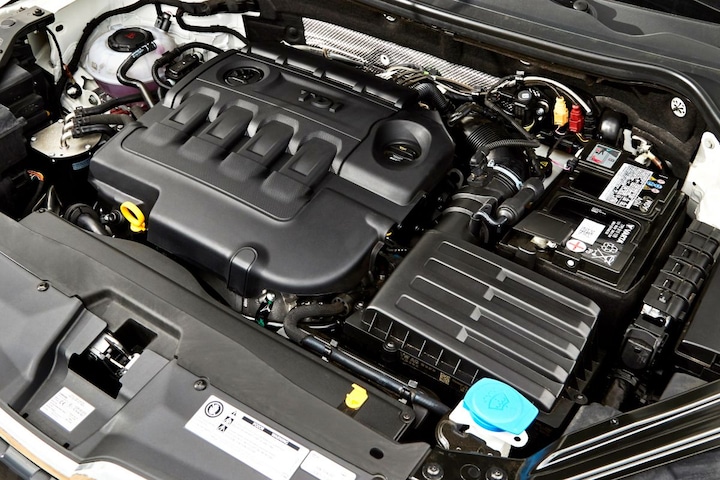
Drivers are also enthusiastic about the engines, both the 1.5 and the smaller 1.0 TSI. “I already knew the engine from my Octavia and it certainly does not disappoint,” writes the 1.0 driver also mentioned above. “I continue to be amazed that a 1.0 with three cylinders runs so smoothly and accelerates a car weighing 1,260 kilos so smoothly. This engine is fine for the Netherlands – and for us. It is not a streak-breaker, but that is not necessary for us.” I don’t like the DSG automatic transmission as much. Riders note that it upshifts very early and downshifts late, which makes for a less smooth drive. “Unless you put it in Sport mode, because then your DSG shifts ‘normally’,” tips this 1.5 TSI driver.
Assistance and safety systems
The adaptive cruise control therefore works properly, which another 1.5 TSI driver emphasizes. “The adaptive cruise control works without any problems and is very advanced. This also works clearly more refined than with the Kia Niro I had before. In the Skoda, the system also responds to the predecessor when you are in a bend, such as an entrance or exit to a highway. That was not the case in the Niro.
This driver is also enthusiastic about the lane assistant. “The lane assist works well and does not cause excessive pulling on the steering wheel. Occasionally you have to be careful if an unexpected line appears, such as an exit when the emergency lane is in use as a rush-hour lane.”
Another satisfied user of these systems provides some constructive feedback: “The options such as the Comfort package, including lane assist and traffic jam support, work perfectly. The only downside I think is that if you hold your handlebars a bit loosely, it quickly gives the message that you have to hold your handlebars while you already feel like you are doing so.” It also has advantages for the traffic image: “On the other hand, I have started to drive more neatly. Indicating direction is also a must when changing lanes with lane assist.”

Disruptions and irritations
Judging from the reviews, the Skoda Karoq appears to be a pretty good car, although that does not mean that every copy is perfect. For example, a user previously wrote about a sometimes uncooperative telephone connection, which other users did not mention. This also applies to a malfunctioning memory function of the seats and mirrors, which can be linked to a key. “There are two keys with a memory function for the seats and mirrors, but this often does not work. Either the seat is not positioned correctly or the mirrors are not. Fortunately, the driver’s seat itself also has memory buttons, and they work,” writes an owner who is not completely satisfied with how they work.
There is also minor suffering for this 1.5 TSI driver. “There are a few minor annoyances. For example, the doors squeak when opening and closing. Everything has been done, but nothing helps. I have now accepted it. The sunroof regularly stopped working after two seconds. I rubbed the rails very lightly with some Vaseline and it has been working fine for a year now.” Private owners of such a 1.5 TSI pay attention: “The second service was quite expensive, partly due to the replacement of the much more expensive Long life spark plugs (iridium),” writes one such driver in his brief review.
The Skoda Karoq may be smaller than the Kodiaq, but it knows how to satisfy its drivers at least as well. Here too, the spacious space and comfortable driving characteristics are praised. The most important improvements relate to the built-in navigation system and the very fanatically upshifting DSG automatic transmission.
– Thanks for information from Autoweek.nl