
by RÜDIGER VAAS
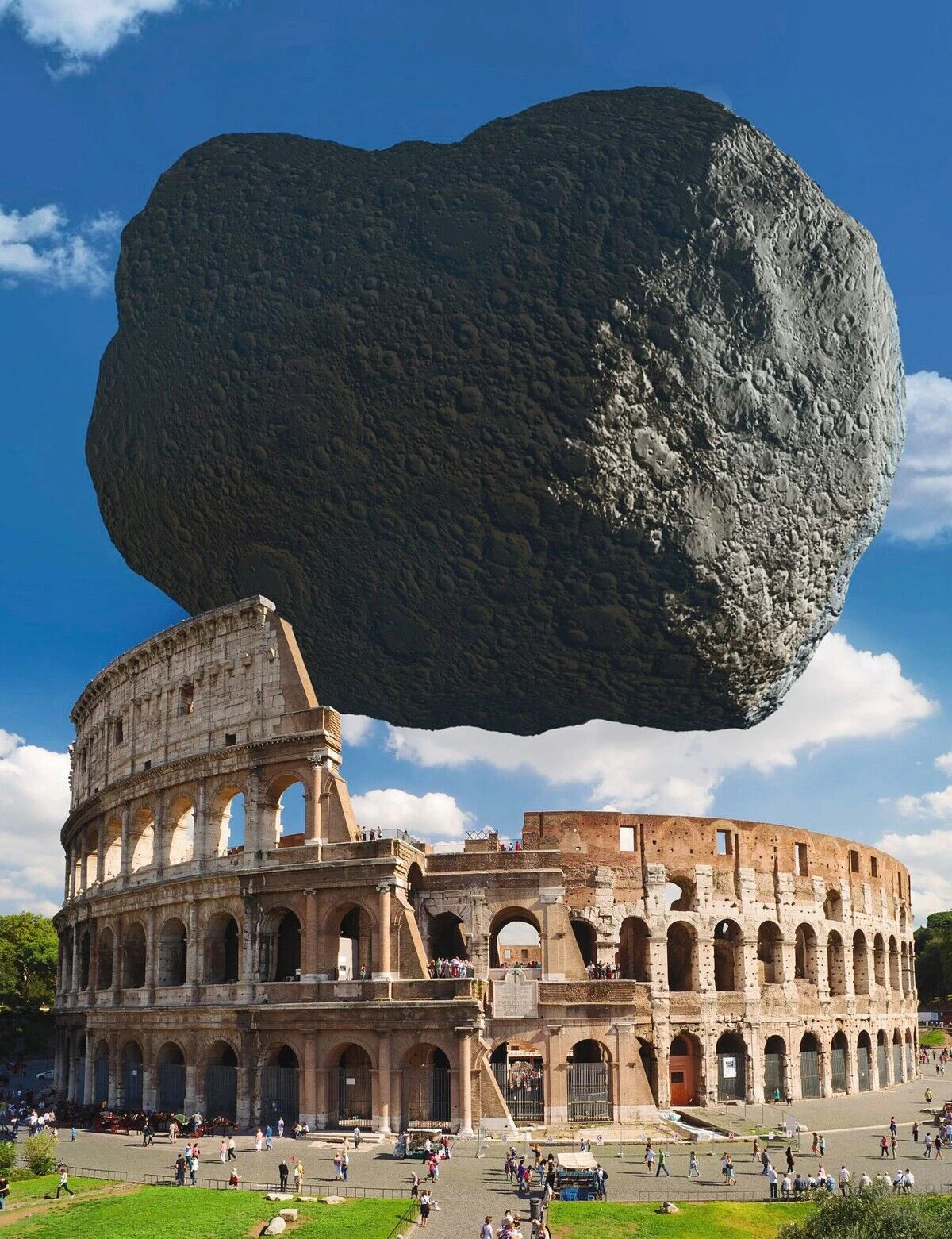
All good things don’t come from above. Earth orbit cruisers – planetoids and comet nuclei – have repeatedly maltreated our planet. The impact at the end of the Cretaceous period was the last such global catastrophe, occurring on average about once every 100 million years. There used to be even bigger collisions. The two billion year old Vredefort structure in South Africa, which was once up to 250 kilometers in size, dates back to a celestial body measuring perhaps 20 to 25 kilometers. Before that, even larger bombs fell on Earth. At least 16 clues have been identified in ancient rocks, including a 3.26 billion-year-old event in South Africa that measured 40 to 60 kilometers. And 4.5 billion years ago, a Mars-sized primordial planet collided with the proto-Earth, and the moon was formed from their shared debris that was blown into space.
Even in geologically more recent times, the Earth has repeatedly been a target for impacts – with devastating consequences for the affected and affected region. In southern Germany, for example, the 14.8 million year old Nördlinger Ries and Steinheimer Basin bear witness to this. And even the explosion of a torn meteorite two or three dozen meters in diameter can destroy an entire city. The Tunguska event of June 30, 1908 in remote Siberia is evidence of such destructive power. Statistically, such detonations occur about every 100 years – fortunately usually over an ocean or uninhabited area.
Earth orbit cruiser in sight
Until now, humanity has been defenseless. But that is changing now. On the one hand, many potential dangers can only be detected thanks to astronomical observations. On the other hand, threatening Earth orbit cruisers could be diverted from their course if necessary – assuming there is enough lead time, which would be the case in most emergencies: often several decades. Even tiny path deviations using targeted collisions or explosions or – more ambitiously – using laser beams, flanged solar sails or rocket motors would be sufficient and, if necessary, possible with conventional technology, at least for smaller objects.
Since the 1980s, astronomers have been using increasingly improved systematics and sensitivity to specifically search for NEOs (Near-Earth Objects), i.e. planetoids and comets whose orbits around the sun come close to Earth’s orbit or overlap with it. In the last decade, thanks to efficient sky surveys, around 27,000 specimens have been tracked down and well recorded – over half of all those now known. (The NEO coordination center of the European Space Agency ESA currently records over 42,500 objects, of which 124 are comets: https://neo.ssa.esa.int).