

The sun’s outer atmosphere, the corona, is both beautiful and dramatic. Because in it, huge arcs of hot plasma bulge above the sun’s surface, the solar wind is created and huge eruptions throw plasma and high-energy radiation far into space.
Hidden structure
The defining force behind these spectacular phenomena is the solar magnetic field, whose field lines extend in complex patterns far into the solar corona. “A direct and reliable characterization of the coronal magnetic field is crucial for predicting space weather,” explain Alin Razvan Paraschiv from the National Solar Observatory in Colorado and his colleagues.
But so far there has been a gap right there: Astronomers can observe the solar magnetic fields on the sun’s surface and the field lines at the edge of the sun seen from the side. However, how the magnetic fields in the corona are structured in three dimensions could previously only be estimated using models. Paraschiv and his team compare this to trying to predict the weather using only ground weather data, without knowing what is happening in the atmosphere above.
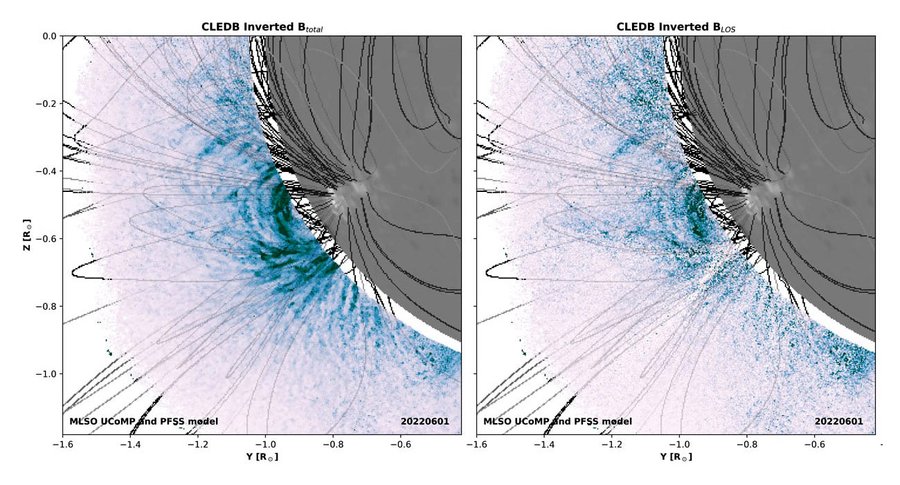
The new method also makes visible for the first time the magnetic field lines in the sun’s corona that point towards or away from us. Overall view on the left, only the field lines in our line of sight on the right. — © NSF/NSO/AURA
With polarization and Alfvén waves
Now the astronomers around Paraschiv have succeeded for the first time in closing this gap in solar observation. On the one hand, their method is based on recent observations of certain wave phenomena in the solar corona. “They provide new insights into the frequency spectrum, energy transport and the possible origins of Alfvén waves,” explain the researchers. They developed an analysis method that combines this data with information from the polarization of certain spectral lines of the sun.
The newly developed IQUD inversion makes it possible to use this combination to reconstruct the magnetic field structures that point towards or away from us and that cannot be directly measured using common methods.
First all-round view of coronal field lines
“For the first time, we can make the Sun’s hidden magnetic structure visible in three dimensions – not by developing an instrument, but by decoding the light and waves of the solar corona,” says Paraschiv. In a first test, astronomers used observation data from the Mauna Loa Solar Observatory to reconstruct the structure and movement of magnetic field lines for solar observations in October 2016 and June 2022.
These mappings confirmed that the magnetic field lines above sunspots and other active zones of the Sun form complex, twisted structures in the corona. In these regions, the astronomers were able to reconstruct the coronal magnetic field up to a distance of around half the sun’s radius from the sun’s surface – significantly further than previously possible.
Important advance for solar research and space weather forecasting
“Using this method, we were able to determine the strength and three-dimensional orientation of the coronal magnetic field for the first time,” says co-author Daniela Lacatus from the National Center for Atmospheric Research (NCAR) in Colorado. The first test marks the transition from a method that has so far only been tested theoretically to a process that can also be used in practice. “This helps solve a problem that has complicated the measurement of the coronal magnetic field for decades,” says Lacatus.
The temporal resolution of the new 3D mapping method is still limited to around one hour, so it cannot yet capture very rapid changes. The precision of the three-dimensional imaging of the field lines also needs to be further optimized. “We would therefore like to encourage as many researchers as possible to try out the method themselves,” says Lacatus. “In this way we can find out together where adjustments and improvements are still necessary.”
Nevertheless, the team sees their method as an important advance for solar research: “The ability to measure a larger part of this hidden architecture could fundamentally change our understanding of the Sun – a star whose magnetic activity influences phenomena from the solar wind to the auroras,” says Paraschiv.
Source: Alin Razvan Paraschiv (National Solar Observatory, Boulder, Colorado) et al., The Astrophysical Journal Letters, 2026; doi: 10.3847/2041-8213