
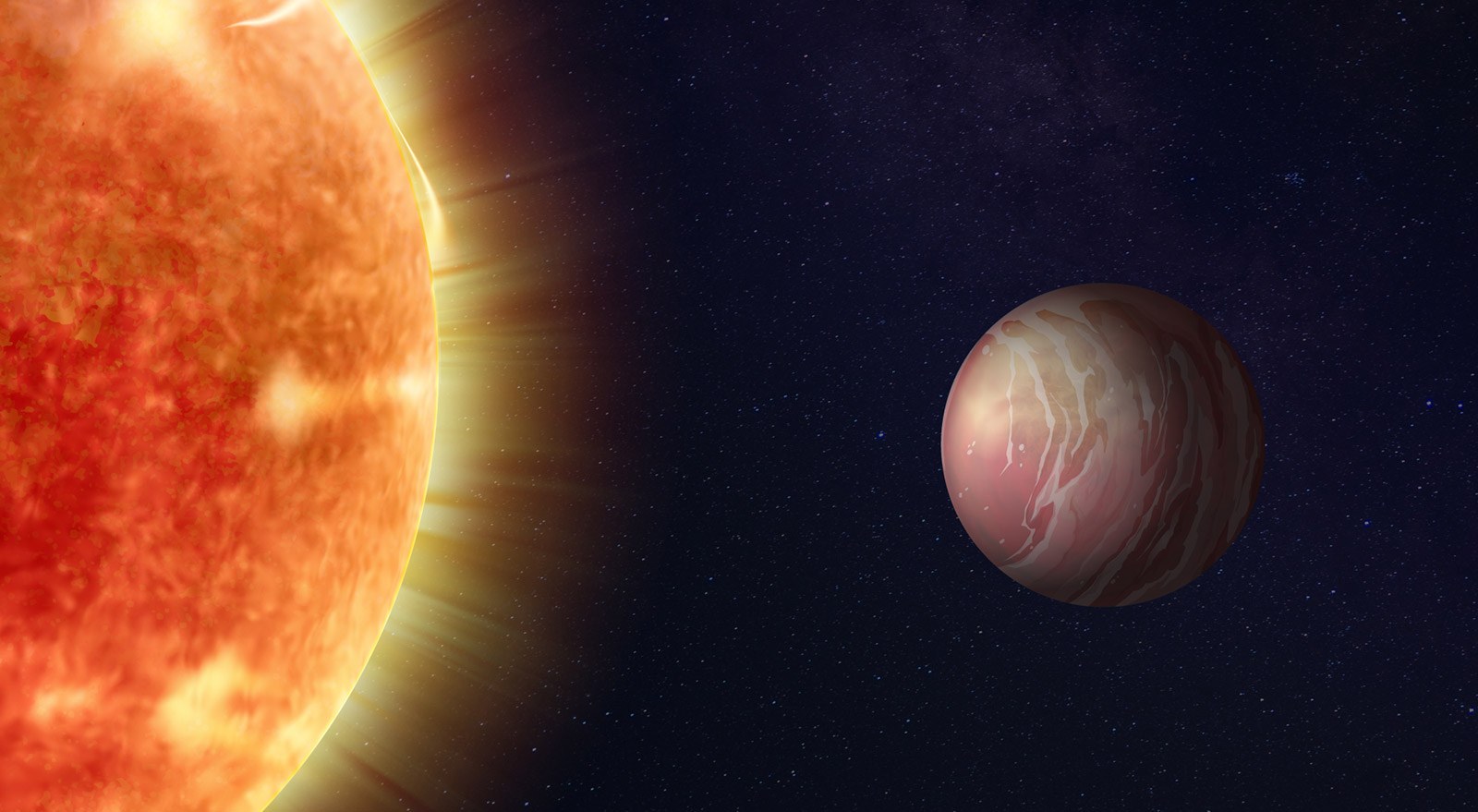
Rocky planets orbiting closely around their stars are not only exposed to extreme heat, the intense radiation from the star also destroys their atmosphere over time – the gases are photochemically decomposed and ripped out into space. As a result, such exoplanets with ultra-short orbital periods are usually hot, barren, rocky worlds without a gas envelope. Some even heat up so much that their surface is covered by a lava ocean.
“Current models suggest that super-Earths exposed to strong radiation can no longer have gas envelopes,” explain Samuel Boucher from the University of Montreal and his colleagues. Data from the James Webb Space Telescope seemed to confirm this so far. The innermost planets of the nearby dwarf star TRAPPIST-1 show no trace of an atmosphere.
A lava planet with unusual properties
All the more surprising is an exoplanet that seems to contradict this rule. The super-Earth TOI-561 b orbits a sun-like star around 280 light-years away at an extremely short distance. This rocky planet with a radius 1.4 times the Earth’s radius takes less than half a day to complete one orbit. Its surface, which is probably covered by glowing lava, is correspondingly hot. Measurements on the day side showed almost 2000 degrees.
The strange thing, however, is that the dayside of this lava planet, which orbits in a fixed rotation, is significantly cooler than it should be given the nearby star. A planet without a shell and covered in dark lava would have to heat up significantly more. At the same time, the density of this lava planet is lower than expected for a rocky planet without an atmosphere: at around 4.3 grams per cubic centimeter, it is below the density of our Earth.
What is behind these anomalies? In search of an explanation, Boucher and his team have now used the James Webb Telescope to focus on TOI-561 b over a longer period of time for the first time. They followed almost four complete orbits of the planet around its ten-billion-year-old star and were therefore able to obtain data on the night side of the lava planet for the first time.
Redistribution of heat and surprisingly high albedo
The measurements revealed something surprising: the night side of TOI-561 b is also significantly cooler than it should be, at around 800 degrees. According to the data, the lava planet must reflect around two-thirds of the radiation arriving from its star instead of absorbing it. According to measurements, its albedo is around 60 percent. This is extremely unusual because the dark lava surfaces of such planets normally reflect little light, as Boucher and his colleagues explain.
But how can the low temperature and high albedo of the lava planet be explained? According to astronomers, there is only one possible explanation for this: TOI-561 b must have an atmosphere. It could transfer some of the dayside heat to the nightside and at the same time shield the planet from radiation. “This discovery challenges previous theories. We would have expected that a highly irradiated rocky planet like TOI-561 b lost its atmosphere billions of years ago,” says co-author Anjali Piette from the University of Birmingham. But everything suggests that the lava planet still has a dense gas shell.
To find the reason for TOI-561 b’s high albedo, astronomers used simulations to test different atmospheric compositions. The focus was on the behavior of the gases rising from the lava ocean.
Mineral clouds as sun protection
The simulations showed that the lava planet’s high albedo could be due to a layer of reflective clouds. “According to our model, various types of clouds could form on the dayside, including clouds made of magnesium silicate and silicon dioxide,” report the astronomers. High cloud cover made of silicon dioxide would also be possible on the night side. Such mineral clouds scatter radiation and can therefore act like sun protection.
Despite its extreme proximity to its star, the lava planet TOI-561 b has a dense atmosphere with mineral clouds – a combination previously thought to be impossible for a rocky planet. “This poses a puzzle to our ideas about planetary evolution,” write Boucher and his team. “According to current theories, such highly irradiated super-Earths should not have any volatile shells – which contradicts our result.”
Contradiction with theory cannot yet be explained
So far, astronomers don’t know why this hot rocky planet was able to escape the loss of its atmosphere. Theoretically, however, there are several possible explanations. Accordingly, the planet could have formed as a gas-rich sub-Neptune and retained at least part of its originally thicker gas shell, as the team explains. It is also conceivable that lava oceans like that of TOI-561 b release more gases than expected and that such secondary atmospheres are more stable than models predict.
Another possibility: “TOI-561 b could have originally formed further out and only recently entered its current orbit,” explain Boucher and his colleagues. As a result, the super-Earth could have escaped the particularly strong X-rays and UV radiation in the early days of its star. “Why TOI561 b has an atmosphere could also be due to a combination of several of these factors,” emphasize the astronomers.
This means that the mystery surrounding the lava planet TOI-561 b remains unsolved for the time being. Boucher and his colleagues therefore next want to examine the exoplanet in the mid-infrared using the James Webb telescope. “Observations of the planet at longer wavelengths could give us new insights and help explain how such a hot planet was able to retain its atmosphere for billions of years,” says Boucher’s colleague Lisa Dang.
Source: Samuel Boucher (University of Montreal) et al., The Astronomical Journal, 2026; doi: 10.3847/1538-3881/ae9763