
©NASA
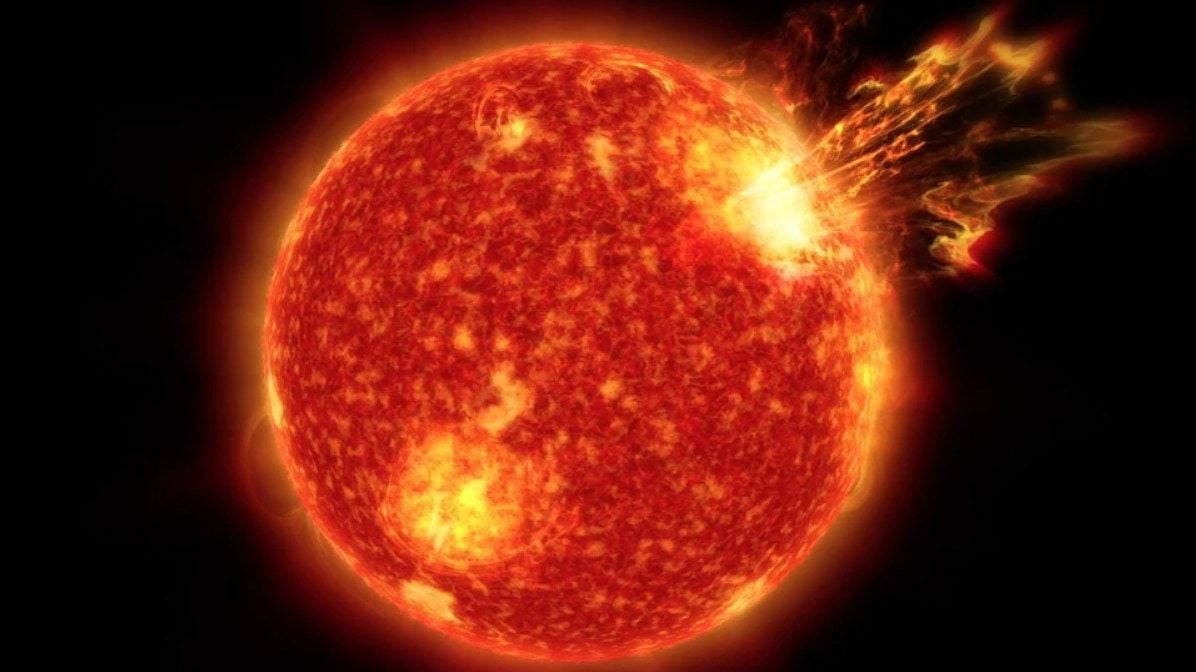
On the night of Monday July 18 to Tuesday July 19, a major solar storm hit Earth. An impressive phenomenon which is not without consequence on our telecommunications networks and our health.
This week the Earth was hit by a solar flare. This phenomenon at the origin of the aurora borealis is not new, but can disrupt telecommunication networks and have consequences for our health. Events that could intensify in the years to come, reaching a peak in the summer of 2025.
A magnetic storm that is not without consequences
It was on Twitter that Dr. Tamitha Skov, physicist in space weather, warned about the formation of a solar flare which occurs following the accumulation of energy on the surface of the star of our solar system. These eruptions project plasma at very high speed in space, until they can reach the upper atmosphere of the Earth, thus disturbing its electromagnetic field. The space meteorologist, who works in particular with NASA, specifies:
“A serpent-shaped filament was launched as a large solar storm while in the Earth strike zone. […] Strong aurora borealis are possible with this storm, up to mid-latitudes. »
Dr. Tamitha Skov also specifies that “this solar flare could cause temporary disturbances for users of radios and GPS”. Some satellites can also deviate from their orbit, but their trajectories can be adjusted by ground control operators.
Regarding our health, these emissions of ionizing particles (which pass through X-rays and UV rays) are fortunately largely blocked by the Earth’s atmosphere. A chance that the members of the international space station do not have who can suffer the full force of radiation from charged particles, which are very dangerous for health. In order to protect themselves against this, cosmonauts and astronauts take shelter in areas of the ISS specially designed for this purpose.
Intensifying solar flares
Although we do not yet know everything about this phenomenon, scientists have found that the Sun experiences a “peak of activity” every 11 years or so which results in an increase in the number of solar flares. This activity is at the origin of the superb aurora borealis that can be observed beyond the two polar circles.
The sun having entered a new cycle of activity for a few years, the peak should be reached in the summer of 2025. This is not the first time that the networks have been disturbed by a solar flare, but we expect then to more intense events that could significantly disrupt terrestrial communication networks.
One thinks in particular of the network of submarine cables of the Internet whose repeaters are particularly sensitive to this kind of phenomenon.
lemon squeezer