
© NanoLetters 2022
Scientists unveil a robot-fish capable of swallowing microplastics to clean up polluted waters. This tiny robot can also repair itself when damaged.
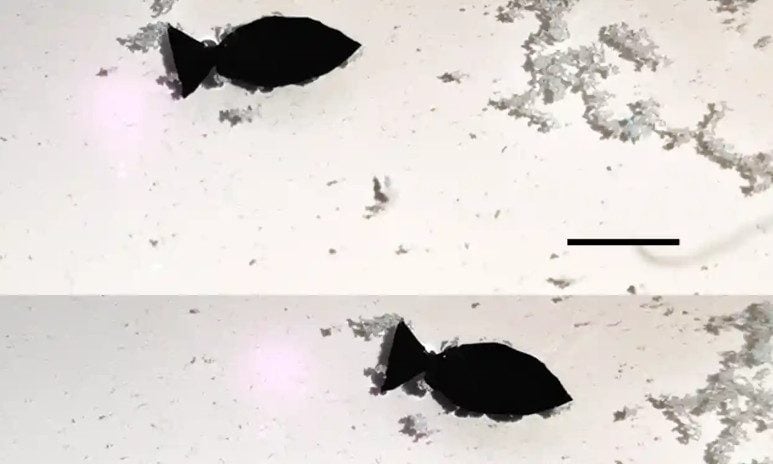
Aware of the scourge of microplastics in the seas, oceans and rivers, Chinese scientists have developed a small robot-fish capable of swimming and clinging to the polluting particles they encounter.
Mini-robots to clean the oceans of microplastics
Microplastics are tiny particles that break off from larger plastic objects. These are often everyday objects that are found in the form of waste in our oceans: water bottles, tires, synthetic clothing, etc. They represent a major environmental problem to me as it is very difficult to collect them. Microplastics are not found only in the oceans. Indeed, traces are also present in our food and drinking water.
This invention, attributed to a team of researchers at the Polymer Research Institute of China’s Sichuan University, is a first. In addition to being able to scavenge microplastics, this tiny robot fish can writhe if mishandled in the line of duty.
The robot, created from materials inspired by elements found in the sea such as the mother-of-pearl of clams, is only 1.3 cm long, but can move at almost 3 cm per second. As you can see in the video, he is completely black and moves thanks to a light stimulation emitted by a laser at the level of his tail.
As it moves forward, it absorbs bits of microplastics floating nearby. Indeed, heavy metals, antibiotics and other organic dyes contained in microplastics have strong chemical bonds and electrostatic interactions with the materials that make up the fish. Thus, they cling to the surface of the fish and can then be removed from the water. Researchers can then further analyze the composition and toxicity of microplastics.
A self-healing robot fish
Yuyan Wang, who worked on the project, specializes in developing self-healing materials. Thus, the robot fish was developed to have regenerative abilities. Even if he takes damage or cuts, he is able to regain 89% of his waste absorption skill. A regeneration ability similar to that of this skin intended for humanoid robots.
However, this robot fish is only a first step. Today, it is only designed to work on the surface of the water. Researchers will soon focus on developing a robot designed specifically to go deeper underwater. Yuyan Wang and his team do not intend to stop their research in such a good way and see a lot of potential in this type of device:
“I think nanotechnology holds great promise for adsorption of traces, collection and detection of pollutants, which improves the efficiency of interventions while reducing operating costs. »
Reuters