

© Pexels
Cryptocurrencies will continue to democratize in the years to come. According to a new study, one billion people will be using digital currencies, like Bitcoin, by 2030. Video games and NFTs are expected to drive industry adoption.
The Boston Consulting Group (BCG), an American strategy consulting firm, has just published a study devoted to the adoption of cryptocurrencies. After analyzing a wealth of data, provided in particular by banks or exchange platforms, the firm believes that the use of digital currencies will continue to spread.
“ We believe the crypto economy is here to stay,” BCG states in its report.
The study predicts one billion cryptocurrency users by 2030. Coinbase, one of the largest platforms for crypto-assets, agrees. During’a conference organized last May, Brian Armstrong, the company’s CEO, has indeed estimated that the adoption of cryptocurrencies will inevitably explode in the years to come. According data collected by Statistathe user base has already “grown by almost 190% between 2018 and 2020”.
Currently, the crypto market has approximately 200 million users worldwide. In the United States, 21% of the population has already invested in cryptocurrencies, reveals a study by NBC News. The enthusiasm is less in France. According to a study by the Association for the Development of Digital Assets (Adan) and KPMG, 8% of French people own digital currencies, such as Bitcoin or Ether, for example. Above all, 30% of individuals plan to make the leap. More broadly, 60% of Europeans are confident in the future of cryptocurrencies, indicates a Bitflyer platform survey conducted in 2020.
The Genesis of Cryptocurrency Adoption
In its report, BCG claims that the adoption of digital currencies is still in its infancy. Moreover, the holding rate of cryptocurrencies is still low compared to traditional assets, such as shares on the stock market. Only 0.3% of the capital of individuals is held in cryptocurrency, against 25% for stocks, notes the study. Experts point out that this “relatively low penetration” rate suggests a good margin for growth. BCG compares the adoption of crypto-assets to the explosion in internet use in the 1990s.
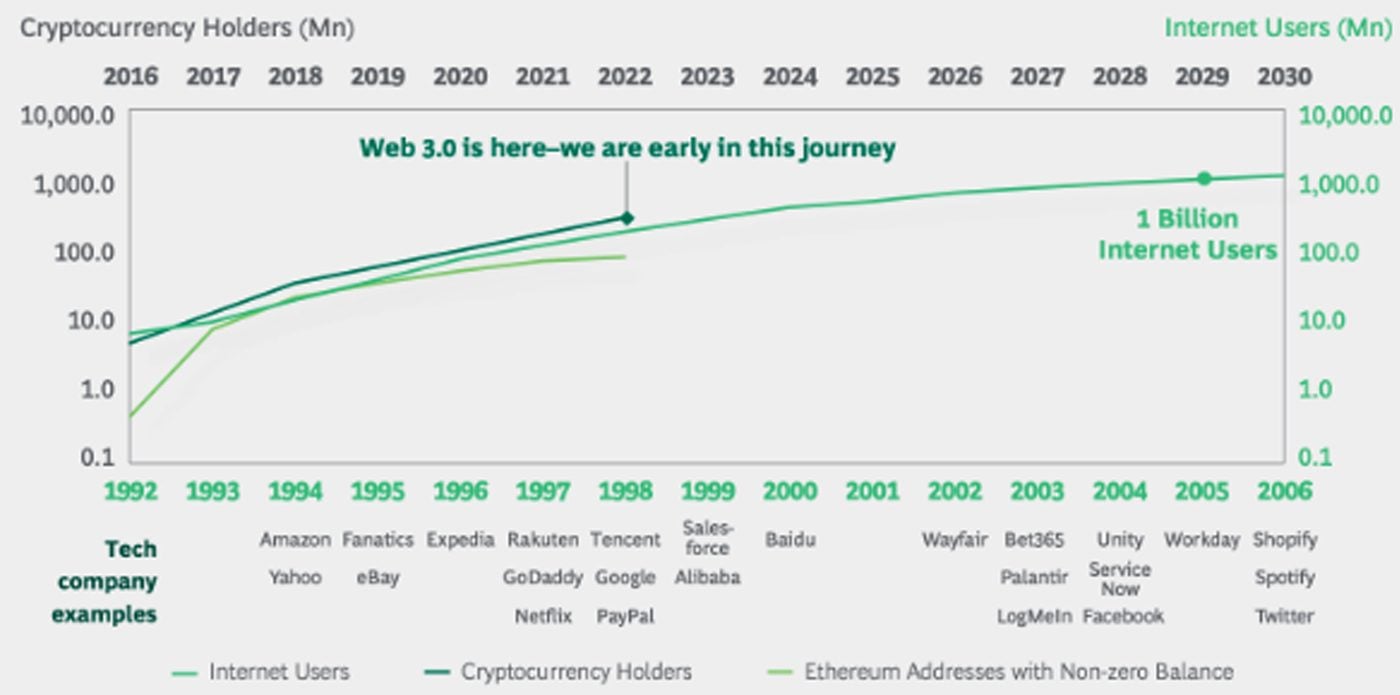
This report comes as the entire crypto ecosystem is in the red. The fall of the Luna project, the bankruptcy of the Celsius platform and the 3AC investment fund has deeply marked investors. In this uncertain context, the price of Bitcoin collapsed. The queen of cryptocurrencies is now trading around $23,000, a far cry from $69,000 in November 2021. Nevertheless, the recent market crash will not dent the adoption of digital assets, the study points out.
Read also: No, cryptocurrencies are not massively used by criminals
Web3 and emerging countries
To explain the enthusiasm aroused by the sector, the BCG highlights the multiplication of uses with the rise of Web3, this decentralized version of the Internet. The development of non-fungible tokens (NFT), crypto video games (PlayToEarn, MoveToEarn) and decentralized finance (DeFi) have boosted the interest of Internet users. These trends have made it possible to attract new users, initially not very interested in finance or cryptocurrencies.
The study also highlights the growing interest of emerging countries, whose banking and financial infrastructure is insufficient. In Nigeria, where national currency inflation is at record highs, 42% of the population hold cryptocurrencies, says Statistics. More than $400 million in annual transactions are recorded in the country.
Same story in countries like Argentina, Mexico, India, Thailand or even Vietnam. In these nations where the banking rate is low, cryptocurrency provides access to services generally offered by banks. By using crypto-currencies, some populations can send funds abroad without having to pay exorbitant fees. It is also partly to prevent its inhabitants from depending on services like MoneyGram and Western Union that El Salvador adopted Bitcoin as its second legal tender in 2021. 23% of the country’s GDP is in fact based on the funds received since the stranger.
For the time being, retail investors “remain the biggest holders of cryptocurrencies”. However, institutional investors, such as banks, investment or investment funds, are increasingly turning to these alternative assets. The BCG predicts that a plethora of pension funds will also launch, in particular by investing in firms of the ecosystem or by betting on traded funds which follow the evolution of cryptocurrencies.
Key players in the financial industry, such as PayPal, Visa, Mastercard and Stripe, should also help boost the adoption of digital currencies. Since the end of 2020, PayPal has also made it possible to exchange cryptocurrencies. For their part, Visa and Mastercard offer holders to pay with their assets through their card. Finally, it will be remembered that Stripe, the payment processor for Internet businesses, makes life easier for merchants who wish to accept cryptocurrencies.
Github