
In a Lannoo encyclopedia for children, I discovered that the planets Mercury, Venus, Mars, Jupiter and Saturn were already known in prehistoric times and could be seen with the naked eye.
If they were already discovered in prehistoric times, I assume that this was in the time of the first humans and that they noted / left / signed this somewhere.
Were they once so close to our earth that we could indeed see them all with the naked eye?
Answer
Dear Margot,
The distance between the planets has not changed in the time that man has existed. Moon and sun are not planets first. The former is a natural satellite of the Earth (ie orbits around the Earth), the latter is a star and, moreover, the center of mass of our solar system (ie all planets are in orbit around the Sun, including Earth) .
All the planets you mention (Mercury, Venus, Mars, Jupiter and Saturn) are still visible to the naked eye. They are of course much less bright than the moon and the sun, but if you know where and when to look they are perfectly visible (when the sun is down). Surely you have already seen Venus and Mars without knowing it. These are about as bright as the brightest stars.
Of course you can’t see any details of the surface with the naked eye, but you can see, for example, that Mars has a red color. The reason the planets were discovered in ancient times is that their position relative to the fixed stars changes over the course of the year. Copernicus taught us that the sun is the center of our solar system, and the earth is just an ordinary planet that orbits there like the others.
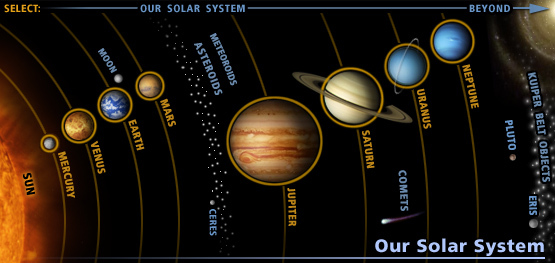
Note further that “as close as now the distance moon-earth-sun” does not make much sense in this context. Some planets are closer than the sun at certain times. The image on the right gives an overview of our solar system (the distances are of course not to scale).
Answered by
MSc Nicki Mennekens
astrophysics

Avenue de la Plein 2 1050 Ixelles
http://www.vub.ac.be/
.