
I made a copper water feature that I want to float on the water. The weight of the ornament is 4800 grams and I want to place it on two airtight copper tubes of 80 mm round. How long should these two, to be placed side by side, be tubes to be able to carry the whole thing? The tubes (around 80 mm) weigh 4870 grams per meter.
Answer
hi louis,
I would first look at the buoyancy per running meter of those tubes, because actually I don’t expect much good from them.
By ’80mm round’ I assume you mean the circumference.
A small calculation to know the volume V per running meter:
We know that the circumference O = 80 mm.
The formula for circumference is: O = 2*pi*R,
from which we find that R = 12.7 mm.
From this we can calculate the area S:
S = R*R*pi = 509 mm 2 .
The volume V per running meter is then 509 mm2 * 1 m = 5.09 E-4 m3.
The buoyant force is equal to the weight of the displaced water (this is Archimedes’ law).
At full immersion, the volume per running meter is V = 5.09 E-4 m3, and the density of water is 1000 kg/m3.
So the weight of the displaced water is
5.09 E-4 m3 * 1000 kg/m3 = 509 g.
There is therefore 509 g of upward ‘force’ per running meter of pipe.
However, I read that the tube itself weighs almost 5 kg per meter. Thus, the tube is unable to float its own weight. The tube alone will sink. Floating the ornament with these copper tubes is out of the question.
Copper is a very heavy metal. Of course that doesn’t help in this story. For example, you could use a lighter material (plastic, balloon …), or a thinner wall thickness of the tubes.
As the tube gets thicker, the weight increases proportionally to the circumference, while the area (and thus volume) increases squared with the circumference. If this last sentence is hard to understand, I can put it simpler: buoyancy increases as the tube gets thicker.
So there is going to be a thicker tube somewhere that it will work for. In the worst case scenario, you’ll end up with a whole ‘ship’ under your ornament, and that’s definitely going to float!
I will make a quick attempt to estimate this tube.
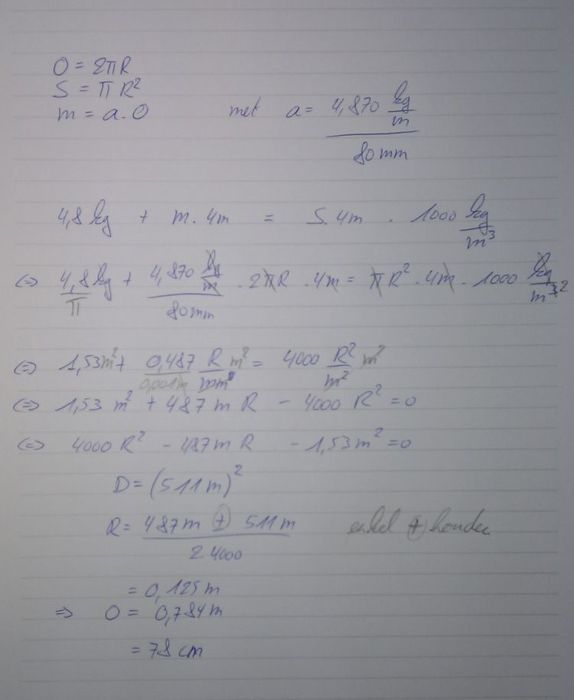
I assume for this that a pipe that has a double circumference also has a double weight per running meter. This is approximately correct if the wall thickness is the same. I also assume that 4 meters of pipe is used.
I think you need a tube of at least 78 cm round to keep the whole thing just afloat. The calculation can be found on the attached sheet (see link on the right).

Answered by
dr. ir. Nico Smets
Engineering Sciences

Avenue de la Plein 2 1050 Ixelles
http://www.vub.ac.be/
.