
I am working on a paper about Archimedes, which also discusses the screw that is put to his name, used for transporting things like water, sand, mud, etc.
In several places I get to read that the fact that the screw is arranged diagonally, and therefore has a slope, is important for its operation. In other places nothing is said about this at all.
I don’t know if it falls under the genre of questions that can be answered here, but I wonder if it is indeed necessary to make the screw and slope, and if so, why?
Thanks in advance!
Answer
Dear Wout,
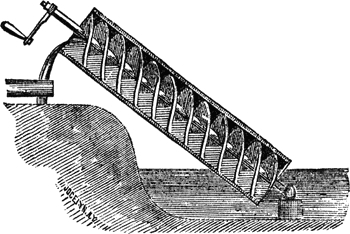
The accompanying drawing shows how in Antiquity the Archimedes screw was used to transfer water from a canal to a higher field. When the shaft is turned, the water flows from the top of the oblique tube.
The oblique position ensures that the water is not only lifted up, but also moved sideways. In fact, the screw would work just as well horizontally and move eg grain or other grains easily.
The screw can also work vertically, only then there must be a spout at the top through which the pumped water can drain. I myself have seen such pumps at work in French villages (Auvergne) where they stood on the edge of the street and water from a subterranean reservoir, fed by a spring, flowed from a spout by vigorous turning of a small wheel, for the benefit of the inhabitants. This pump had the advantage that it was always empty at rest and was therefore insensitive to frost.
The slope therefore only has to do with the possible need to not only pump the water or the granules higher, but also to move it sideways.
Answered by
Prof. dr. French Cerulus
physics, especially classical theoretical mechanics, electromagnetism, quantum mechanics, history of physics .

Old Market 13 3000 Leuven
https://www.kuleuven.be/
.