
Answer
Dear Cornel,
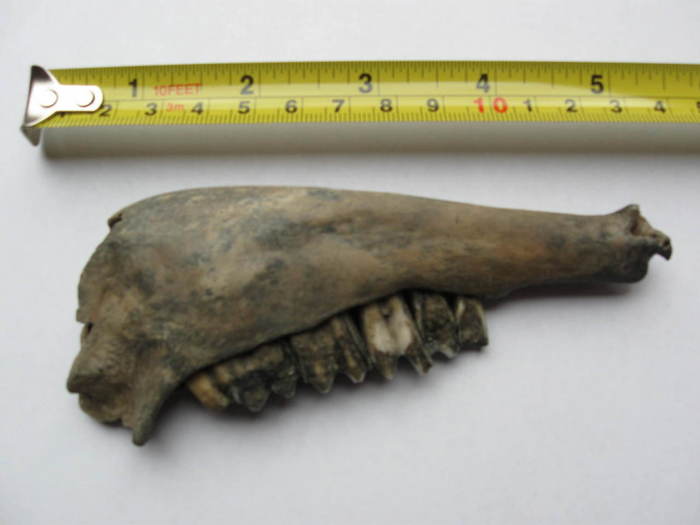
What you found is the lower jaw of a sheep or a goat. You actually have to turn the piece over, teeth facing up. Then you keep it right, just like with a living animal. A piece is broken off in the photo on the left. There the lower jaw is normally attached to the skull of the animal. The front teeth should normally be on the right, ie the incisors, but these have been lost over time.
It is impossible to tell whether the lower jaw comes from a sheep or a goat. After all, these animals have a skeleton that very much resembles each other. That is strange because alive sheep and goats look quite different. The explanation is that sheep and goats are close to each other in evolution.
The teeth also show that the lower jaw comes from an adult animal. After all, there are no longer milk teeth in the jaw, but the teeth of the permanent teeth. Sheep and goats change their teeth as they get bigger, just like us.
It is difficult to say what time your find came from, but the brown color indicates that it has been in the bottom for a while before it was washed off and ended up on the beach. Perhaps the jaw is several hundred years old after all.
Regards,
Anton Ervynck
Real Estate

Answered by
Dr Anton Ervynck
Ecological Archaeology: Study of Animal Remains from Archaeological Excavations

Koning Albert II-laan 19 box 5 B-1210 Brussels
https://www.onroerenderfgoed.be/
.