
An umbilical cord is attached to the placenta in the uterus on one side, but what is the other side attached to? To a blood vessel in the abdominal cavity? That would seem illogical since mother and baby do not always have the same blood type.
Asker: Martin, 40 years old
Answer
the umbilical cord
The umbilical cord is a reinforced structure of blood vessels that connects the child to the placenta.
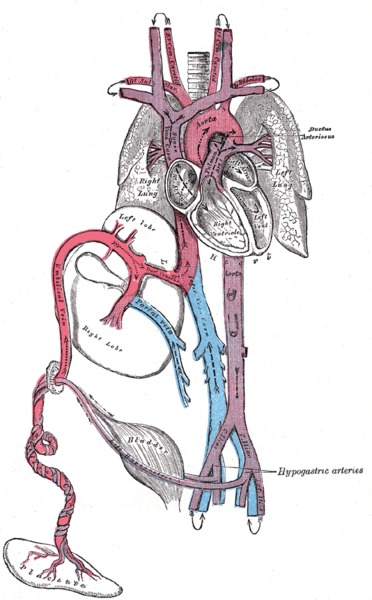
So, on the one hand, the blood vessels run to and from the placenta (the placenta) and on the other hand, the blood vessels run via the navel (thus via the abdomen) to the baby’s blood vessel system.
These umbilical cord vessels consist of two arteries (arteries) and one vein (vein). In the attached drawing you can see how those vessels in the baby connect to the rest of the vascular system. After birth, the connecting vessels close and that part of the blood circulation is closed.
Mother and child
The placenta is actually a part of the baby, not the mother. The blood can thus flow freely between the baby and the placenta. The exchange of substances between baby and mother takes place between the placenta and the uterus. But it is not the case that the blood flows from mother to the baby or vice versa.
The barrier in the placenta prevents the exchange of blood. The barrier is best compared to the barrier in the lungs. We do not exchange blood with the air, but we do release waste products into the air (CO2) and take oxygen (O2) on.
Similarly, the placenta exchanges nutrients, waste products and oxygen through an important barrier.
Some substances from the mother’s blood cannot pass through this barrier, while others can. This means that certain things from the mother’s blood are harmful to the baby and others are not. For example, alcohol, a number of medicines and a number of viruses pass through the barrier and can harm the baby.
Mother-child transfusion
Exceptionally, it happens that a blood vessel from the placenta grows directly into the uterus and the mother-child barrier is thus bypassed. In that case there is a small connection between the two blood vessel systems. In that case you can find fetal blood from the mother, which indeed causes problems in the event of incompatibility.
There are hypotheses that such a mother-child transfusion may be a cause of pregnancy itching. As for the child, it risks anemia because it loses blood to the mother. The child can develop life-threatening anemia (anaemia).
The severity of the situation depends on the compatibility of the blood and the size of the “leak” (the blood vessel connection between mother and child).
Answered by
Inge Habex

Free University of Brussels
Avenue de la Plein 2 1050 Ixelles
http://www.vub.ac.be/
Avenue de la Plein 2 1050 Ixelles
http://www.vub.ac.be/
.