
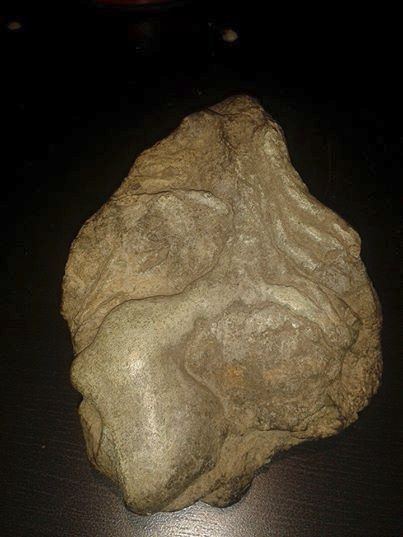
Dear, I have found an exceptional stone in the Belgian Ardennes that I am almost certain is solidified lava. The underside is black with air holes in it, the top is green-coppery and irregularly shaped. It almost looks like a bird fossil. But is this possible? I would very much like to know the history of this stone.
Answer
Dear Reinhard,
thanks for your question!
Rock samples that we find on the site, also called ‘handpieces’, usually have a heavily weathered exterior. This also seems to be the case with your find. In order to give a well-founded answer, it is best to saw the stone open or break it into several pieces with a hammer. After all, the core of a handpiece is usually better protected against water and wind… A more precise location could also help (village, city, GPS or Google Earth/maps coordinates, etc.).
However, based on the geological background of the Belgian Ardennes, we can already rule out some possibilities: the most recent – and perhaps also only – known volcanic rocks in Belgium can be found in the so-called ‘porphyry quarries’ of Quenast and Lessines, where 17th century stone from an old volcanic pipe is quarried, for example for use as the cobblestones so familiar to us. There must once have been a volcano on top of that pipe, but it has been completely eroded away by water and wind, leaving only its ‘root’. Solidified lava from a lava flow therefore does not occur geologically at the surface in the Belgian Ardennes. For that you quickly have to go to the Eiffel region in Germany. Your handpiece looks very weathered (see the yellow color), and could be a sandstone for example. In addition, you should also ask yourself whether you have found the handpiece ‘in situ’, ie at its original place of occurrence, whether there is a chance that it was brought there by humans. Did you find this piece of rock in connection with a large outcrop of the same rock, or isolated in a field?
You see, more questions than answers right now. With a view of an unweathered, fresh part of this rock, and an idea of the location of the find, I could get you on your way a lot better.
Good luck, and don’t hesitate to contact us if your curiosity isn’t answered enough!
Regards,
Sam Poppe (sam.poppe@vub.ac.be)
Answered by
Sam Poppe
Geology – Volcanology

Avenue de la Plein 2 1050 Ixelles
http://www.vub.ac.be/
.