
Are we going to buy Chinese? Or other newcomers from America, such as Lucid and Rivian? I’m getting the question more and more and it’s getting harder and harder to say anything about it. Perhaps also because it is not the complete question. It should now read: will people buy electric cars, if they can buy them again soon without endless delivery times, but also without tax benefits? be able to purchase?
With your Dutch common sense you dare to take a single gamble. For a Lucid Air of 220,000 euros, I don’t see it going fast. It is much too big for Dutch roads and for half the money you have a perfect electric BMW or Mercedes from a well-functioning dealer organization. The prospects for newcomers to the EV market are not necessarily favorable in the lower segments either. Addition benefits are history, subsidies are being phased out, energy rates at the charging station are rising. Most EVs were already well above the budget of ordinary citizens. Especially now that manufacturers have scrapped loafers due to chip shortages and temporarily only offer their most expensive models with the highest margins. Meanwhile, inflation continues to rage and the lunatic named Putin hangs like a sword of Damocles over the world. As an honorable family father with a hysterical utility bill, precious offspring and uncertain geopolitical prospects, the last thing I would do right now is buy a new car, let alone an electric one.
In Germany, a research agency asked more than a thousand Germans what they think of Chinese cars. For the Chinese, the result was not too bad. More than 45% of those surveyed believe that Chinese manufacturers will take root in their country. Then you can assume some willingness to consider a Chinese product. On the other hand, what good is that in a country where the market share of electric cars is still small? In 2021, 356,000 electric cars were sold in Germany. That was 85% more than in 2020, but of a total of 2.62 million passenger cars, it is still relatively small, and that with purchase subsidies that ours pale in comparison. The plug-ins, which are also subsidized there, also rose just as fast in Germany, a worrying indication for customer confidence in fully electric. A large part of the customers is holding back. And who anyway all the way goes take a Tesla, thanks to the factory in Brandenburg now also almost a German product. The Model 3 runs excellently and in October the Model Y was the best-selling passenger car in Germany. But in a market where, just like in our case, market forces have been disrupted by the government to such an extent that you cannot actually draw any binding conclusions from it.
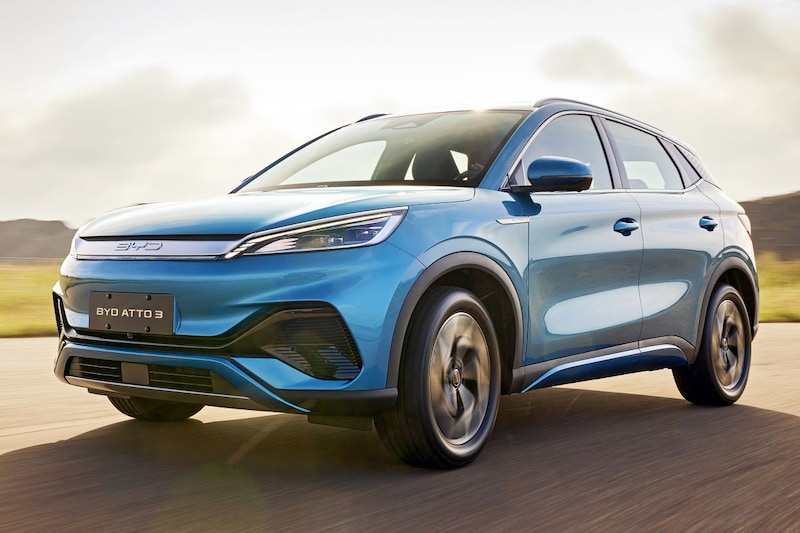
Last week I drove the BYD Atto 3. I was quite impressed by that car. As an intended competitor of the Volkswagen ID3, it doesn’t cut a bad figure. Good equipment, decent range, a fun crazy interior for enthusiasts, decent price. What does the customer turn to, when does he go for the axe? For newcomers only for a bargain price, I’m afraid. The size of the financial gap with the establishment must be has become clear since the short-lived sales success of the MG ZS; with an advantage of 10 grand you lure the Dutch bargain hunter to the showrooms. The gap between BYD and Volkswagen, depending on how you look and calculate between three and five thousand euros, seems too small from this point of view, although the purchase subsidy for individuals with this budget may be the deciding factor. Even in its most expensive Design version, the Atto 3 remains just below the upper limit of 45,000 euros for purchase subsidies. With the 44,000 euro costing, comparable ID3 58 kWh you go over it with a set of larger rims plus the heat pump that is standard at BYD, and that should have been at VW. So picky.
I could imagine that, encouraged by the favorable reviews, as a relatively indifferent individual I would take the BYD, if only because that car is faster at the door than the ID.3. But the drive will be less strong generically than with new entrants with one-off features like the hyper-efficient Teslas with their super-fast charging networks. And also to the credit of a potentially comparable USP like Nio’s battery swap stations, there is an upper limit to what a new brand can afford price-wise. I don’t think many Dutch customers will pay 1,300 to 1,500 per month for a Nio ET7 that has yet to prove itself in terms of reliability and service after an impressive first impression. Perhaps in the high price range the bottom line remains that for the same money you have a packed i4, an EQE or for much less an equally quiet, just as fast, equally advanced Tesla Model 3 or Y. In my opinion, the only war the Chinese can win in Europe is a price war, unless they literally screw everything up in Taiwan with another prestige battle.
At least: in the short term. Because at the same time it is awe-inspiring to see how quickly they are developing and are already building cars that are in no way inferior to the European standard in the premium segment and the Golf class. In that respect, ET7 and the Atto 3 have opened my eyes. They are disturbingly mature cars for the European and Asian establishment. The Chinese learning curve seems even steeper than the Korean one, and one thing the Chinese have already learned from Tesla; in principle, a product with actual added value has golden opportunities, even without a history.
– Thanks for information from Autoweek.nl