
Year icons
Now that every self-respecting car brand gradually has SUVs and EVs (or a combination thereof) in its portfolio, there seems to be hardly any room for sedans, coupes or convertibles, whether or not equipped with oversized engines. This list shows how it once was: illustrious models in all shapes and sizes, with the agreement that they will celebrate an anniversary in 2023. Earlier we already looked at the ‘younger’ party animals. In this part the jubilarians of 50 years and older.
Austin Allegro – 50 years

In 2008, it was named the worst British car of all time by The Independent, beating notorious models such as Morris Marina, Rover SD1 and Triumph Stag. The Austin Allegro wasn’t good either. If you accelerated too quickly, the rear window could pop out of the frame. If you braked too hard, you could be overtaken by a rear wheel, because wheel bearings were mounted the wrong way round. It must be because a lot was expected of the Allegro – as the successor to the successful Glider series. It was not the technology, because all the ingredients of the beloved Mini – a transverse engine, front-wheel drive, wheels on the corners and hydragas suspension – were present. And in fact, the Allegro built on its successful predecessor, the Glider. Due to cost-cutting, engines and the heating system from larger models were used, rather inflating Harris Mann’s original design. It earned the Allegro unflattering nicknames like ‘flying pig’, ‘mussel’ and ‘snail’, as well as the corruption into All aggro (only annoyance). As a result, and due to the many strikes, nothing came of the planned production of 4,000 units per week. In ten years, less than 650,000 copies found an owner, compared to more than two million Glider derivatives. A pity, because from 1976 the quality and rust protection were in order and the strange square ‘quartic’ steering wheel was put in the bulky waste. However, the competition (Ford Escort, Volkswagen Golf and a trio of reliable Japanese) had outstripped the flying pig.
Citroën Méhari – 55 years old

It must have been a strange contrast: among the rioters in Paris in May 1968, people walked around with white rabbits in cages. It turned out to be journalists who had been to the introduction of a new Citroën and were allowed to take such a fluffy animal home as a thank you. Striking, because a mehari is something completely different: a small, friendly dromedary with a carrying capacity of about 400 kilos, exactly the carrying capacity of the leisure vehicle of the same name. Most notable? The ‘open’ bodywork, both in terms of design and use of materials. For the first time in car history, an ABS body was placed on the chassis of the still young Dyane 6. ABS stands for acrylonitrile butadiene styrene and is a petroleum-based plastic. This colored material was light and easy to produce, but had the disadvantage that it became brittle over time and could discolour. It was also highly flammable, which did not prevent several fire brigades in rural France from acquiring the vehicle (especially the 4×4 (1979-1983)) for off-road activities. Despite the increasing aspects of safety and the environment, the Méhari remained in production until 1987. The car found sun-worshipping users all over the world and the cheerful Frenchman was even used as a rental car in Hawaii.
Opel GT – 55 years

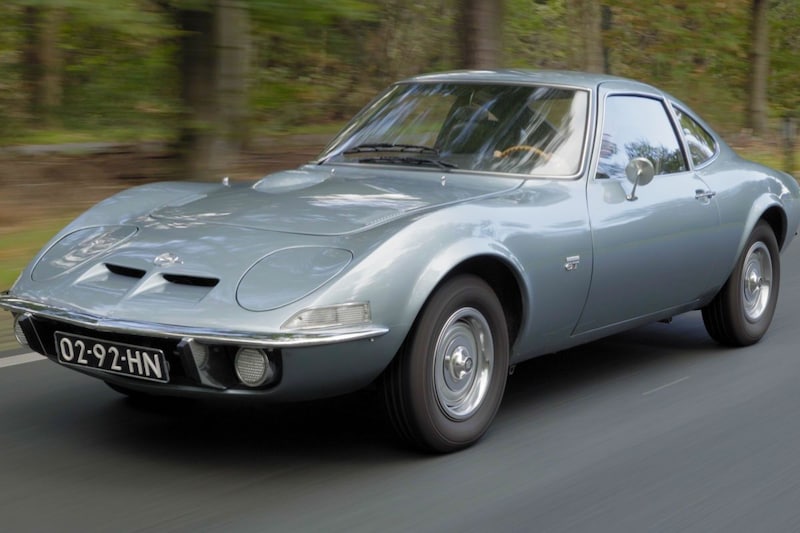
With a few exceptions, Opel has always been the brand of the best, good cars for ditto citizens. Until the brand suddenly came up with the exciting GT in 1968. This compact sports car, designed by Erhard Schnell (who was involved in the creation of the Manta A, Kadett D, Corsa A, Vectra A and Calibra, among others), resembled a Mini-Corvette with its Coke bottle design. The B-Kadett was mainly used for the technology: chassis, drive and 1.1 block found their place under the beautifully curved bodywork. Much more popular was the 1900 from the C-Rekord. The GT 1100 soon cleared the field in favor of a stripped-down 1900, the GT/J. It had a less luxurious interior and a simpler dashboard and the chrome had been replaced by matte black trim. The Dutch customer saved about 3,000 guilders compared to the normal GT 1900, plus less cleaning work. Speaking of money: thanks to the use of many components from existing models, the price could remain relatively low: about 10,000 marks in 1968. However, production was not a piece of cake. Due to limited own production capacity, the bodies were manufactured at Chausson, after which the also French Brissonneau & Lotz took care of the interior and the paintwork. Finally, at Opel in Bochum, the marriage between body and chassis took place. More than 103,000 GTs were produced in five years. Much of it went to the US, for people who couldn’t afford a real Corvette!
Mercedes Benz 600 – 60 years

‘The best car in the world’ was Rolls-Royce’s slogan for a long time, while Cadillac used ‘Standard of the world’. Mercedes-Benz hit back hard with the 600. Just like the 770 before the Second World War, the W100 was again a real ‘Grosser Mercedes’. In one fell swoop, the Silver Cloud seemed archaic. The British countered the 600 two years later with the Silver Shadow. It lasted until 1980, the 600 for a year longer. It made those two dead competitors, while their clientele differed considerably. Where the Rolls was mainly purchased by ‘old money’, the ‘new money’ opted for the Benz. George Harrison and Ringo Starr had one, as did much less innocent characters. Dictators such as Idi Amin, Nicolae Ceaucescu, Saddam Hussein and Ferdinand Marcos liked to be applauded by their poor people. Bond villain Blofeld also had a copy in ‘Diamonds are forever’ (1971), just like the Vatican. This motley crew was propelled by a 6.3-litre V8 (coincidentally 100 cc more than Rolls-Royce’s 6.2 V8!). In combination with air suspension, this gave a special comfort, also because of the hydraulic operation of windows, seats and in some cases also the roof. In addition to the regular, 5.54 meter long four-door and the six-door Pullman version of 6.24 meters, the latter was also available as a Landaulet, with the rear part of the roof folding down. With 2,677 600s (of which 429 Pullmans and 59 Landaulets) in eighteen years, production lagged behind the 30,000 Shadows, but the Swabians had clearly given their calling card – again.
Rover 2000 (P6) – 60 years

The English may have been labeled ‘conservative’, but the first Car of the Year was really a British four-wheeler. That honor fell to the Rover 2000, better known as P6. David Bache designed a car that was innovative on several fronts. For example, the P6 consisted of a basic frame to which the body cladding à la Citroën DS was screwed. Furthermore, the four-wheeler had a refined De Dion rear suspension. A persistent misunderstanding is that it took up so much space that there was no room for the spare wheel and that it therefore rested on the stern. The truth is that the suspension was indeed complex and the spare wheel (sometimes lying flat on the bottom, sometimes upright on the side) took up a lot of space, which clearly limited the luggage space. However, the spare wheel resting on the boot lid was an option, which was called ‘Touring Package’. Although that made it characteristic, it had disadvantages: less visibility to the rear, a raised center of gravity and a difficult to open boot lid. Also characteristic was the 3500-V8 from Buick that operated alongside the 2.0 (and later also 2.2). An experimental turbine engined P6 (1961) did not reach production. The P6 was loved by the better off and the British police. In 1977, the technically much simpler SD1 took over.
Morris Minor – 75 years

When we think of the term ‘car for the people’, our eastern neighbors quickly think of the Volkswagen Beetle. In France, the Citroën 2CV and the Renault 4CV were regarded as people’s cars, in Italy the Fiat Topolino plus successors 500/600. When it comes to Great Britain, the primal Mini quickly emerges, but that is not correct. The Morris Minor is regarded as the British people’s car. With its perky appearance (pronounced wheel arches, bowler hat roof), the Minor, designed by Alec Issigonis, made post-war Britain mobile. In addition to the two- and four-door sedan, there was a convertible, a wood-trimmed station wagon called ‘Traveller’, while craftsmen and small merchants opted for the Van or the pick-up. The charming cart turned out to be a hit. Even when the ultramodern Austin 7/Morris Mini Minor (later Morris Mini) appeared eleven years later, this sympathetic family car did not budge. It was not until 1971 that the last one left the production line, after more than 1.5 million units. The ‘Moggy’, with its rear axle with leaf springs and drum brakes all around, was already very outdated by then. It is amazing that the Marina succeeded this sought after classic. Even more amazing (or not!) is the fact that the Marina simply took over many technical components from the Minor introduced in 1948.
Tucker Torpedo – 75 years

‘Tucker – The man and his dream’ is a 1988 cinema film by Francis Ford Coppola (Tucker owner himself) and tells the dreamed life work of Preston Tucker. In the 1940s, Tucker wanted to build a revolutionary car with safety and streamline as spearheads. Because it had to be a real family car, he designed a car with the engine in the back, following the example of the KdF car (Volkswagen Beetle). His view: no cardan tunnel, so more space. A softly padded dashboard, a safety cage, a central, rotating headlight and a windshield that did not shatter in a collision, but simply knocked out of its frame, were also not commonplace in the US. Tucker was therefore viewed and opposed by the competition with suspicion. From spreading fake news to legal proceedings, everything was pulled out of the closet. With success, because of the 48 introduced in 1948 (better known as the ‘Torpedo’), only 51 were built, while Tucker had bought a factory with an annual production capacity of 60,000 vehicles. Remarkable: all but a few Tuckers still exist. They are all equipped with a – not everyday – 5.5-liter helicopter engine in the tail. When they sell, sometimes it’s for a seven-figure sum. Preston didn’t live to see that: he died poor and penniless in 1953 of lung cancer. His American Dream fell apart.
Volvo PV444 – 80 years

Volvo’s first passenger car saw the light of day in 1927, but the fame of the Swedish brand started in 1943 with the introduction of the PV444. According to the then prevailing American fashion (Mercury Eight), the four-wheeler was given a steeply sloping roofline, which earned it the nickname ‘Cat’s Back’. With its pronounced wheel arches and sturdy nose, the image of a sturdy car was created, yet it weighed less than 1,000 kilograms. From the beginning, Volvo paid attention to the robustness, quality and safety of the PV444 (Personvagn, 4 seats, 4 cylinders, 40 hp). Not surprising: until then, with few exceptions, Volvos were six-cylinder luxury cars. The PV444 was the first people’s Volvo, which was also the first to have a self-supporting body. In order to attract a new audience, the brand had to be well prepared. Especially from 1950, annual adjustments to the model were required, ranging from detail changes to more powerful engines and more luxury. In 1953 (so another anniversary) the PV445 ‘Duett’ station wagon joined the ranks. Volvo established itself as a safety brand by offering seat belts from 1957. In the meantime, the 121 ‘Amazon’ had appeared in the showrooms as a successor to the PV444, but because it was a lot more expensive, Volvo released the PV544 in 1958 (another anniversary). Main difference with the PV444: the undivided front and rear window. It was still very solid and you still see it regularly in today’s traffic. Truly a solid foundation.
This article was previously published in the AutoWeek Annual Special 2023.
.
– Thanks for information from Autoweek.nl