
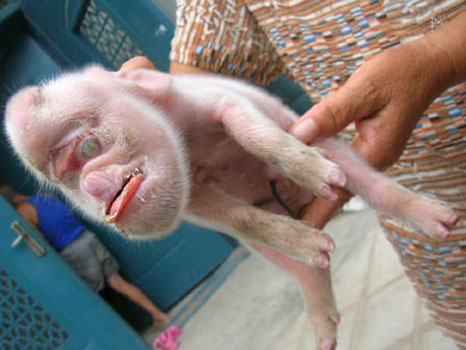
In China, a pig born with an apparent monkey head would do this by mutation. Seen on the internet. Is that possible or would this have happened in a lab? Is this really possible or is the deformity so bad that it resembles a monkey’s head? Or is it an edited photo? Links: – http://www.hln.be/hln/nl/959/Bizar/article/detail/359002/2008/07/25/Varkentje-met-apenkop-geboren-in-China.dhtml – https:/ /www.youtube.com/watch?v=Q7VXl85VO7Y – http://www.macroevolution.net/pig-primate-hybrids.html – http://www.natureworldnews.com/articles/10885/20141204/pig-monkeys -face.htm
Answer
Dear Diane,
no, of course that is not possible. There is an entirely different explanation for the deviation in this piglet. By the way, the deviation is not that exceptional at all, it is one of the more frequent malformations in pigs. Our own teratological collection (collection of congenital anomalies) contains several such cases, and new cases are brought in on a regular basis. We also see it regularly in small ruminants (sheep & goat) and to a lesser extent in cattle. Only we don’t dramatize it that way, and such cases rarely make the press with us.
The abnormality you’re seeing comes under the umbrella of “holoprosencephaly,” a difficult term to indicate that the front part of the brain didn’t split apart during development. Embryonically, the brain is formed one after the other as several vesicles. The anterior brain vesicle (prosencephalon) must split in two in front, and from these two parts both hemispheres of the cerebrum develop. The posterior part of the prosencephalon remains single, but the eyes that develop from this part have arisen from the division of an original single eye field, which was formed in the lower center of this brain vesicle and which, after division, gives rise to two eye vesicles that migrate sideways from the brain to the left and right, pulling toward the surface.
A disruption of this cleavage mechanism leads to holoprosencephaly. The deviation can take different forms, depending on whether or not the split could still go through a part. If there is absolutely no division, this results in “cyclopia”, in which animals are born with a single eye located in the midline, just above the upper jaw (= the original eye field was not split in two, and remained in the midline below). the brain).
In the case of the piglet in the photo, there has been a little bit of splitting: if you look closely you can see two eyeballs in a central eye socket. The division of the eye field was thus successful, but the embryo failed to move the eyes laterally: they remained in the midline and grew forward. The cerebrum has also not split (narrow head), but there is something of an olfactory brain, and as a result a nose has been formed. In animals with holoprosencephaly, this nose is above the fused eyes, on a small trunk (proboscis) that is folded back in the piglet in the photo. You can explain this because the eyes grow forward under the brain, but the olfactory nerves grow forward directly from the front part of the brain (and thus remain above the eyes). What you see below the eye socket above the tongue is just some lip & upper jaw, but no nose.
In still further cases of partial breakdown, the eyes may have separate eye sockets, but still be very close together. We refer to this shape as “cebocephaly”, literally translated as “monkey head”… because monkeys also typically have their eyes very close together (and so the press makes a different story of it…).
The causes of many birth defects in our pets are often little known, but holoprosencephaly happens to be one of the best described and researched defects with known causes. This is partly due to the fact that in the early 1960s there was a whole epidemic of holoprosencephaly in lambs in America. Research then showed that the ewes were fed hay that was contaminated with a poisonous plant, the California hellebore (Veratrum californicum). This plant contains a toxin, which for logical reasons has been called “cyclopamine” because of the type of abnormalities it can provoke (cyclopia). When cyclopamine reaches the embryo via the bloodstream, it disrupts, among other things, the division of the anterior brain vesicle.
Other Veratrum species, such as the white hellebore that occurs in Europe (not in Belgium (not in the wild anyway)), also contain this poison, and a number of other plants are also known to cause such abnormalities via similar substances.
Another cause of holoprosencephaly is a genetic abnormality in the animal’s cholesterol transport. If there is too little cholesterol in the blood, these animals cannot (easily) mobilize the cholesterol from their own tissues to supplement the deficiencies in the bloodstream (and elsewhere in the body). As long as the animals have a sufficient supply of cholesterol during their embryonic development (via the food intake of the mother) there is no problem. However, if too little cholesterol is supplied, they have no opportunity to use their own reserves. Cholesterol is a necessary molecule in the whole process responsible for the division of the anterior brain vesicle…
Answered by
Prof. dr. Dr Pieter Cornillie
Veterinary Morphology: Embryology incl. Teratology Anatomy Histology

http://www.ugent.be
.