
My father says that if we put a plastic bucket of soup in the microwave and set it to 900 watts (maximum of our microwave oven), then we also eat plastic besides soup. He says the plastic of the bucket is melting.
He usually puts the microwave on a lower setting, for example 750 watts.
But then set it for a longer period of time. (for example 4 minutes instead of 3 minutes) He thinks that is better.
Does the time and number of watts for defrosting/warming affect the plastic bucket in my example?
And what about energy consumption taking these 2 factors into account?
Is it true that there are 7 types of plastic?
And that numbers 2,4 and 5 are safe and with numbers 1 and 7 caution is advised and numbers 3 and 6 should be avoided?
We have a plastic bowl that looks quite orange inside, because it is used a lot to thaw spaghetti sauce. Maybe this is because of the acidity of the spaghetti and not because of the plastic?
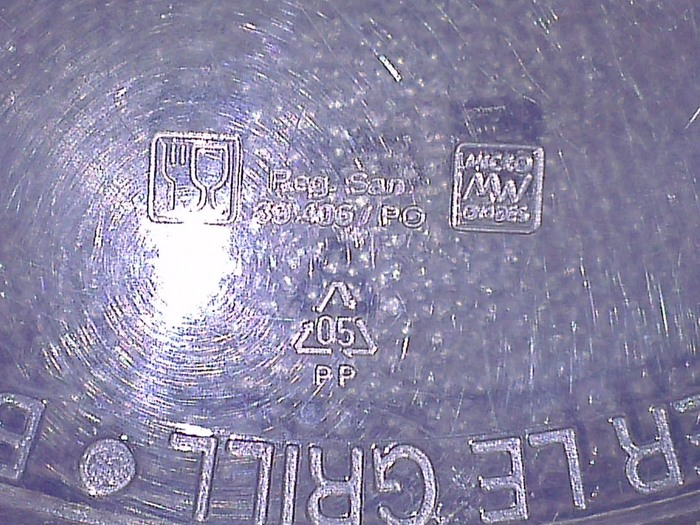
In the photo I took of my plastic cover, there are 3 logos on it.
The left logo: material used with food
The logo on the right: material that can be used in a microwave
and the bottom logo: the kind of plastic
Is this explanation correct?
Finally, I read the Wikipedia article on microwaves and it seems to me that the advantages of having a microwave do not outweigh the disadvantages.
Thanks for your reply.
Answer
Dear Samuel,
Indeed, there are many stories circulating about hazardous substances that can end up in your food from the plastic container through use in the microwave: dioxins, plasticizers,…
This is therefore being investigated by authorities involved in food safety. Plastics that are safe are labeled “microwave safe” and can be used without any problem. You do run a risk with other plastics.
You shouldn’t make it more complicated than that: the plastic number (1-7) is actually a recycling symbol that indicates what kind of plastic it is, but I wouldn’t rely on this to determine its use in the microwave. By the way, there are many more than 7 types of plastic (symbol 7 means “other plastic”). Type 5 (polypropylene) is often also suitable for the microwave oven, but look for the microwave label…
A plastic can turn orange because you heat tomato soup or spaghetti sauce in it (microwave or normal). this is because some (Fat-soluble) dyes can end up in the plastic from your food. The plastic is not scratched or anything, so this is also harmless.
Finally, these effects are caused by the heating, not the microwaves. So it doesn’t make much sense to me to use a lower power (750W) to heat up your soup, hoping to have fewer hazardous substances in your soup.
Below you will find some more interesting links.
Answered by
Dr Geert Hellings
Nanoelectronics, microelectronics, scaling of transistors, semiconductors

Kapeldreef 75 3001 Leuven
http://www.imec-int.com
.