
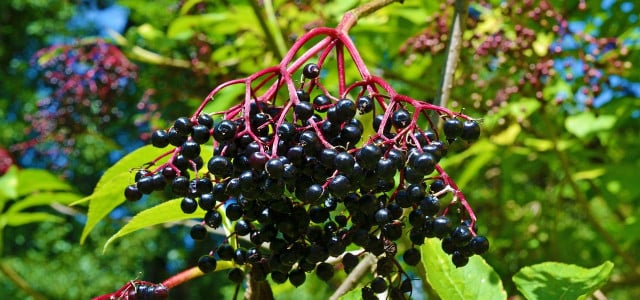
While they bloom, elderberry bushes can be easily recognized by their yellowish and white flowers. But did you know that there is a risk of confusion with elderberries? So you can avoid poisoning.
When we speak of elderberry, we usually mean the black elder (sambucus nigra). But there are other types of elderberry – and they can even be poisonous.
We describe the difference between black elderberry, grape spellberr (sambucus racemosa, also called red or mountainholder) and dwarf-Helunder (sambucus ebulus). If you can tell the individual varieties apart, you don’t have to worry about the risk of confusion when collecting elderberries.
Risk of confusion for elderberries: the elderberry species
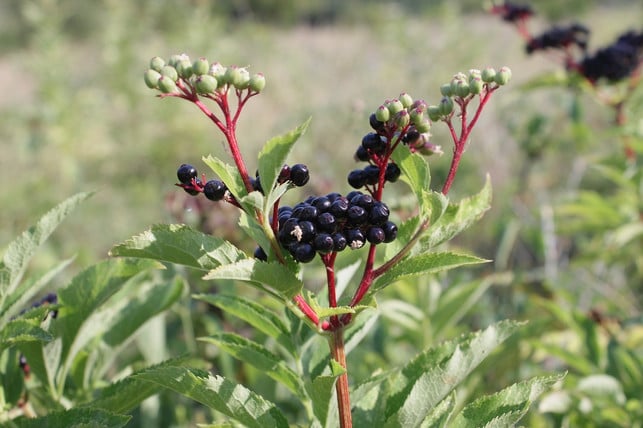
The three elderberry types differ in their toxicity, whereby the dwarf hotelunder is particularly dangerous and the black elder is least risk.
-
Dwarf-Helunder (Sambucus Ebulus): All parts are strongly poisonous, especially the seeds of the berries. Symptoms are nausea, vomiting and diarrhea. Poisoning can be fatal, which makes the risk of confusion among elderberries particularly serious.
-
Grapeholer (sambucus racemosa): the flowers and berries are raw poisonous, the latter can be cooked but can be edited in small quantities. Important: You have to remove all seeds from the berries because their poison is not destroyed by heat.
-
Black elderberry (sambucus nigra): the “normal” elderberry, from which flowers are traditionally baked elderflower or elderflower tea. His berries can also cause symptoms in the raw state. With the cooked berries, for example, you can prepare elderberry syrup or elderberry jelly.
So be careful with raw elderberries: Dwarf-Helunder is always toxic and the berries of grape and black elderberry should also not eat raw.
Distinguish the elderberry species correctly
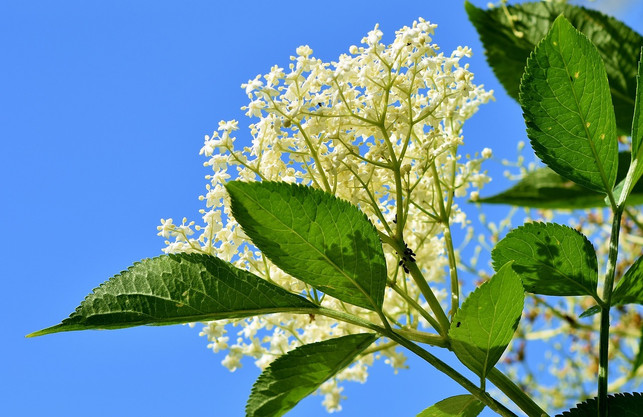
The greatest risk of confusion in elderberries is therefore between the black elderberry, the flowers of which are even raw edible, and the ever toxic dwarf-Helunder. This is how you differentiate all three varieties:
Form and growth
- Dwarf-Helunder grows rather herbaceous and its stems are filled with yellow, corky mass. It is at most around 1.50 meters high.
- Black elder grows, more like a tree, and can get up to six meters high. The mark in the branches is white.
- Grapeholder becomes about two to four meters high. It grows as a branched shrub. Striking: If you break off a branch, the open place stinks. That is why the grape hotel is also called the “stinker elder”.
Leaves
- Dwarf-Holunder has leaves that grow in groups from seven to nine. In spring they are reddish and are getting greener in early summer. Their shape is rather elongated and pointed, they are the widest in or below the middle. In addition, the leaves are sawn weakly.
- The Black Elder leaves grow in groups from five to seven, also asymmetrical. The leaves are less pointed and elongated than with the dwarf hotelunder. Black elder blooms from late May to early June.
- On the grape hotel, the leaves are also lanceolate, similar to those of the black elderberry, and often overflowed reddish.
Flower
- The dust bags at the dwarf-Helunder are only red and become black after a while. It blooms from June to September, depending on the location.
- The dust bags are weak yellow in the black elder. The flower has the well -known plate shape.
- Did the grape hotel get his name? The flowers grow up in the shape of an upside down bundle of grapes. It blooms from late April to mid -May.
Berries
- Dwarf-Helunder also has black berries, but they are more upright and have a small dent.
- The berries of the black elder are hanging down and are round, without a trim.
- The berries of the grape spellberder become strongly red when they are ripe.
Especially in southern to Central Germany, the probability of paths, embankments, rubble places and forest edges and on nutrient-rich, rather dry soils must be met on a dwarf-Helunder.
Beware of collecting elderberry
As always, if you collect wild plants for consumption yourself, you should also be extremely careful when collecting. Watch nothing where you are not sure what it is. It is best to take a wild plant guide at hand or take part in a tour with which experienced experts: accompany the collection inside. Such tours not only offer security, but you also get tips on the right harvest and workmanship.
Read more on utopia.de:
- Collect berries: Nature now offers this
- 4 edible wild plants that you can collect in autumn
- Collect wild herbs, determine, eat: 11 tips
** marked with ** or orange underlined Links to sources of supply are partially partner links: If you buy here, you will actively support Techzle\.com, because we will then receive a small part of the sales proceeds. More information.