
Whether we like it or not, driver assistance systems are starting to penetrate the motorcycle industry. For example, Honda recently filed patents for an ADAS system that captures crosswinds.
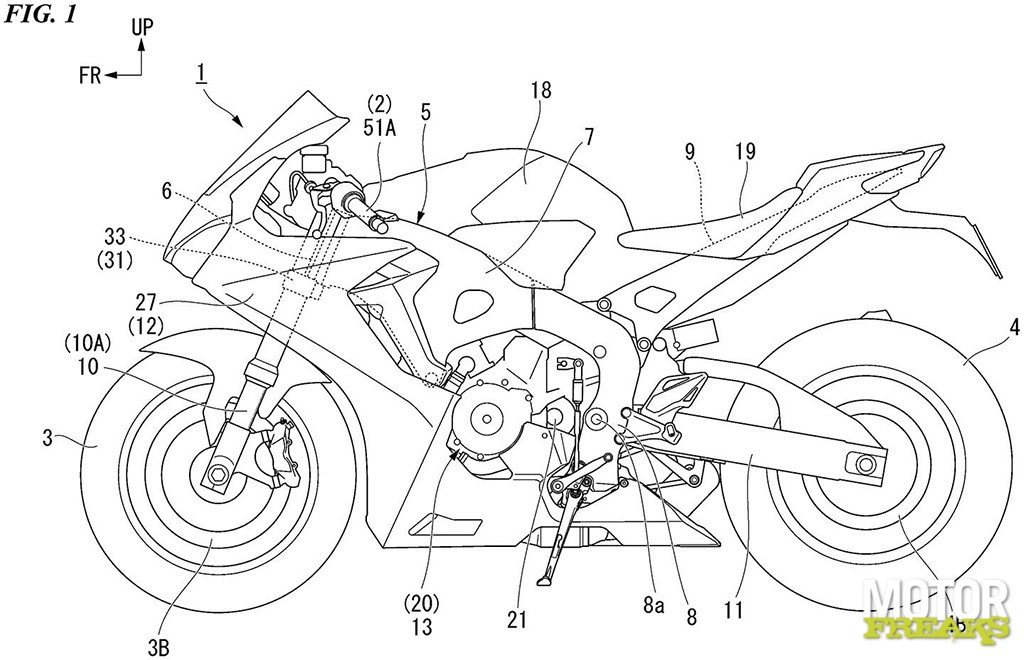
Driver assistance systems, called ADAS (Advanced Driving Aid System) in the automotive industry, are a controversial subject, because the intended goal is not always achieved. The jargon talks about false positives and false negatives, or: taking action when it is not necessary and not taking action when it should be done.
We have already experienced this personally with adaptive cruise control, where with the Multistrada V4 the radar at the front did not spot a truck driving in front of us, while the Ninja H2 SX decided to brake for a truck that was not in front of us. , but drove on an exit lane.
Properly calibrated, however, they can be exactly the unobtrusive tools they promise to be on paper. Whether Honda’s rider assistance – when it eventually goes into production – will succeed in finding that fine balance that distinguishes a help from a hindrance remains to be seen. Based on pending patents, no other company appears to be so actively involved in the development of such systems.
Like previous Honda patents, the latest patent revolves around a servo motor-assisted steering device that falls somewhere between an active steering damper and an automatic steering system. The actuator itself is mounted behind the steering head, attached to the triple clamp via a simple arm and link system.
Visually it resembles a rotary steering damper, but instead of simply preventing rapid movements of the steering wheel, it can introduce steering itself on command from an on-board computer. This computer receives information from various sources, including acceleration and speed sensors, sensors to measure the force applied to the steering wheel, lean angle sensors, radar and a camera, with the aim of understanding what you want the engine to do and how to achieve that goal. the best can be achieved.
Under normal circumstances the actuator would do nothing, giving you complete control of the motorcycle, but when necessary, like ABS for braking or traction control for your throttle, it can step in to add an extra layer of safety.
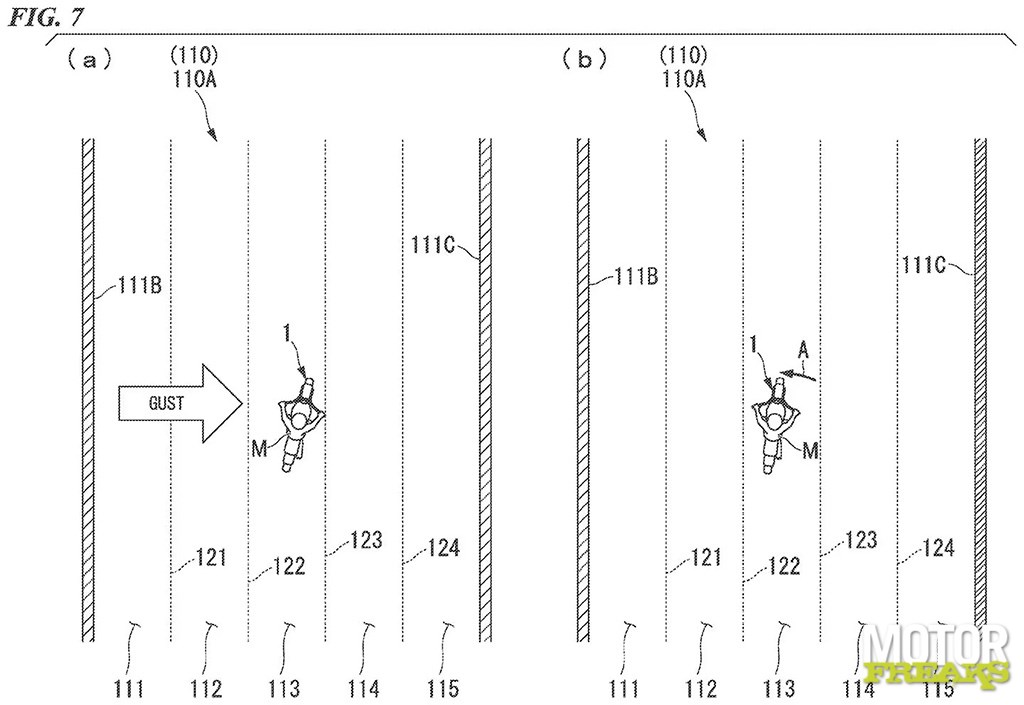
Honda’s latest patent application regarding the system shows how it hopes to counteract the effects of crosswinds, whether steady or gusty, to keep the bike on your chosen line. To do this, the computer divides the lane you are traveling in into several narrow “virtual lanes”, as indicated by dotted lines in the patent drawings, and attempts to keep the motorcycle within one of those lanes.
The system is intended to be linked to a range of driving aids, including adaptive cruise control, so that it is aware of the positions of other nearby vehicles and the edges of the road, so that the intervention can be adapted according to the urgency of getting the motorcycle back on track. to get a rate.
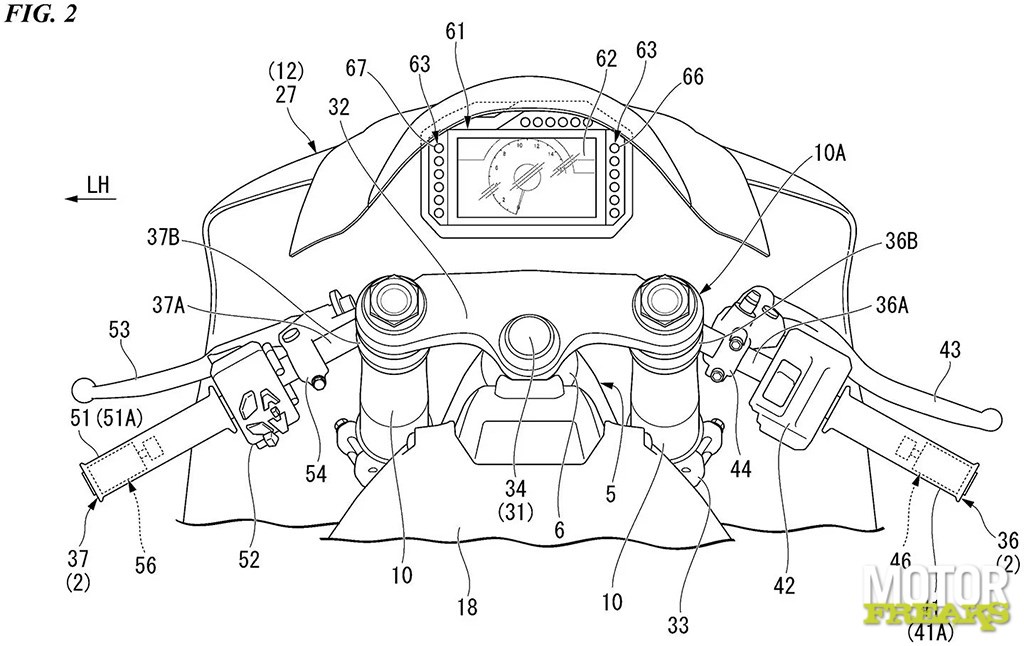
At the same time, Honda has filed another patent for a simpler part of the planned rider assistance system in the form of tactile feedback for the rider. Cars already use this idea, with some systems vibrating the steering wheel or seat if you are in danger of drifting out of the lane or into the space of another vehicle, often as a precursor to active intervention.
Since audible warnings are of little use on a motorcycle and dashboard warning lights are easy to miss, Honda’s idea is to vibrate the left or right handlebar (or both at the same time) to provide physical feedback.
The vibrations are achieved by the same idea already known from the “rumble” systems that have been used in video game controllers for many years. An offset weight is attached to an electric motor, creating a vibration that can be controlled by the computer.
Honda’s patent proposes placing one of these vibration motors in each end of the handlebar. Like a game controller, the vibrations can be at different speeds and rhythms to convey different messages, but the most obvious use for the idea is warning alerts for lane-keeping assist or blind-spot monitoring.

– Thanks for information from Motorfreaks.