
The interview was conducted by Dirk Eidemüller
Professor Genzel, can you explain to us what exactly you discovered?
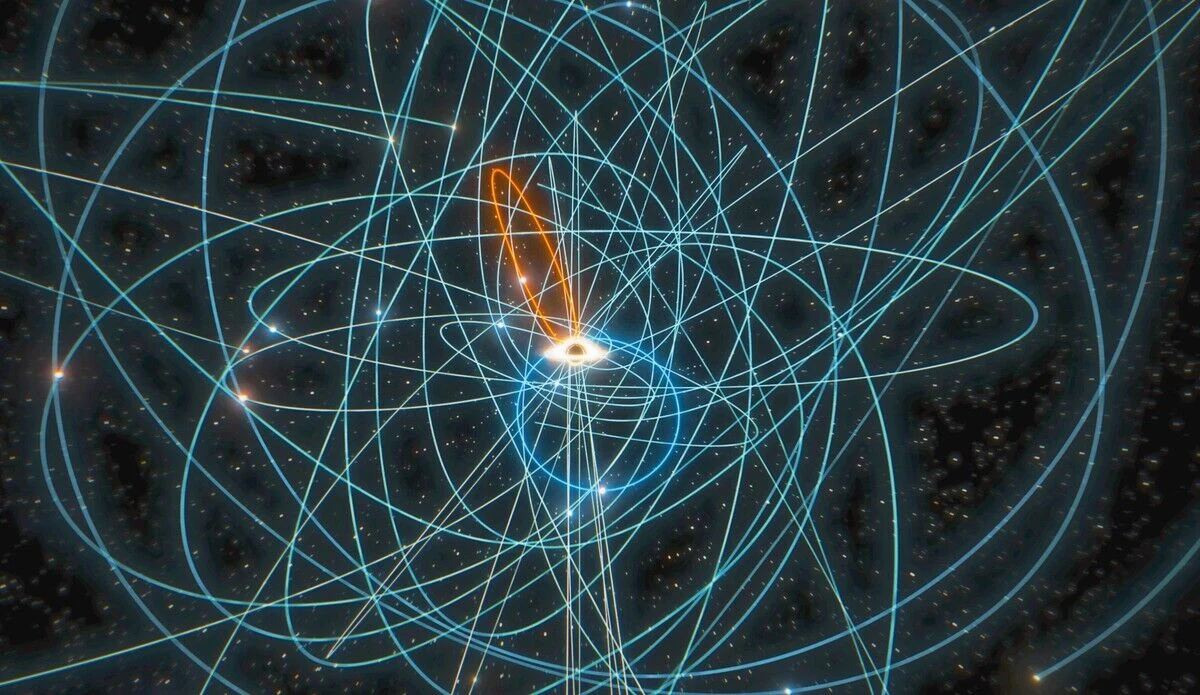
We have set our sights on our galactic center with the most powerful telescope system in the world, the Very Large Telescope, or VLT for short. Thanks to special optics that we developed here at our Max Planck Institute, we were able to connect all four large telescopes of the VLT and thereby achieve extremely high resolution and sensitivity. After detailed observations, around three years ago we noticed a very faint star that was very close to the supermassive black hole at the center of our Milky Way. We have therefore repeatedly checked whether and how this star moves. Normally stars don’t change their motion too quickly.
But this star, which we have named S301, does that very well: it is in a narrow and highly elliptical orbit around the black hole – much narrower than all stars known to date. This also means that we can use this star as a test specimen, so to speak, to examine the area around the black hole. Albert Einstein’s theory of relativity predicts that large masses distort space-time. So with the help of S301 we can test the theory of relativity, and we can do it better than with any other known object.
What properties does the black hole at the center of the Milky Way have?
This object is also called Sagittarius A* – pronounced Sagittarius A star or in astronomical notation Sgr A*. It is by far the heaviest object in our galaxy and weighs around 4.3 million solar masses. It has an event horizon whose radius is approximately one-tenth of the Earth’s distance from the Sun. This is the place where gravity becomes so extreme that there is no return possible. Anything that falls in there is inevitably lost. Not even light can escape from there – hence the name black hole. But apart from its mass, there are discussions among theorists about what other properties black holes might have.
Which could those be?