

Whether the massive Tharsis volcanoes, ancient lava layers or the largest volcano in the solar system, Olympus Mons: they all bear witness to Mars’ “fiery” past. But how long did this volcanically active phase of our neighboring planet last? The most prominent volcanic formations on Mars are all billions of years old, so the planet was long considered geologically dead.
But there is now increasing evidence of ongoing activity in the Martian subsurface. Evidence for this includes young volcanic deposits in the Cerberus Fossae area that are only a few tens of thousands of years old. In this region just north of the equator, several rift valleys almost a thousand kilometers long cut through the surface of Mars. This area is also the origin of numerous earthquakes recorded by NASA’s Mars InSight lander since 2018.
Where does hydrogen chloride gas come from?
An international research team led by Alexander Trokhimovskiy from the University of Bern has now discovered new evidence of ongoing volcanic activity on Mars. The starting point were tiny traces of hydrogen chloride that the European space probe ExoMars Trace Gas Orbiter (TGO) detected in the Martian atmosphere from 2021. Because this gas breaks down chemically quickly, it must have been created or released relatively recently – but how?
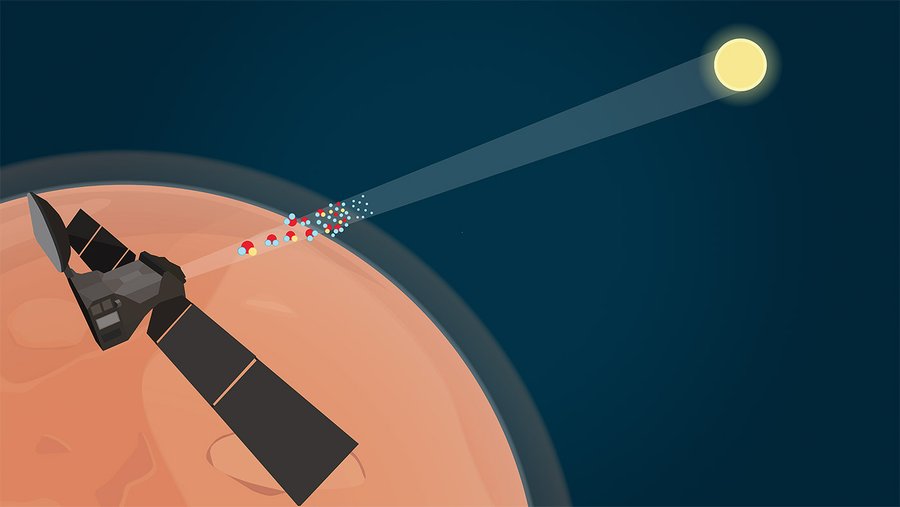
ESA’s Trace Gas Orbiter probe analyzes the Martian atmosphere using multiple spectrometers. These evaluate the absorption spectra of the sunlight falling through the gas envelope. — © ESA
Planetary researchers attribute at least part of the hydrogen chloride to dust containing perchlorate. In the southern summer of the Martian southern hemisphere, dust storms stir up this dust and the higher temperatures cause the perchlorate to evaporate. But there could be another source of hydrogen chloride on Mars: volcanic activity. As Trokhimovskiy and his colleagues explain, this gas is often released on Earth from cracks and gas vents in volcanic areas.