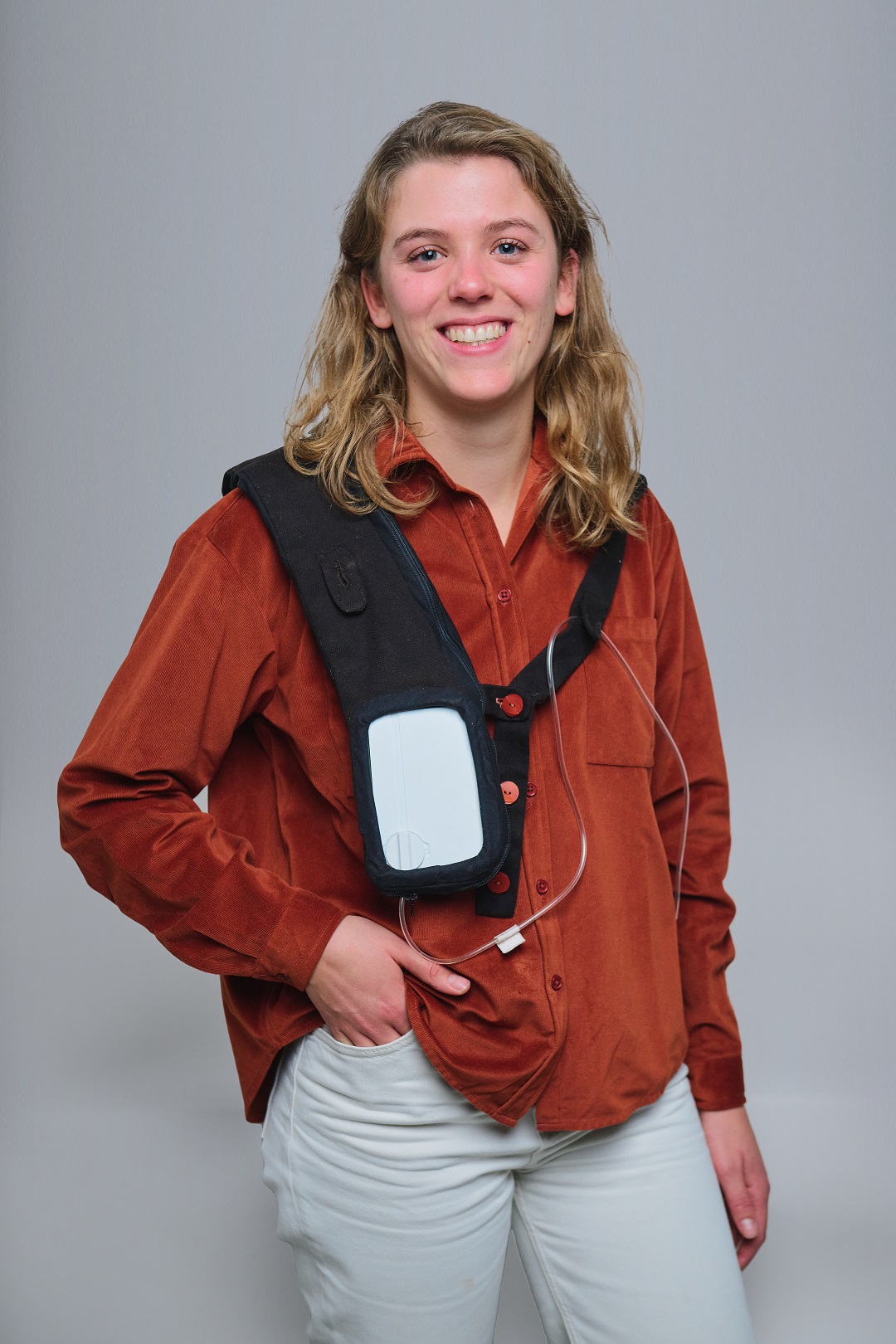
Antwerp student Charlotte Blancke is one of three international winners of the James Dyson Award 2022 design prize with ivvy, a portable solution for the simple use of an infusion at home.
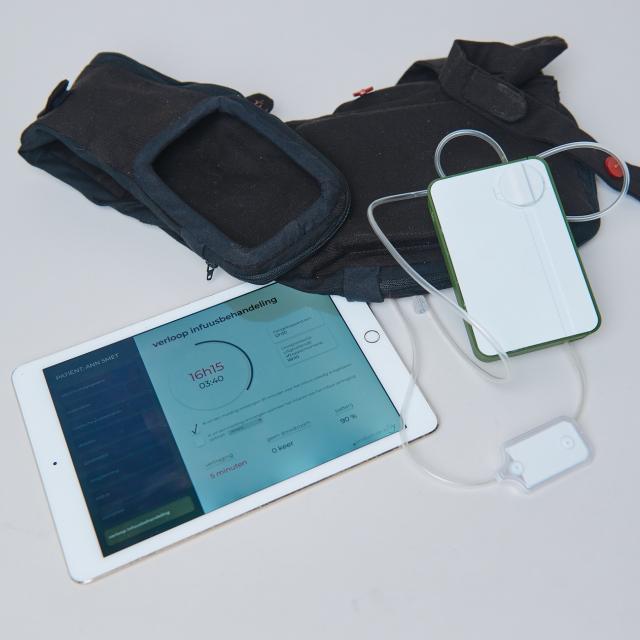
Dyson is best known for its vacuum cleaners, but also has desk and floor lamps such as the Dyson Lightcyle Morph Desk and recently opened the Dyson Demo Store in Amsterdam. In addition, the James Dyson Award was created by Sir James Dyson to give engineers a platform to change the world. With ivvy, Charlotte wins this year’s international runner-up prize of the James Dyson Award 2022 out of more than 2,000 entries from 29 countries. Ivvy is a portable infusion pump with self-designed equipment that automatically adjusts infusion therapy to the needs of the home situation, designed by Charlotte Blancke (University of Antwerp). Ivvy consists of three products: a portable solution for hanging the infusion pump, the infusion pump itself and the accompanying software for intuitive use. It is a product solution tailored to the needs of patients and home nurses in a home environment.
Ivvy: the problem
Charlotte came up with the idea because a colleague of her mother was dissatisfied with the uncomfortable device her child had to use for her medical treatment. The co-worker shared that she actually swapped an intravenous pole for a clothes hanger to improve her daughter’s comfort.
During Charlotte’s research, she discovered that medical treatments at home are increasing, but that the equipment used for intravenous therapies at home is the same as that used in hospitals, even though the characteristics of a home setting are different. As more patients receive home care for recovery or long-term care, complex medical devices are now more often used in the home, often under inappropriate conditions.[1]
The solution
Infusion therapy is when fluids or medications are administered at a controlled rate through a cannula or needle.[2] Ivvy replaces the current intravenous IV pole with a portable device that offers optimal patient mobility, an easy-to-use IV pump and built-in software that allows nurses to monitor their patients remotely.
Currently there is a lack of feedback on intravenous treatments and existing infusion pumps have a complex interface. Charlotte has developed an infusion pump with a simplified interface and intuitive use. Nurses can easily set up the treatment at home and patients can follow their therapy via an LED strip, display and sound notifications.
How it works
In the current situation, the infusion equipment brings a clinical atmosphere to the patient’s home. Ivvy replaces the IV pole with an aesthetic wearable, making the product less confrontational and better suited to the interior. The wearable can be worn on the body or as a bag and ensures optimal mobility. Currently, there is a lack of feedback on treatment and existing infusion pumps have a complex interface. That is why an infusion pump has been designed with a minimal interface and intuitive use. The pump works with a linear peristaltic pump. Nurses can easily set up therapy and patients can monitor their treatment via the LED strip, display and sound notifications. By using the Sigfox network (this network is specifically intended to enable Internet of Things solutions), data is sent from the infusion pump to the software, so that patients can be monitored by the home nurse.
“If you are treated with an old-fashioned drip at a high standard, your home can resemble a hospital. Ivvy is a simple concept that can improve people’s treatment and improve their quality of life. It shows the genius of simple design and I wish Charlotte the best of luck in developing her idea towards commercialization.” – Sir James Dyson, Founder and Chief Engineer at Dyson.
“It is a huge honor and I am very grateful that I have come this far with my entry. I never expected James Dyson to call me personally to share this news, so I was of my own accord and only then pressed it occurred to me what the possibilities of the Award are. The goal of ivvy is to make the home situation of patients and caregivers easier. With this award I hope to be able to make an even greater impact.” – Charlotte Blancke, inventor of ivvy (University of Antwerp).
Next steps
Charlotte is working with industry professionals to support her in further developing ivvy. The JDA runner-up award assists Charlotte in further development and provides the award with a platform to raise awareness for the solution.
Facts and statistics
• The current IV pole is expensive and has a complex design. There is no wireless communication between a nurse and the IV pole and the machines use a lot of power.[3]
• The most common type of IV pole is the free-standing mobile pole. The main drawback of this design is that it is prone to tipping over. Its great height and relatively small base make it unstable. [4]
All winners
• SmartHEAL: a smart dressing sensor that indicates how well a wound is healing by measuring its pH value, invented by students at Warsaw University of Technology, Poland
• Polyformer: a machine that recycles plastic bottles into affordable 3D printer filament for developing countries, invented by students from McMaster University, Canada
• Ivvy: a portable replacement for the existing intravenous IV drip that improves comfort and mobility for patients, invented by Charlotte Blancke of the University of Antwerp, Belgium
Footnotes
[1] https://www.fda.gov/medical-devices/home-health-and-consumer-devices/home-use-devices
2 https://www.healthline.com/health/infusion-therapy
3 https://www.hindawi.com/journals/jhe/2020/7963497/
4 https://hal.archives-ouvertes.fr/hal-01966833/document