

John Vanderaart answers many questions on pcactive.nl. The same goes for the question of whether smartphones that are rooted are less secure and he briefly discusses LineageOS.
I have now rooted two older smartphones and it now says LineageOS. Now when I use DigiD, my banking apps, etc., I don’t get any notifications that something goes wrong. However, it does go wrong with the app of the pharmacy. To what extent is a rooted device less secure? And if so, can you still limit this? In view of the environment and child labour, using a smartphone for longer is recommended. And I must also say that there is more memory left and it works just as fast.
Rolf R.
That LineageOS can be found here: lineageos.org. We are talking about a free and open source operating system based on the Android mobile platform. It’s about the latter, of course: “You’re still working with Android.” In the meantime, you download a LineageOS distribution that is ‘suitable’ for your smartphone and install it on your hardware. And then pay attention, because there is also an Android version! Have a look here: en.wikipedia.org/wiki/LineageOS (see image below). As you point out, most apps just work fine. So if ‘that one’ app doesn’t work or doesn’t install, it’s obvious that it has to do with the Android version you have on your hardware. Also, of course, have a look at the privacy settings and the assigned app rights. Furthermore, a rooted device is not necessarily more insecure than a non-rooted device: “It all depends on how you handle it.” Admittedly, by rooting you release the highest rights, but if you practice good app and internet hygiene it will run smoothly. Compared to the environment and child labour, this is certainly justifiable. And to praise! But just to be sure, install a good virus scanner app.
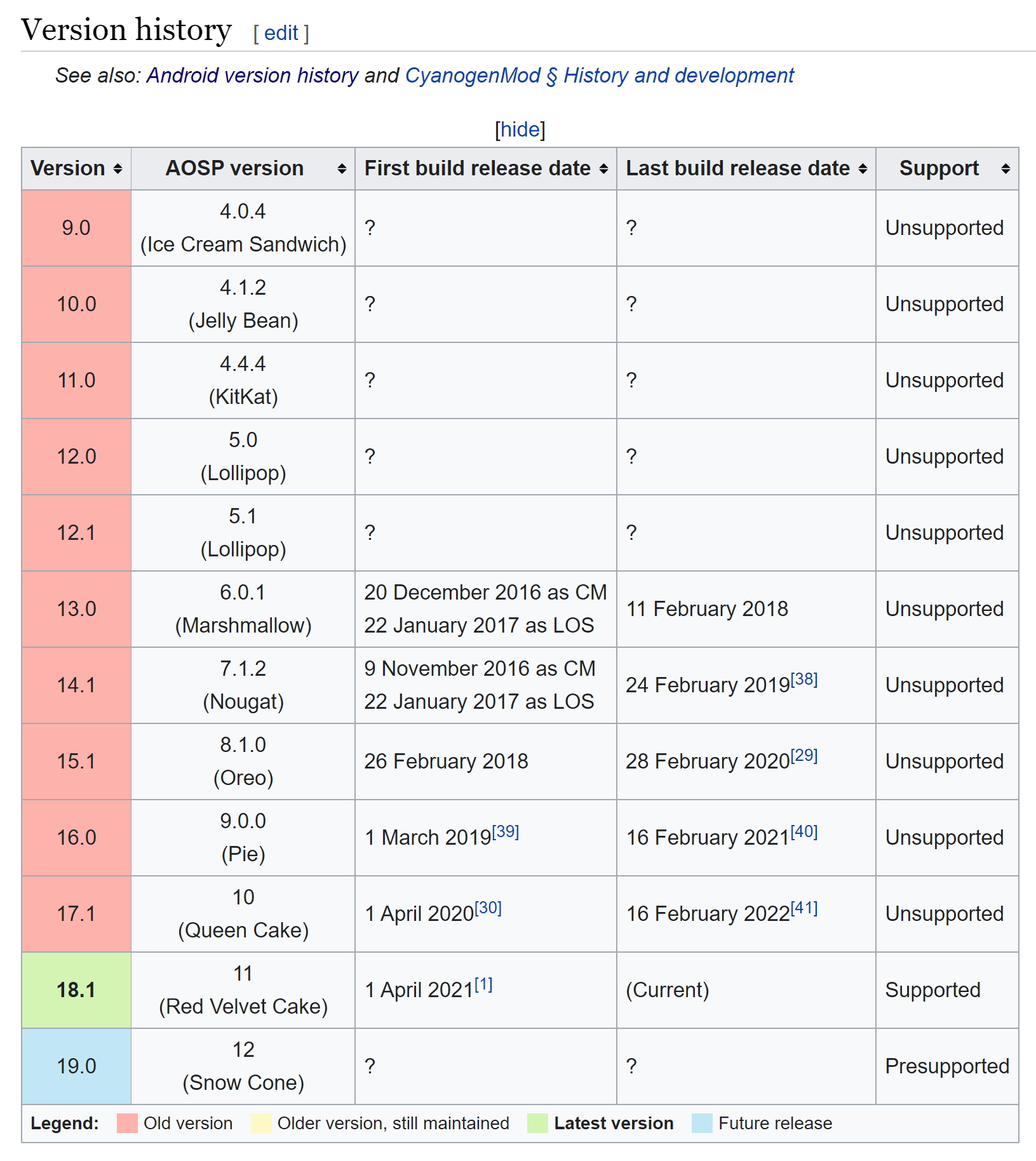
Figure 1: The version of LineageOS combined with the version of Android. Please keep an eye out…