

Moringa tea is made from the leaves of the tree of the same name, which is also called the tree of life in its Indian homeland. We reveal how the tea works, how you prepare it and what local alternatives there are.
The leaves of the Indian Moringa tree (Moringa Oleifera) are packed with vitamins and minerals. That’s exactly why they’re supposed to get your metabolism going.
So it’s no wonder that Moringa is touted as a superfood. You can easily make tea from the dried leaves.
In traditional Indian Ayuveda medicine, fresh leaves, roots and seeds of the Moringa tree have been used for centuries – especially for metabolic and nutritional deficiency diseases. It probably owes its name to the tree of life to this fact.
Buy and prepare Moringa tea
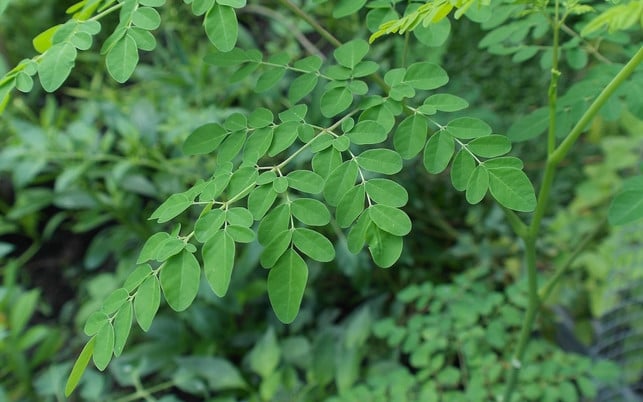
When buying Moringa tea, look for organic labels. This way you can ensure that the leaves are not contaminated by chemical-synthetic pesticides or artificial fertilizers. You can get certified organic Moringa tea in organic markets or herbal shops.
Moringa leaves are sometimes also included in tea blends with other herbs – the proportion of Moringa leaves is then stated on the package.
For one cup of Moringa tea you need about three to four teaspoons of dried Moringa leaves:
- Place the leaves in a tea strainer.
- The water should not boil: the valuable ingredients of the tea are retained at around 80 degrees.
- Let the tea steep for four to five minutes.
You can drink Moringa tea both hot and cold. If you like, season the tea with honey or lemon juice.
Moringa tea: A healthy thirst quencher

The mustard oils in the plant give the moringa tree its German name, horseradish tree. These essential oils also give moringa tea a sharp taste that can wake you up.
Uses of Moringa Tea:
-
In the morning, a cup of Moringa tea is a gentle wake-up call.
-
When exercising, cold Moringa tea is a good thirst quencher. They contain minerals such as potassium and magnesium to support the muscles and can help prevent muscle soreness. Studies show that Moringa has a positive effect on the muscles.
-
As a cure or to lose weight, you can drink Moringa tea to support it. During a drinking regimen similar to juice fasting, you drink one liter of Moringa tea a day. This relieves the digestive tract and supports the liver and kidneys in detoxification. There is not enough evidence as to whether Moringa can help you lose weight.
Moringa tea contains many vitamins and minerals.
Health Aspects: Nutrients of Moringa

Moringa leaves contain the following valuable nutrients:
-
Iron, which is important for blood and overall cell metabolism.
-
Calcium and phosphorus for bone building.
-
Vitamin C to strengthen the immune system.
-
Vitamin B1, vitamin B2 and vitamin B3 for cell metabolism.
- Beta-carotene, a precursor of vitamin A. It is important for the eyes and mucous membranes.
Medical research has only recently focused more intensively on Moringa. Existing studies have mostly been carried out in the laboratory or with animals. These results do not always translate directly to humans and further research is needed.
A pilot study with young men suggests that Mohring extract may support physical performance.
International aid organizations also see Moringa as an opportunity to provide nutrients, especially to children in tropical regions:
- A study from Pakistan indicates that the moringa tree grows even under unfavorable climatic conditions in the tropics.
- The WHO reports on a project in East Timor that recommends the moringa tree to women as a source of nutrients for their families.
Can everyone drink moringa tea?
Moringa tea is well tolerated by healthy people. Nevertheless, in some cases medical publications advise careful use of moringa. It’s better to get a doctor’s opinion first.
-
Pregnancy and breastfeeding – There are not yet enough reliable studies to clearly confirm the safety of moringa tea. Extracts from the bark and large amounts of moringa in particular could have undesirable effects. If in doubt, use suitable teas during pregnancy.
-
Kidney diseases – Moringa tea contains many minerals. However, if you have existing kidney problems, this can be problematic and overload the weakened kidneys.
-
Medication – Moringa can affect blood sugar and blood pressure. If you take appropriate medication, interactions could occur.
Important! Moringa tea is not a substitute for medication.
Local alternatives to Moringa tea

The long transport of Moringa tea to Europe with its CO2 emissions pollutes the environment. In addition, we don’t necessarily need it here to supply us with vitamins and minerals. Native plants also provide many valuable nutrients.
You can achieve the same effect with a balanced, regional diet. Another advantage: you can always buy regional food fresh and in season.
-
Tea mixture – made from nettle, horsetail and dandelion stimulates the metabolism and flushes out the liver and kidneys.
-
Salads – With a portion of fresh spinach salad, chopped nuts and beetroot you will also get your iron, potassium, phosphorus, vitamins C and E.
-
Natural yogurt and carrots – They provide calcium and beta-carotene without any long transport routes.
You can read more about the power of local plants in our article about local superfoods: Alternatives to chia seeds, goji berries & co.
Read more on Techzle\.com:
- Low-carb diet: how does it work, is it useful for losing weight?
- Food combining: This speaks for and against the diet
- Matcha tea: Does the green pick-me-up make you healthy and happy?
** marked with ** or orange underlined Links to sources of supply are partly partner links: If you buy here, you are actively supporting Techzle\.com, because we then receive a small part of the sales proceeds. More info.