
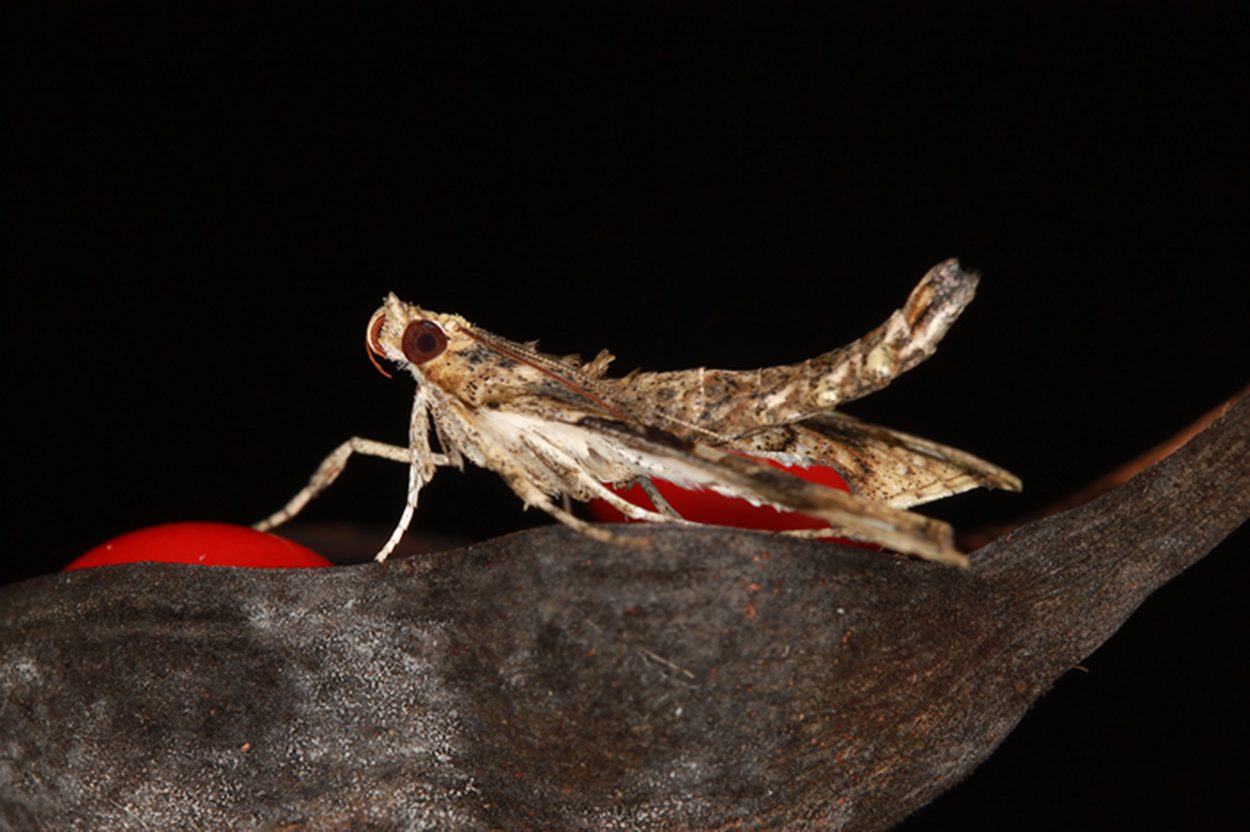
This inconspicuous, greyish-brown moth is responsible for the death of countless magnificent coral trees in southern California: whenever there is increased rain, these pests spread.
A few years ago, an initially unknown pest suddenly swept away hundreds of coral trees in southern California. Popular for its large red flowers, this tree species is the official city tree of Los Angeles and is widely planted in gardens, streets and parks throughout the area. But in 2012, and then again in 2015, many California coral trees began to wither, often dying altogether. Closer examination revealed that their branches had been hollowed out and the marrow eaten out.
The larvae of the inconspicuous butterfly pictured here, belonging to the species Terastia meticulosalis, turned out to be the culprit. This moth lays its eggs in the delicate branches, flowers and fruit of the coral tree. The larvae then eat their way into the fresh tissue of the tree and can completely hollow out the young shoots. Because this interrupts the tree's conduction system, the affected crown areas die off. A few terastia larvae are enough to completely kill a young coral tree.
So far, this butterfly has been found mainly in South and Central America and in the southeastern states of the USA, including Louisiana and Texas. Since 2012, however, this pest has apparently also spread to California. As Andrei Sourakov of the Florida Museum of Natural History found, this was aided by 2012 and 2015, which was unusually heavy for California. Since then, the Californian climate has become much drier again, but the moths have remained.
In order to find out where the newcomers were brought in from, Sourakov carried out comparative DNA analyses. It turned out that the variant of Terastia meticulosalis rampant on the Californian coral trees apparently comes from Arizona, but differs from the moths of this species known from Texas or Louisiana. "To our surprise, however, all of these western moths form their own group, genetically isolated from the rest of the population in the New World," explains Sourakov. "One population is distributed from Florida to Argentina, while the other is only found in western North America." The latter forms a new, only now discovered subspecies.