
Save wisely on allseasons
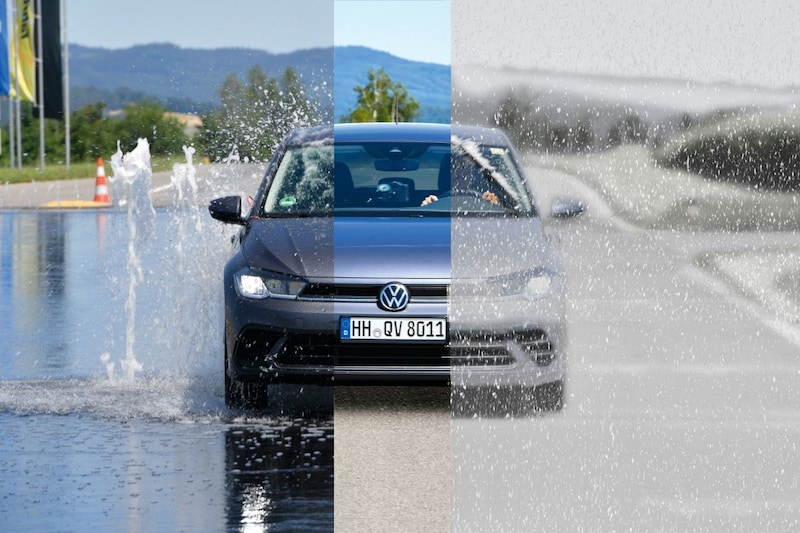
In times like these, everyone is trying to save money wherever possible. Hopefully that won’t be at the expense of safety. We’ve tested a number of all-season tires so we can tell you how to save money the right way.
You can save on everything, even when it comes to tires. However, it is important that you do not lose sight of safety. After all, tires play a crucial role as the link between your car and the road. All-season tires are growing in popularity. After all, you keep exchange costs and money for a second set of wheels in your pocket. On the other hand, tires should not be at the expense of road safety. Our candidates had to prove their qualities in fourteen separate test disciplines under the most diverse weather conditions before being tested for ‘value for money’ in the final chapter. You will find all individual results on this page and the extensive tables in the PDF accompanying this article.
Braking test as a qualification for the all-season tire test
All tires must first qualify for the final of this test in the braking tests. They get a fair chance in the braking test on wet and dry surfaces, but we draw the line with rubber that records braking distances of more than 99 meters in total (yellow). The products with the yellow numbers still deliver acceptable performance, the ones with the red numbers (total braking distance more than 105 meters!) are not recommended if you do not want to run unnecessary risks. For comparison, the braking distances of the summer and winter tires also tested as references are shown at the bottom of the table in the PDF.
1 Bridgestone Weather Control A005 Evo 91 V
2 Vredestein Quatrac 91 V
3 Michelin CrossClimate 2 91 V
4 Kleber Quadraxer 3 91 V
5 Hankook Kinergy 4S² 91H
6 Goodyear Vector 4Seasons Gen-3 91 V
7 Dunlop Sport All Season 91 V
8 Continental AllseasonContact 91 V
9 Firestone Multiseason 2 91 V
10 Maxxis Premitra All Season AP3 91 V
11 Falken EuroAll Season AS 210 91 V
12 Kumho Solus 4S HA 32 + 91 V
13 Toyo Celsius AS 2 91 V
14 Nexen N’blue 4Season 91 H
15 Nokian Seasonproof 91 V
16 Laufenn G Fit 4S 91 H
17 CST Medallion All Season ACP1 91 V
18 GT Radial 4Seasons 91 V
19 Tristar AllSeason Power 91 V
20 Sebring All Season 91 V
21 Triangle SeasonX TA01 91 V
22 Minerva All Season Master 91 V
23 Ovation VI-782 AS 91 V
24 Kormoran All Season 91 V
25 Tracmax X-Privilio Trac Saver 91 V
26 Nankang Cross Seasons AW-6 91 V
27 Hifly All-Turi 221 91 V
28 Torque TQ025 91V
29 Fortuna Ecoplus 4S 91 V
30 Goodride AllSeason Elite Z-401 91 V
31 Fulda Multicontrol 91 H
32 Superia Ecoblue 4S 91 V
33 Westlake All Season Elite Z401 91 V
34 Ceat 4 SeasonDrive 91 V
35 Atlas Green 4S 91 V
That’s how we tested
For the most important part of the test, we traveled to the southern half of this earth with the fifteen finalists. In the New Zealand Alps, we find optimal winter test conditions at -5 degrees at the SHPG test site. In contrast, a summery 22 degrees prevailed during our wet and dry tests, which we carried out at the ATP test site in Papenburg, Germany, and at Wachauring in Austria. We have left the cost chapter, the wear test over 12,000 kilometers, to the wear professionals at IFV.
The cost sheet
The purchase price plays only a minor role in our cost chapter. The most important criterion is the so-called mileage. This indicates after how many kilometers the legal minimum tread depth of 1.6 millimeters in the main tread grooves has been reached. With an unprecedented mileage of 72,000 kilometers, the Nexen is far ahead of this test section. Michelin tyres, which have always been the benchmark in terms of mileage, finish in penultimate place, albeit with a still respectable 44,000 kilometers. As the most expensive tire in this comparison, it ends up at the bottom of the table in the cost calculation per 1,000 kilometers together with Continental’s all-season.
The test parts on snow
Although the winters are getting milder and there is hardly ever any heavy snowfall, all-season tires must provide safe driving characteristics even under extreme conditions. A direct comparison of the winter and summer tires tested in all disciplines shows how well they perform. All candidates marked with green bars offer good and safe winter qualities. The Michelin CrossClimate 2 is in some ways even superior to the winter tyre. But although all test participants wear the snowflake symbol, the winter suitability of the yellow-marked candidates can only be described as ‘adequate’, and in the case of the Bridgestone Weather Control A005-Evo even ‘severely limited’.
The test parts on wet roads
On wet roads and at summer-tyre-like temperatures, all-season tires must offer a suitable alternative to summer tyres. Except in the aquaplaning tests, where the rain specialist Goodyear Vector 4Seasons Gen-3 offers the best reserves, the summer tire always comes out on top as expected. The directly submitting and dynamically responding candidates from Vredestein, Hankook, Dunlop and Bridgestone are at almost the same level. Doing less well, the products of Nexen and Toyo stand out. These all-seasons lack traction when braking and cornering.
The test parts on dry road surface
In sunny temperatures and on dry slopes, the summer tire serves as a benchmark for the tested winter tyres. This applies in particular to the steering and driving characteristics, which, in addition to driving safety, ideally also provide the necessary driving pleasure. The greatest fun factor is offered by products from Vredestein, Bridgestone, Michelin and Kleber. These react spontaneously to steering commands and circle dynamically over the track. It was no coincidence that our test Polo with this rubber came to a stop the fastest during the simulated emergency braking. On the other hand, the VW feels rather swampy with the winter tires from Maxxis and Nexen, while the Continentals, Firestones and Nokians provide the longest braking distance.
Special measuring equipment for extremely accurate measurements
Gone are the days when fuel consumption was measured by means of a jerry can hanging from the windshield with a connecting hose to the carburettor. Today’s car fuel systems are complex; the consumption measurement is therefore complicated and requires a lot of technical effort. However, this is a daily routine for the specialists at AVL GmbH. The company from Graz, Austria, is a leading supplier of this type of measuring equipment for the entire mobility sector.
The Plutron Classic used for our tests measures fuel consumption to within one-hundredth of a litre. The flow meter has only two connections, which are connected to the fuel lines. The measurement is based on the volume and density of the fuel. All data is recorded while driving and analyzed on the computer.
New environmental rating tires
The effects of car traffic on the environment are huge, we cannot ignore that. But we cannot easily, and certainly not quickly, eliminate particulate matter, noise emissions and waste of raw materials. And, let’s not kid ourselves, there will be no question of environmentally friendly individual transport even with the switch to e-mobility. The production of millions of tires is partly responsible for this. Nevertheless, tire manufacturers are making serious efforts to gradually reduce this environmental burden. We are happy to contribute to this by taking a closer look at these aspects during our tire tests. It is of course important that road safety is not compromised. Less wear, less fuel consumption, less use of raw materials, less noise pollution and shorter transport distances – after applying these criteria, we analyzed the candidates from our four-season tire test and evaluated the individual points. The mileage, the lowest possible tire wear as a result and the fuel consumption are the decisive characteristics. In the end, Goodyear’s Vector 4Seasons comes out on top, convincing proof that top performance in terms of driveability and care for the environment are not mutually exclusive.
Conclusion
Are all-season tires a bad compromise? No, that’s long gone. Modern all-season tires are an absolutely safe alternative, especially for small and compact cars, as our tests in all climate zones prove. Modern technology makes it possible. They save a lot of time and money. But beware: the tire market is teeming with black sheep, so make sure you buy a tire with a good recommendation or that has passed a test like this.
The top 5:
These tires finished highest in the test. The links take you to the AutoWeek Car Tire Price Comparison and you see which suppliers can supply them the cheapest.
- Goodyear Vector 4Seasons Gen-3 91V
- Vredestein Quatrac
- Hankook Kinergy 4S² 91H
- Kleber Quadraxer 3 91 V
- Kumho Solus 4S HA 32 + 91 V
Extensive results and graphs
All results are also presented in graphs, as is an overview of all tires and their performance. We cannot show these on the web page, but you will find them in the PDF that you can download on this page.
Price comparator
With the AutoWeek Car Tire Price Comparison we offer you a handy tool to find the best offers on summer tires. The price comparator currently provides an overview of the full range of 16 different tire providers. Also here are the results all tire tests of the past 9 years.
– Thanks for information from Autoweek.nl