
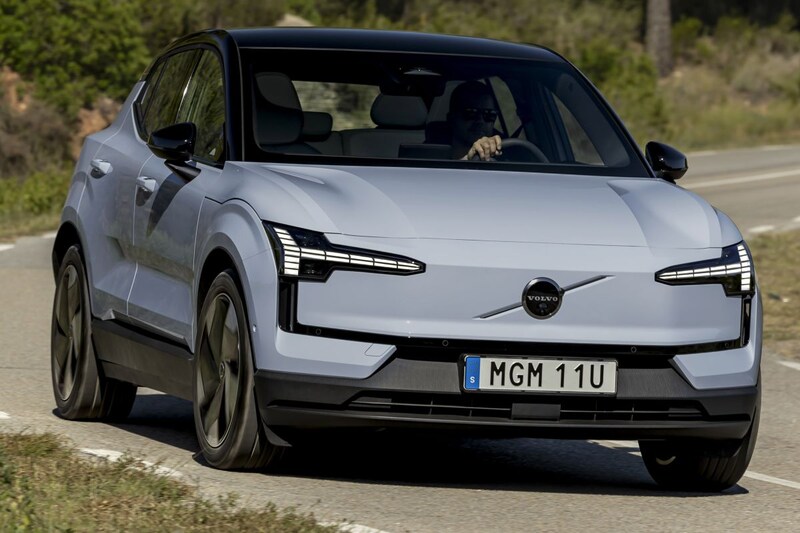
What is it, a brand face? Three times in a row I drove cars that made you wonder what was still tied to their name. What is Volvo about the semi-Chinese EX30, clone of a technically identical Zeekr X and Smart #1? What Renault about the Scenic E-Tech Electric, which could have been a Nissan Quasqai or any random Korean? What is Mini about the electric Countryman SE, now as high as the Volvo XC60?
The Volvo is a Chinese clone in an artificial Volvo jacket, although it drives well. Nor are there any serious complaints about the Renault. It is not a disastrous design, the dashboard is beautiful, Google understands everything and the car drives much more efficiently than that poor little Volvo. The Mini; lovely, comfortable car actually, very fast also with 313 hp. IN A MINI, YES. Only good news, on paper.
Is it bad that brands are becoming more international, styles are becoming more general, and cars intended for small are becoming larger? It’s inevitable. But when does a brand reach its identity limit?
Simplest answer, killer answer: The customer decides that. If he swallows an EX30, and he does, brand fanatics can jump high and low, the market is right. And perhaps the shedding of old feathers will bring a new spring. But according to my gut feeling, the customer should be able to identify with a responsible minimum of brand-typical style features. So it is unwise to put your entire gene bank on the street. You lose what people look for in you, individuality.
I think my BMW i3 is a wonderful example of how evolution and tradition can go together. Apart from the double kidney grille, the design looks nothing like the BMWs you knew. But the BMW veteran knows what he has in store after driving a hundred meters. The car steers like a 3-series E30, tight and incredibly precise. The steering position? Totally BMW. If you want to know how to tackle the blandness of EVs, study my car. There is one problem for newcomers; such an identity requires a past that BYD and Nio do not yet have.
On the other hand, your history can also be an obstacle. How should Volvo find itself again? Which Volvo then? It is difficult. Fashion SUVs have clouded the classic Volvo image, but what we now see as typical Volvo is not the whole story either. The square stations idealized by enthusiasts were preceded by a different Volvo aesthetic; that of the Amazons and the rounded Katteruggen. But what if the EX had become a beautiful little brick in the style of an 850, compact but unusually spacious inside? Then the current EX driver would have wanted it too, because he decided on price. Hooray, prestige brand for little! However, with a characterful design you might have kept it longer. You had given him something he could have learned to love. Maybe then you create brand loyalty. Now he is going fire surfing due to a lack of identification options. Now a Volvo, next time a Renault, just the best offer, who cares.
This also applies to the Countryman. There is little wrong with that car. There are no binding objections to larger Minis, EVs are heavy anyway, so what could be lost? Nothing. And yet everything. Such a cabinet becomes an SUV like so many. You have lost your Go Kart Feeling, the driving feeling as Mini itself describes it; flashy and light, with the car around you like a second skin. You couldn’t buy that sensation anywhere else. At least now you will no longer find it in the Countryman, so the regular Mini must be completely bulls-eye at this point, otherwise the core of their brand DNA will have disappeared and Mini will also end up on the slippery slope of gradual identity blurring.
This now threatens quite a few old brands. And that character suicide will give the Chinese more momentum, because then they will no longer have to compete with qualities that they do not have themselves. See Volvo. Your brand face is so much more than a logo with a slash through it. In the long run you gain nothing from cars that anyone could have built. Identity is key business.
– Thanks for information from Autoweek.nl