
Ken Divjak – Our man in Flanders
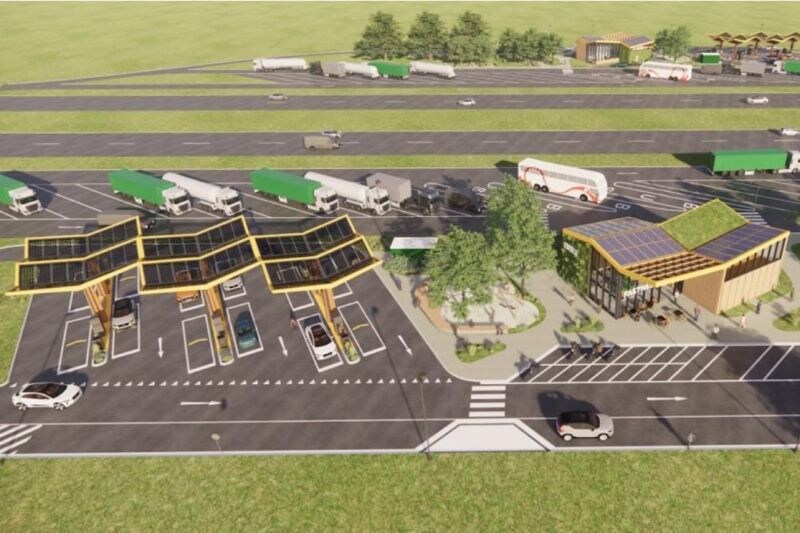
Belgium appears to be rapidly closing its backlog in terms of charging infrastructure. In fact, nowhere would there be as many fast chargers per EV as in the small kingdom.
There was once a time when there were more charging stations in Amsterdam than in the whole of Belgium. Not anymore in 2024, because the providers are really catching up. In fact, according to figures from the European Alternative Fuels Observatory, no one did better in 2023, putting Belgium well on its way to becoming the top of the DC class with a 275% growth in the number of fast charging stations.
Lucrative business
If there were only 894 DC chargers throughout Belgium at the end of 2022, there were already 2,460 a year later. For comparison: the Netherlands had 3,892 fast chargers at the end of 2023, but three times as many BEVs on a territory that is a quarter larger. In Belgium, the ratio of electric passenger cars per number of DC chargers is 56.4 to 1, in the Netherlands it is twice as high at 106.9 per 1. This places Belgium between Germany (59.7 EVs per DC charger) and France (52.2), but given the planned investments it is well on its way to becoming the European leader. The Netherlands is doing even better in the field of AC chargers, with 145,016 charging points compared to 46,667 in Belgium. But that number has also doubled in Belgium in the past year.
With such a catching-up process, the following question is not out of the question: why the urge to expand in the small country of Belgium, especially for fast chargers with more than 150 kW of power? Engie and Sparki are planning even more in the short term, although the ratio between the electric vehicle fleet and the available charging points is already good. The consensus is that the major players want to take over all strategic locations as quickly as possible, for example in the car parks of shopping centers and supermarkets, but also at busy petrol stations. It is therefore a lucrative business, with Belgian rates that easily rise to 0.90 euros and more for 1 kWh of fast electricity. In the Netherlands, the price seems to peak around €0.75/kWh in the most expensive case.
Not a Belgian story
Just like in the weblog about the low-emission zone of southern Belgium, we must also take a moment to focus on the Walloon Region. Not to make fun of it (as some commenters incorrectly interpreted), but to face reality. When we talk about charging stations in Belgium, we are mainly talking about Flanders. The mentioned growth as well as the planned investments relate to the Flemish Region, which means that the Walloon area is in real danger of becoming a loading desert. The local authorities do not seem to be really concerned about it, nor do they understand the consequences of such a general LEZ. The only plan currently on the table in Wallonia is to have 6,000 charging stations by 2026. That is fewer than there are currently in Brussels alone, which is causing several authorities great concerns regarding the European EV deadline of 2035.
– Thanks for information from Autoweek.nl