
If a fighter jet flies twice as fast as the sound, do you hear another bang? Does the pilot feel this shock wave? What happens when the plane starts flying slower than the speed of sound again (another bang, or…)?
Answer
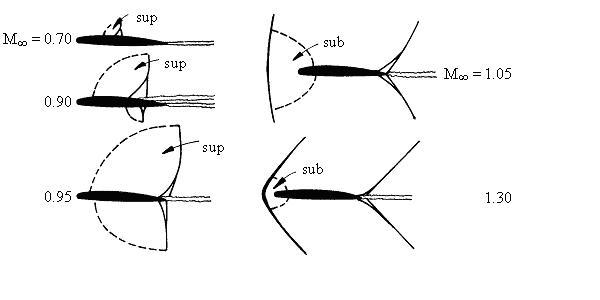
When an aircraft approaches Mach 1, there will already be a zone locally around the aircraft where Mach 1 is reached. The (fly) Mach number at which this occurs is called the critical Mach number, eg Mach 0.65. This critical Mach number depends on the shape of the aircraft. So when the aircraft flies faster than this critical Mach number, local shock waves are created where the flow that is locally supersonic changes back to subsonic speeds. You can see this in the figure at the top left (shown for an airfoil). As the flight Mach number increases, that supersonic zone expands and the shocks move. These shocks are located at the height of the aircraft and therefore move with the aircraft. When Mach 1 is exceeded, a bow wave also begins to grow (as with a boat traveling faster than the wave speed on the water’s surface). At Mach 1, the strength of that shock wave is minimal (infinitesimal) and when the Mach number increases, that shock strength becomes greater. This means that the pressure jump over the shock increases. Further from the aircraft, the strength of the shock quickly decreases, eg from the order of magnitude of a few bar to order of magnitude of Pa (Pascal). However, a pressure jump of 1 Pa still corresponds to 100 dB.
When a bang is heard, this happens when such a spur of a shock wave (that moves with the aircraft) passes the person who is, for example, on the ground. A person who is a little further away will therefore hear the bang a little later. If the plane flies faster, the shock strength will be greater and the bang that one hears will be louder. If the plane flies lower, the bang will also be louder because the shock wave is less attenuated than. When piercing the sound wall, which is a plastic expression, nothing is actually pierced. What does happen in the transonic region (around Mach 1) is that the shocks move quite a bit and with that the pressure distribution on the aircraft also changes, which can give rise to vibrations and instabilities that must be taken into account in the design.
The bang one hears is therefore the attenuated shock wave (actually there are two as you can see in the figure) that passes by when an airplane flies over supersonic. The bang is always heard when an aircraft would fly over at supersonic speed and has nothing to do with the transition from subsonic to supersonic flying. The pilot who moves with the aircraft does not hear the bang, but does feel the vibrations that occur because the position of the shock waves changes in function of the Mach number.
Answered by
Prof. dr. Jan Vierendeels
Flow Mechanics

http://www.ugent.be
.